Pages

Showing posts with label Cross Connection Control. Show all posts

Wednesday, June 26, 2024

Most Frequently Cited Significant Deficiencies and Violations - Inspection Year 2023

The Field Services Section (FSS) wrapped up the 2023 inspection year (IY 23) in September 2023 and the new IY 24 inspection year started and is almost halfway over! We appreciate all the assistance from public water systems in completing 491 sanitary surveys in 2023. IY24 started October 1, 2023 and FSS inspectors have completed 297 site visits to date. In this article we will share the top 10 most frequently cited significant deficiencies and violations from IY23 and a sneak peek into IY24 trends to raise awareness and help operators identify and correct issues before they become a potential health threat or citations in a sanitary survey. 

According to Regulation 11, Section 11.3(72), a significant deficiency means: any situation, practice, or condition in a public water system with respect to design, operation, maintenance, or administration, that the state determines may result in or have the potential to result in production of finished drinking water that poses an unacceptable risk to health and welfare of the public served by the water system. Field-based Violations of Regulation 11 have either Tier 2 or Tier 3 public notice requirements that are dependent upon the severity of the violation and any potential public health effects, pursuant to Regulation 11, Sections 11.33(1)(a,b), 11.33(2)(a), 11.33(3)(a) and 11.33(4)(a). All issued notifications must comply with the general content and distribution requirements and notice reporting requirements that are included in Regulation 11.33(5),(6) and (7).

During the 2023 inspection year, 1,256 significant deficiencies and violations were cited in 491 sanitary surveys. The Top 10 most frequent inspection citations were:
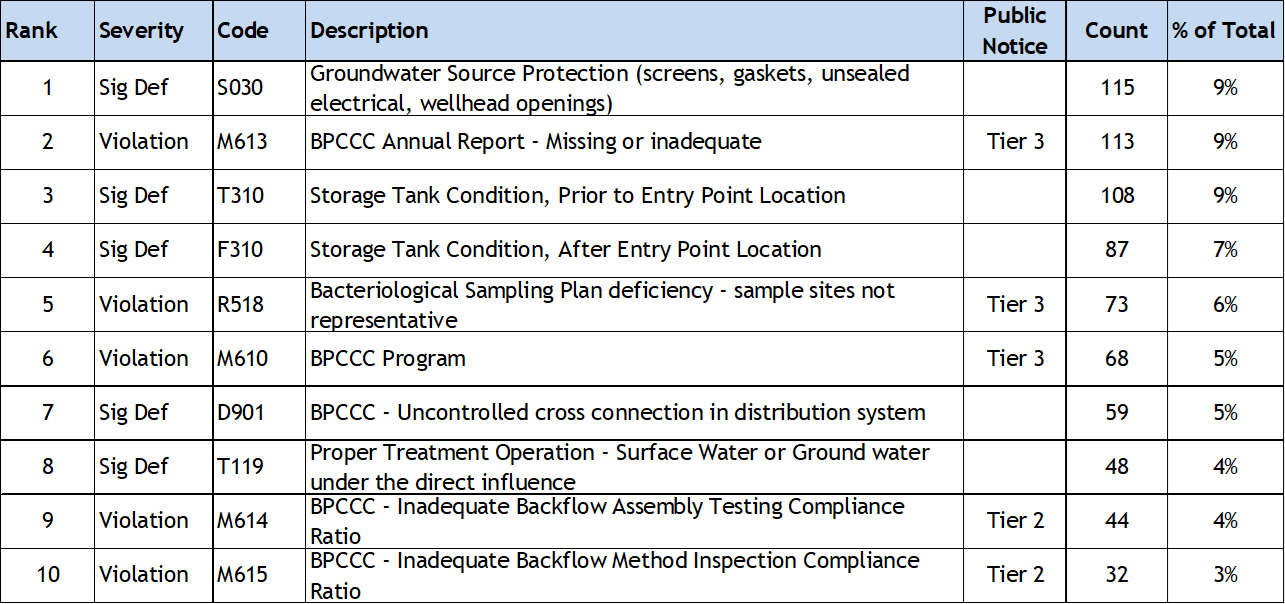
Storage tank deficiencies (F310 and T310), in the distribution system and before the entry point (CT tanks) combined account for 16% of all citations in IY23 and 17% of all citations in IY22. Storage tank deficiencies can include improperly protected screens, hatches and overflows. This underscores the importance of robust routine tank inspections under the Storage Tank Rule and also for tanks that are used for contact time or before entry point. 

The next most frequently cited significant deficiency, with 9% of the total IY23 and IY22 citations, was for wellhead pathways of contamination (S030). This can include loose wellhead seals, missing or damaged vent screens, missing gaskets, broken/open electrical boxes/conduit, cracked sanitary seal plates and wellheads. 

Backflow prevention and cross connection control (BPCCC) has four violations and a significant deficiency that make the Top 10 list, including failure to develop BPCCC annual reports, failure to develop or implement the BPCCC program (both Tier 3 public notice violations), and failure to meet the assembly testing ratio and method inspection ratio which were a Tier 2 public notice violations. Combined, all the BPCCC violations and significant deficiencies make up 26% of the citations in IY23. In 2023 the Division streamlined the BPCCC rule with the Water Quality Control Commission and the assembly and method compliance ratios were combined. In IY24 the M614 and M615 violation codes were replaced with one code, the M619 for Inadequate Backflow Prevention Annual Compliance Ratio due to combining assembly testing ratios and method inspection ratio.

A newcomer to the Top 10 is the Bacteriological Sampling Plan R518 violation which can include not performing representative sampling of the distribution system, not having a sampling plan, not rotating sample locations or not following the plan. 

In IY24 to date, 673 significant deficiencies and violations have been cited. The majority of these citations are the same as the IY23 Top 10 with the addition of two other findings:

  • Violation R536 - MONITORING DISINFECTION (T3); Failure to Monitor Groundwater EP Residual Disinfectant.
  • Significant Deficiency T116 - GROUND WATER TREATMENT; Supplier could not demonstrate adequate operation of approved groundwater treatment processes which are being used for compliance with Regulation 11.

Please check your water systems for these issues to protect public health and avoid significant deficiencies and violations during your next sanitary survey. If you would like additional assistance on technical issues or sanitary survey preparation, please sign up for individualized coaching here.  For any questions or concerns about sanitary surveys please email our Field Services team at cdphe_wqcd_fss_questions@state.co.us. Thank you for all your efforts to protect public health!

➽ Heather Young, PE, CWP, Field Services Section Manager

Wednesday, May 22, 2024

Questions from Q&A Session during CRWA Annual Conference

The Water Quality Control Division Field Services Section participated in the Colorado Rural Water Conference on March 18th during the WQCD round table discussions and received really great questions and feedback from operators attending the session. We wanted to share some of the questions related to Backflow Prevention and Cross Connection Control and Storage Tanks for those operators that were not participating in the conference. 

Backflow Prevention and Cross Connection Control Rule (BPCCC)

BPCCC Resources 

1. Under the new Backflow Rule updates, do I still have 15 months to get 100% of all my devices tested every year?

This question relates to the untested 2-year rule in the 2023 updated regulation as opposed to the 90-day rule from the old BPCCC regulation. With the 2023 regulation update, the “90 day rule” is gone. Under the updated rule, the supplier must achieve a backflow prevention annual compliance ratio of greater than or equal to (≥) 0.90 and with that remaining 0.10, the supplier must ensure that no backflow prevention assembly is present for more than two consecutive calendar years without being tested, service being suspended to the customer, or the cross-connection being removed.

2. What happens if a device fails a test and tests good 7 days later? What if the device fails and is fixed and passes on the same day?

This is a great question and the backflow policy DW007 helps answer this. An assembly that fails testing and is repaired and receives a passing test will be reported in the combined compliance ratio (Report lines 8-10) AND as an uncontrolled cross connection that has been controlled (Report Line 7.A) in the annual report. A violation does not occur for a failed assembly unless the assembly is not repaired within the required timeline. If an assembly fails but is repaired and passes a test on the same calendar day, the supplier may exclude reporting the assembly as having failed in the annual report and only count it in the compliance ratio (Report Lines 8-10) in the annual report. 

3. How do I handle if a place closes and is no longer in use but they had a backflow device?

If it was in use at any time during the year it must be included in the annual report. The supplier can suspend service to the location to remove the cross connection concern for future years while the business is not occupied or using water.

4. Can PWSs have their operators certified as backflow testers? What are the pros/cons?

There are no Colorado state limitations on whether an operator can also be the certified backflow tester. Some utilities administer their backflow program where the operators perform device testing. Other utilities consider it to be a conflict of interest. Each water system can work with their management and legal team to decide the best path for their water system. Some pros to having operators test backflow devices may include having some level of control over the timing of when the assembly is tested, immediate test results, and prioritized testing. However some of the “Cons” of having operators test devices are potential conflicts of interest, it’s another certification to test and maintain.

5. How do I become a certified backflow tester?

Regulation 11 allows for two certification organizations; ASSE and ABPA. They are national organizations with testing/certifications in Colorado. Just google ASSE or ABPA backflow tester and it will bring up testing, schools and how to sign up.

6. Yard hydrants - I installed one with a “Y” adapter with a hose attached to one end with a HBVB installed. Is this ok?

When not in use, the hydrant can be shut down with the non-used side of the “Y” left open to allow for the yard hydrant’s weep hole to work correctly. As long as the non-used side of the “Y” has no hose attached this should be acceptable.

7. Do I have to use your forms?

No, suppliers can develop their own forms as long as they meet the Regulatory requirements and include all the required information.

8. Can I use GIS to track my methods/assemblies?

WQCD does not mandate how suppliers track their methods/assemblies. As long as all required information needed in completing the annual report and maintaining a backflow program are achieved we see no issue with using GIS. One area of concern when using locational software to track assemblies/methods is that one location may have multiple assemblies/methods (isolation versus containment or multiple service connections).

Storage Tank Rule

Storage Tank Rule Resources 

1. Overflows - do I need a flap and a screen or are screens banned? Are you going to issue me a significant deficiency during my next sanitary survey for this? 

This highlights the difference between a significant deficiency associated with Sanitary Surveys and changes in the design criteria for designs submitted to the Engineering Section. New or modified water facilities must meet the design criteria, but the Field Services Section does not issue significant deficiencies if an existing tank does not meet the current design requirements unless there is a condition that is a potential threat to public health (flap valve is stuck open, screen is torn or missing). During a sanitary survey, tank overflows with flap valves or screens are fine as long as they are in good operating condition (flap valve functions, seats completely, flap valve is not propped open/submerged; screens are non-corrodible 12-16 Mesh and intact).

2. Do I have to use 24-Mesh non corrodible screen - I can’t find it.

Screens may not have openings that exceed 0.07 inches (typically 12 or 16 mesh) and have to be non-corrodible.

3. Can I use actual plastic window screen to screen my vents, overflows, etc?

Plastic window screen can be easily damaged/torn by rodents and should not be used. Non-corrodible metal screen should be used.

4. My tank is 20 years old and does not meet the current design criteria. Are you going to cite me for a significant deficiency or violation during my next sanitary survey?

New or modified water facilities must meet the design criteria, but your inspector will not issue a significant deficiency if your existing tank does not meet the current design requirements unless there is a condition that is a potential threat to public health (examples include unprotected openings to tanks, missing/damaged screens, unsealed/un-gasketed hatches, etc.).

5. Does the Storage Tank Rule apply to all my tanks?

The storage tank rule applies to finished water storage tank(s). “FINISHED WATER” or “FINISHED DRINKING WATER” means water that is supplied to the distribution system of a public water system and intended for distribution and human consumption without further treatment, including disinfection contact time, except treatment as necessary to maintain water quality in the distribution system (e.g., booster disinfection, addition of corrosion control chemicals). If you need help determining if a tank is considered to be part of the treatment system or part of the distribution system, please email us at: cdphe_wqcd_fss_questions@state.co.us

6. What should I do to maintain my Contact Time tanks that are not part of the distribution system?

We recommend that you consider following the Storage Tank Rule guidelines for Contact Time (CT) tanks to avoid a potential risk to public health but it is not a requirement. Your inspector will be looking at all tanks including the contact time tanks during your next sanitary survey and any potential risks to public health (example: unprotected openings, missing/damaged screens, unprotected overflows, sediment buildup) will be cited as significant deficiencies.

7. When are you going to make me do the Storage Tank Rule for my Contact Time Tanks?

The Division does not have any current plans to re-open the Storage Tank Rule however, the tanks must still be maintained and will be inspected during sanitary surveys.

We hope sharing these questions and answers from the Colorado Rural Water Association helps all operators. If you have any questions please feel free to reach out to us at: cdphe_wqcd_fss_questions@state.co.us.

➽ Tom Valenta Field Services Section Work Group Lead, Unit 3 

➽ Heather Young Field Services Section Manager

Wednesday, January 31, 2024

New and Improved Template for Backflow Annual Reports

Recent changes to the backflow rule in order to maintain this critical public health protection aspect of the safe drinking water regulations, while making compliance easier to achieve has led to a new and improved backflow annual report template. The new report template titled Appendix D is available now on the department’s backflow website. The Appendix D template is recommended for all public water systems, including all community and non-community systems. Some highlights of the recent improvements include:

1. Uncontrolled Cross-connection Tracking: 

Water suppliers are required to track all uncontrolled cross-connections found during the calendar year. This tracking is important to ensure that all uncontrolled cross-connections are controlled within the required regulatory deadlines (120 days of discovery or an approved deadline extension). To assist with tracking this, uncontrolled cross-connections were divided into 3 sub-categories:

  • Question 7.A: Uncontrolled cross-connections that WERE controlled within regulatory deadlines
  • Question 7.B: Uncontrolled cross-connections that WERE NOT controlled within regulatory deadlines
  • Question 7.C: Uncontrolled cross-connections that REMAIN uncontrolled and are within regulatory deadlines
  • Question 7 Total: Sum of 7.A+7.B+7.C = 7 Total

For more information on uncontrolled cross-connections, see Section 4.1 of Drinking Water Policy 7.

2. Combined Compliance Ratio: 

The tracking of backflow assemblies and methods have now been combined into a single Backflow Prevention Annual Compliance Ratio for easier reporting. Questions 8, 9 and 10 in the improved annual report help suppliers calculate this compliance ratio as shown in the equation below.


3. Untested Assembly Tracking: 

All assemblies and methods must be tested or inspected every calendar year. If any assemblies or methods were missed one year, they need to be tracked to ensure they are prioritized the following year. If any assembly or method goes two calendar years without being tested or inspected then a violation has occurred and must be reported to the department. This replaces the old “90-day” rule as it was too challenging for suppliers to track and comply, with uncertain added health protection benefits. The new “2-year” rule gives suppliers time to get things tested and inspected. The department continues to guide systems to test/inspect annually and “catch up” with any missed tests or inspections as soon as possible in the next year.

Remember, backflow annual reports must be completed on or before May 1, 2024. Stay tuned for updated guidance related to supplier developed extensions, new templates for small systems (Appendix G & H), and the updated one-stop shop backflow guidance document coming soon. For any questions related to the backflow rule, please email the department’s backflow team at CDPHE_WQCD_FSS_Questions@state.co.us. 

Thank you.

➽ Clayton Moores, P.E., Backflow Team Lead 

Wednesday, April 5, 2023

Updates coming to the Backflow Prevention and Cross Connection Control Policy - Policy 7

Our October 26, 2022 posting on the Aqua Talk blog announced our stakeholder process for proposing updates to the Backflow Prevention and Cross Connection Control Rule within Regulation 11 - section 11.39 (BPCCC rule). 

From November 2022 to January 2023, stakeholders engaged with the Water Quality Control Division to develop a draft, updated BPCCC rule which will be considered by the Water Quality Control Commission in the August 2023 rulemaking hearing. A summary of the effort to date is located on our website. The division believes the proposed updates to the rule will equivalently protect public health while making the rule more implementable. The division would like to thank all the stakeholders that engaged during that process for the thoughtful feedback and helping to craft a better rule.

During the outreach, multiple comments were received both in December and January about needing to provide better clarity within the BPCCC policy (Policy 7) in order to make the proposed changes to the rule more optimal and to help water systems know how the division will interpret some of the language in the rule. The division agreed with stakeholders that Policy 7 needs to be updated concurrently with the proposed rule update as the rule and the policy work very closely together. 

Save the date: April 20, 2023 at 2:00 PM.

The division intends to continue the stakeholder engagement process with an initial stakeholder meeting outlining the potential updates needed to the BPCCC Policy 7. The meeting will be held on 4/20/23. The division intends to utilize working groups in several key topic areas to assist in writing the policy updates. We would like to complete most of this work prior to the August rulemaking hearing. 

The topic areas will include, but are not limited to: extension requests, expanding examples on eliminating cross connections, clarifying system surveying and rounding issues, and annual reporting templates, as well as other minor edits.  

We would like feedback from the stakeholder community whether there are other areas that need to be updated within the policy and are hopeful you can participate. The division will provide a comment form on our website in mid-April for stakeholders to submit BPCCC Policy update ideas to us. Also, if you know of other professionals that can contribute to this process, please share this article and our BPCCC website with them. Sign up for stakeholder updates here to be notified of all the latest developments. 

➽ Tyson Ingles, PE, Lead Drinking Water Engineer

➽ Clayton Moores, PE, Field Unit I Manager

Wednesday, February 2, 2022

Backflow Prevention Program Requirements for 2022

Happy New Year, 2022 is here and there are Backflow Prevention and Cross Connection Control Program (BPCCC) requirements (in Regulation 11 Section 11.39) that will be coming up quickly. The BPCCC rule was originally adopted with stakeholder consensus in 2015 and became effective in 2016. 

What is coming due in 2022?

Two major milestones take effect in 2022. The first, is the final milestone for the staged implementation of the BPCCC surveys that started in 2016. This requires suppliers to survey all non-single-family-residential connections to the public water system to determine if the connection is a cross-connection, unless the supplier controls that connection with the most protective backflow prevention assembly or backflow prevention method. Suppliers must achieve the survey compliance ratios as specified in Table 11.39-I:

  • By December 31, 2021 and each year after, the survey compliance ratio required is 1.0 
  • A NOTE on rounding: Policy 7 - Compliance Ratio Rounding: 0.951 rounds up to 1.0, but 0.947 rounds down to 0.9
  • Suppliers may apply to the Department for an alternative survey compliance ratio. Applications are online here. 

The second major milestone taking effect in 2022 is the final milestone for the backflow prevention assembly annual testing compliance ratios. Suppliers must ensure that backflow prevention assemblies used to control cross connections are tested annually by a Certified Cross-Connection Control Technician and maintained. Suppliers must achieve the backflow prevention assembly annual testing compliance ratios as specified in Table 11.39-II:

  • By December 31, 2021 and each year after, the backflow prevention assembly annual testing compliance ratio must be > 0.90 
  • A NOTE on rounding: Policy 7 - Compliance Ratio Rounding: 0.896 rounds up to 0.90, but 0.893 rounds down to 0.89
  • No Alternative Compliance Ratios are allowed 
  • Beginning January 1, 2022, for each backflow prevention assembly not tested during the previous calendar year, the supplier must ensure the backflow prevention assembly is tested no later than 90 days after the active date of the backflow prevention assembly in the following calendar year.
  • If the supplier is unable to meet the 90-day deadline, the supplier must consult with the Department and the Department may approve an alternative schedule. The extension application form is available online here.

What BPCCC information will inspectors be looking for in 2022?

BPCCC records for 2021/2022 that will reviewed during a sanitary survey include:

  • A list of the number and location of assemblies not tested in 2021
  • Their active date and when they were tested in 2022 (must be tested within 90 days of active date in 2022 or by a Department approved alternate schedule). 
  • This information must also be included in the 2021 BPCCC Annual Report that must be completed by May 1, 2022.
  • If you were granted an extension request, please have your application and approval on hand for your inspector.

What is this Active Date and what do I do about Irrigation / Sprinkler Systems?

The active date is determined by when the assembly is first used during the calendar year, or the first date water runs through the assembly during the calendar year. Beginning January 1, 2022, each assembly that was used but not tested in 2021 must be tested no later than 90 days after the active date of the assembly in 2022.

For example: 

  • If an irrigation assembly is not tested in 2021 and is first used January 1, 2022, the assembly would be required to be tested no later than April 1, 2022. 
  • If an irrigation assembly is not tested in 2021 and is first used April 15, 2022, the assembly would be required to be tested no later than July 14, 2022. 
  • If an assembly is not tested within the required time frame and the supplier has not removed or suspended service to the connection the supplier would be in violation. Note: violations are expected to be reported to the department within 48 hours.

Where can I get more information?

Field Services has developed an BPCCC FAQ that is available online here. 
For any questions or concerns about backflow prevention please email our backflow team at 
cdphe_wqcd_fss_questions@state.co.us. Please stay tuned!

➽ Clayton Moores, PE, Field Unit I Manager

➽ Cameron Wilkins, PE, Field Unit II Manager

➽ Heather Young, PE, CWP, Field Services Section Manager


Wednesday, November 3, 2021

Coming Down the Pipe: Reg. 11 Backflow Guidance Updates


Please see updates on the division’s webpage

In early 2021, we ran a stakeholder process to update policies both for backflow prevention and cross connection control as well as storage tank regulations. After those updated policies were published, we began an effort over the summer to update guidance materials for both rules. We prioritized the backflow prevention and cross connection control guidance materials because more systems are struggling with them.
  • In early October, we published the first in the series of several guidance documents for stakeholder review and comment - the backflow prevention and cross connection control annual reporting template for community water systems - available on the webpage. 

  • The stakeholder community has valuable insight and we would like to receive stakeholder feedback about the template. Please navigate to the page above and review the annual report template. The deadline to provide feedback to the division is November 20. 

Wednesday, October 20, 2021

Inspection Year 22 Begins October 1, 2021


It’s that time of the year again to start a new inspection year for sanitary surveys. The Water Quality Control Division (WQCD) has primacy in Colorado to conduct sanitary survey inspections of public water suppliers covering the Eight (8) Elements of a Sanitary Survey. The inspection year runs on a federal fiscal year which starts October 1st and ends on September 30th. Inspection year 2022 (IY22) starts October 1, 2021 and the Field Services Section has 476 sanitary surveys planned for IY22. We continue to conduct sanitary surveys using our
COVID-19 Standard Operating Procedures with the two part remote file review, followed by the in person inspection. 

When is my Sanitary Survey?

Regulation 11.38(2) outlines the Sanitary Survey frequency requirements as once every three (3) years for Community Water Systems and once every five (5) years for Non-Community water systems. Please remember that these are minimum frequencies, and that the division has the authority to conduct sanitary survey inspections at any time.

You may ask, “we are overdue for a sanitary survey, what do we do?” First of all, do not panic, the WQCD has a backlog of suppliers due for sanitary surveys due to historic resource constraints and the COVID-19 pandemic. Please reach out to the Field Services Section email at cdphe_wqcd_fss_questions@state.co.us if you need to talk to someone about your sanitary survey schedule. A member of the Field Services Section will respond to let you know if you are scheduled for a sanitary survey this year or if it is delayed.

I am scheduled to have a Sanitary Survey, how do I get ready?

The WQCD has many documents to help prepare for the sanitary survey on our website. A great resource to take advantage of is the free Sanitary Survey Preparation training from the Local Assistance Unit. It’s a 3.0 hour course, you get 0.3 TUs and can register by selecting your date. 

Do you need additional help beyond the basic sanitary survey preparatory class? Are there special treatment issues you could use help on? Please reach out for one-on-one customized coaching and assistance. A coach will come to your facility to take a look and discuss your specific needs. Training units are available, depending on time spent with the coach. Please use the Online training request to register. For more information please see the Local Assistance Unit website.

What changes do I need to be aware of?

EPA Region 8 performed a review of the CDPHE WQCD drinking water program to determine if CDPHE is in compliance with the National Primary Drinking Water Regulations (NPDWR). This review included sanitary survey letters and entry of sanitary survey findings into SDWIS. The EPA evaluation found that the historic practice of downgrading Significant Deficiencies to Observations if resolved prior to the letter issuance is not acceptable and must be discontinued. Therefore, in IY22 starting October 1, 2021, if a significant deficiency is identified during the Sanitary Survey Site Visit, CDPHE must cite it as a Significant Deficiency even if it was resolved the day of the sanitary survey. If the supplier is proactive and resolves it during the sanitary survey or before the sanitary survey letter is issued, we still have to cite the significant deficiency but will make sure to memorialize the resolution in the sanitary survey letter. The supplier will also need to include it in their Consumer Confidence Report (CCR). With this in mind, it will be critical that water system operators do a walkthrough of the facilities before the Sanitary Survey site visit date to identify any significant deficiencies and resolve them. A future Aqua Talk article will be coming that identifies the most frequently cited significant deficiencies and violations. We understand that this is a big change, but a necessary change to maintain compliance with our primacy agreement with EPA. If you have any questions or concerns, please reach out to me at heather.young@state.co.us.

Thank you for all your efforts to protect public health and we look forward to seeing you at your next sanitary survey.

➽ Heather Young, PE, CWP, Field Services Section Manager

Wednesday, May 5, 2021

Updates to the Storage Tank and Cross Connection Control Guidance Documents: Stakeholder Information

 Updated rules and policies from 2020/2021

In August 2020, the Water Quality Control Commission (commission) updated the Colorado Primary Drinking Water Regulations (Regulation 11). While there were a few minor changes to several rules, the commission made more significant changes to the Storage Tank Rule (Section 11.28) and to the Backflow Prevention and Cross-Connection Control Rule (Section 11.39). Subsequently in early 2021, the department updated several policies related to Backflow Prevention and Storage Tanks. These policies included:

  • Policy 7: Backflow Prevention and Cross Connection Control Policy

  • Policy 10: Sanitary Defect Policy (section about storage tanks only)

  • Policy 12: Storage Tank Rule Alternative Inspection Schedule Policy

  • Policy 15: Storage Tank Rule Inspection Methods Qualified Personnel Policy

As part of the process used to update the above policies, the department solicited feedback on the draft policies in February 2021 before issuing the final policies in April 2021. Please get acquainted with the updated policies. The department’s responses to the feedback we received on the draft policies are located here.

Plan to update guidance in accordance with updated rules from August 2020

During the stakeholder work for the August 2020 rulemaking, the department heard from stakeholders that additional work on guidance documents, such as the annual backflow report template and the periodic tank inspection checklist is needed.

As the next step in these updates, the department is taking a two phased approach to updating guidance documents. Phase 1 includes updates to templates and guidance for the Backflow Prevention and Cross Connection Control Rule (BPCCC), especially the annual report template. The  majority of field-identified violations we cite are related to BPCCC reporting. Phase 2 will then focus on Storage Tank Rule inspection guidance and checklists. A tentative schedule for these documents are as follows:

  • Phase 1: BPCCC guidance and report template updates - May through August, 2021

  • Phase 2: Storage tank guidance and inspection checklists - September through December, 2021


For more information, to read draft material, or comment; please go to: The Regulation 11 Updates website.


Wednesday, February 10, 2021

Coming Down the Pipe - Policy Updates

2021 Storage Tank and Cross Connection-Control Policy Updates 


In August 2020, the Water Quality Control Commission updated the Colorado Primary Drinking Water Regulations (Regulation 11). While there were a few minor changes to several rules, there were significant changes to the Storage Tank Rule (Section 11.28) and to the Backflow Prevention and Cross-Connection Control Rule (Section 11.39). 

During the stakeholder work for the August 2020 rulemaking, the department acknowledged that several key policies would need to be updated as a result of a successful rulemaking effort. Also, the department acknowledged that additional work on guidance documents like the annual backflow report template and the periodic tank inspection checklist needed to be completed.

As a first step in these updates, the department identified minor changes in four policy documents to reflect the updates to the regulation. The department considers these changes relatively minor and is seeking stakeholder feedback on the changes. Once the policy changes are finalized, the department intends to launch a second stakeholder process to update the guidance. 

There are four key policy documents that must be updated to reflect the new language in Regulation 11. These were established policies the department published after the 2015 Regulation 11 rulemaking, but given the Regulation 11 updates in 2020, there were items that needed updating and clarifying. Please check our engagement page for more specific details on the minor modifications to these 4 policies:

Policy 7: Backflow Prevention and Cross Connection Control Policy

Policy 10: Sanitary Defect Policy (section about storage tanks only)

Policy 12: Storage Tank Rule Alternative Inspection Schedule Policy

Policy 15: Storage Tank Rule Inspection Methods Qualified Personnel Policy

➽Tyson Ingels| tyson.ingels@state.co.us


Wednesday, December 16, 2020

Dear Aqua Man - Customers Refusing to Comply with the Cross Connection Rule


Dear Aqua Man, 

How do I respond to a customer that refuses to install or test their backflow device due to COVID-19?

Sincerely,
Sy Phoning

Dear Sy,

Recently the WQCD has been contacted by citizens requesting extensions from CDPHE to extend backflow device installation deadlines or device testing deadlines issued by their drinking water supplier. Frequently, they express COVID-19 exposure concerns. The Division has taken the approach to help educate citizens that the backflow prevention and cross connection control (BPCCC) requirements are an important part of the Drinking Water Regulations. Many people are unaware that Colorado has about one known waterborne disease outbreak that makes people sick every year due to unprotected cross-connections. Drinking water suppliers must protect the water in their piping by making sure that backflow prevention assemblies are installed and tested annually. Installing these assemblies and keeping them in proper working order are the only barrier to prevent unintentional contamination of the drinking water supply from backflow events. Therefore, this kind of work, and other plumbing work responding to pipe breaks, etc. are considered essential functions that need to be carried out during the COVID-19 pandemic. 

Drinking water suppliers across the state and their customers are proceeding with backflow prevention work including installation and testing during the pandemic with COVID-19 safety precautions. Drinking water suppliers and their customers are working together with plumbing contractors and others to safely and effectively protect their water systems against backflow while avoiding unnecessary exposure to COVID-19 by taking appropriate safety precautions. 

Resources:

CDPHE oversees implementation of the rules by water systems. CDPHE does not override decisions made by drinking water suppliers unless they are failing to protect the drinking water. There is no provision in the regulations allowing CDPHE to do this. In this case, drinking water suppliers are acting in the interest of public health to protect drinking water via their rule implementation and CDPHE will not override their determinations. Therefore, CDPHE will not grant extensions to citizens for deadlines their drinking water supplier has implemented to install or test backflow prevention assemblies. The customer needs to continue to work with the drinking water supplier to protect their piping from uncontrolled cross connections. If the drinking water supplier needs an alternative schedule for installation or replacement of a device, then they can apply to the Division for an extension under Regulation 11.

For any questions or concerns about backflow prevention please email our backflow team at cdphe_wqcd_fss_questions@state.co.us. 

Wednesday, December 2, 2020

Regulation 11 - Cross Connection Regulation Updates

In the early summer 2020, the department proposed minor modifications to the Backflow Prevention and Cross-Connection Control Rule along with the Finished Water Storage Tank Rule - see other Aqua Talk post for storage tank discussions. The department completed a stakeholder effort and presented the modifications to the Water Quality Control Commission. The Commission approved all proposed modifications in early August and the changes took effect September 30, 2020. The Backflow Prevention and Cross-Connection Control Rule (Regulation 11, Section 11.39) protects public health from contamination associated with cross-connections and backflow events. The department proposed three changes that will lessen the burden on water systems while still protecting public health:

  1. Keep requiring distribution system surveys, but move the violation from a treatment technique to a monitoring violation.
  2. Allow systems to continue to request alternative survey compliance ratios with justification.
  3. Given delays due to pandemic, allow for a longer time to comply with higher survey ratios and assembly testing ratios.  

Changes to the Backflow Prevention and Cross Connection Control Rule

Distribution System Survey:

Each public water system is required to survey their distribution system and waterworks to determine a list of cross connections that need to be controlled. The previous regulatory requirement was to survey 100% of each distribution system by December 31, 2020. Also, systems could only apply for a specific alternative survey compliance ratio for the compliance periods between January 1, 2016 to December 31, 2019. The latest version of the regulation has extended the requirement to survey 90% of the distribution system from December 31, 2019 to December 31, 2020. The 100% requirement has therefore been pushed back to December 31, 2021. Also, the department's ability to grant alternative compliance ratios has been reinstated and will be ongoing. Systems can continue to request specific alternative compliance ratios with proper justifications.

The above approach is still protective of public health because of the overwhelmingly excellent work public water systems have done over the last 5 years in surveying their systems. Many, if not most, public water systems have nearly finished surveying their water users, however the final few percent can be difficult to finish. Therefore, the department recommended that the Commission modify the type of violation that distribution system surveying represents to a monitoring violation. This means that if a violation occurs, instead of requiring Tier 2 public notice (within 30 days, health effects language) for treatment techniques, it now will only result in Tier 3 public notice (included in the annual consumer confidence report). Also, given the pandemic, water systems reported struggles with being able to enter properties to execute surveys due to exposure concerns.

The department would like water systems to continue diligently surveying their distribution systems. If an alternative survey compliance ratio will be necessary for 2020, the department encourages water systems to send in that request as soon as possible. Such requests can be submitted to the drinking water portal labeled as a sanitary survey response or the the Field Services Section general email address at CDPHE_WQCD_FSS_Questions@state.co.us.

Testing Ratios for Assemblies:

The other notable change to the regulation was to extend the assembly testing compliance ratio an additional year. Previously, systems were required to have 80% of assemblies tested for calendar year 2019 and 90% tested in 2020. With the newly approved regulation change, systems will only be required to have at least 80% of assemblies tested for calendar year 2020 and at least 90% for 2021. Hopefully, this will offer some measure of relief to water systems as they navigate the pandemic and interfacing with private properties while still progressing with protecting public health from potential cross-connections.

What's next?

It is important to stay tuned over the winter months as the department will initiate a stakeholder process to perform needed updates to Policy 7 which deals with cross connection control. These updates are necessary because of regulatory changes discussed above and also due to lessons learned in implementing the regulation over the last four years.

Additional Information and Responsibilities for Extending Deadlines:

Recently, several upset customers of water systems have approached the department asking for extensions to control or repair backflow assemblies when the public water system felt it was not justifiable to grant further extensions for that customer. It is important to remember that the department will override decisions of water systems when those decisions are considered protective of public health. Therefore, customers can be referred to the department and the department will gladly reiterate the importance of backflow prevention, but will not make decisions that extend deadlines on behalf of customers. If a water system believes an extension is warranted, the department will consider those requests and frequently grants them. But if a customer becomes upset, please do not have them ask the department for an extension because we will not grant one if the water system does not think it is justified.

➽ By Tyson Ingels, Clayton Moores

Wednesday, September 16, 2020

Private Cisterns Connected to Public Water Systems

Private Cisterns: an Often Overlooked Potential Cross Connection 

Colorado’s majestic mountains, plateaus, gorges and canyons, rolling plains and high deserts are a beauty to behold all year round and also truly awe inspiring! However, Colorado’s varied geography also makes it a distinct state with numerous remote water systems that present unique situations. One of these is the use of private water cisterns at homes to store or supplement the water supplied by a public water system. Historically, the construction details of these cisterns  were not always well documented by the public water system. In addition, private cisterns have not typically been thoroughly inspected to ensure they contain robust protections of potable water. As a result, these cisterns can pose a risk to public health from backflow and may or may not be a cross connection, depending on how they are constructed and maintained.

For example, in September 2018, a consecutive water system in Delta County had total coliform (TC) and repeat TC positive samples in the distribution system. The responsible operator’s investigation identified that the distribution system was contaminated by a backflow event from a private cistern that was inadequately controlled. The cistern was tested for bacteriological contamination and came back positive for total coliform. The investigation found that the existing residential cistern was plumbed from the meter pit through a single non-testable check valve to a dole valve then to the cistern below water level. The customer service line was then plumbed to a tee between the dole valve and the cistern. 

To address this unique situation in Colorado, the department has created a guidance document to provide answers to frequently asked questions about backflow prevention and cross connection control (BPCCC) of cisterns that are used by customers of public water systems.

The cistern guidance explains and clarifies BPCCC expectations for suppliers with private cisterns connected to their system. The department expects that cisterns are constructed in accordance with the Colorado Plumbing Code or be properly protected with an assembly (RPZ or testable double check) or method (air gap) as described in the guidance. The guidance and additional BPCCC documents can be found on the department’s BPCCC website.   

Suppliers first need to determine whether or not a private cistern is a cross connection. If a private cistern is constructed per the 2018 Colorado Plumbing Code, it is not considered a cross-connection. In that case, the supplier only needs to keep that determination on file but does not need to track the private cistern in their BPCCC program. If the private cistern is not constructed per the plumbing code, then the cistern is a cross connection. The supplier must begin tracking the private cistern in their BPCCC program and control the cross connection within 120 days (or department approved alternative schedule) of discovery.

Does your system have private cisterns? Please review the reference guidance and if there are any questions feel free to reach out to the field services section at cdphe_wqcd_fss_questions@state.co.us.   


➽ Monique Morey, PE, field services section

Wednesday, August 19, 2020

Ask Aqua Man


Dear Concerned:

Thank you for your question! We are also concerned about the impacts of COVID-19 and compliance rates with both the Backflow Prevention and Cross-Connection Control Rule as well as the Storage Tank Rule. The division worked with stakeholders since April to propose some important updates to the rules. On April 10, 2020, the division proposed the rule to the Water Quality Control Commission and they approved them! We have a web page dedicated to this effort. Below are some highlights of the proposed changes.


Cross-Connections:

  • Make failing to achieve an adequate distribution system survey ratio a Tier 3 violation. This is mostly due to the outstanding effort that water districts have made over the last few years of implementation. So many water systems have performed surveys of their distribution systems to the extent that the division now has confidence a very high percentage of systems have been surveyed.
  • Extend out the final compliance deadlines by a year for the rule given the major impact COVID had on assembly testing.
  • Extend the allowable window to repair the assembly from 60 days to 120 days once an assembly fails. 


Storage Tanks:

  • Allow two inspections per year before assessing a violation rather than the current four per year. This is primarily due to the outstanding performance of systems and the dozens of acceptable alternative schedules showing proper tank inspections twice a year adequately protect public health. However, the division still strongly recommends performing monthly or quarterly inspections as best practice.  
  • A single missed inspection will result in a Tier 3 violation rather than a Tier 2 violation. However, if a system does not complete a periodic inspection over an entire 12- month window, a Tier 2 violation is warranted because that length of time constitutes neglect of storage tanks.


Please check out the web page for more details. Any questions about that can go to Tyson Ingels, lead drinking water engineer at tyson.ingels@state.co.us. 


-Aqua Man


Friday, July 10, 2020

Storage tank, cross-connection control, public notice, and sanitary survey rulemaking information

Updated alternative proposal language


The department has posted documents to the stakeholder website showing the draft alternative proposal language that was discussed during the June 24, 2020 stakeholder meeting. This is located under the heading "July 15 Workgroup DRAFT Alternative Proposal" at the bottom of the page. It includes the changes discussed relating to periodic tank inspections and updates to the basis and purpose statements.

The department intends to submit this language to the Water Quality Control Commission on July 15, 2020. 

Comment Deadline: 
Monday July 13, 2020 at noon

Please email Tyson Ingels, Lead Drinking Water Engineer, with all comments by noon on Monday, July 13, 2020. Please visit the stakeholder website for information from previous stakeholder meetings. 

Upcoming stakeholder meeting

The department is hosting a final stakeholder meeting on the proposed changes to the storage tank, cross-connection control, public notice, and sanitary survey rules. 

Meeting - July 22, 2020, (1 - 2:30 p.m.)

The Zoom meeting will open at 12:30 p.m. so stakeholders have the opportunity to test functions beforehand. 
Online participation: Attend via Zoom
Call-in:  1-669-900-6833
Meeting ID:  846 2373 1238
Materials: Agenda and other materials will be available on the stakeholder website. 

Contact 


➽ Tyson Ingels, lead drinking water engineer

Tuesday, May 14, 2019

Cross Connection Control

Case for containment: Backflow prevention and cross connection control implementation practices

In Colorado, water suppliers provide water to various types of customers. There are five types of customers served by public water systems: residential, multi-family, commercial, industrial and agricultural. Contamination of drinking water can occur in any supplier’s water distribution system. This potential contamination can come in the form of a cross connection. A cross connection is a connection in a plumbing system where the potable water supply is connected to a non-potable source. 

Colorado Revised Statutes 25-1-114(h) makes it unlawful to “install, maintain, or permit any cross connection between any water system supplying drinking water to the public and any pipe, plumbing fixture, or water system which contains water of a quality below the minimum general sanitary standards.” Cross connections in a drinking water supply system can be a health risk. According to the Center for Disease Control, the presence of contaminants in water can lead to adverse health effects, including gastrointestinal illness, reproductive problems, and neurological disorders. Infants, young children, pregnant women, the elderly, and people whose immune systems are compromised because of AIDS, chemotherapy, or transplant medications, may be especially susceptible to illness from some contaminants.

There are examples of different types of cross connections that suppliers may see in the table below.


Colorado cross connections to building’s internal water supply systems are generally controlled in accordance with the Colorado Plumbing Code (CPC) and the local plumbing code. Cross connections to a Public Water System (PWS) are controlled in accordance with Regulation 11. There are instances where Regulation 11 and the CPC are both applicable. This is most common for smaller PWS, such as non-community suppliers, who are located on one property and own the water supply systems.

Reduced pressure zone - Irrigation backup water supply
Regulation 11 requires that the supplier survey and evaluate their distribution system and applicable water supply systems, for potential cross connections. Specifically, the Department of Public Health and Environment requires that suppliers evaluate all non-single-family-residential (e.g. apartments) plumbing for cross connections, with the exception of connections that are controlled with an air gap or a reduced pressure zone backflow prevention assembly. These connections do not need to be evaluated. 
Uncontrolled bypass to boiler - cross connection
When discovered, water suppliers are required to implement control measures for the identified cross connections within 120 days. More information on minimum control requirements can be found in Regulation 11. Additional policy and guidance is available on the department’s Backflow Prevention and Cross Connection Control (BPCCC) webpage.

Regulation 11 allows public water systems to control a cross connection by containment or containment by isolation. When backflow prevention assemblies are installed at the service connection, this is commonly referred to as containment (figure below). Containment by isolation allows suppliers to protect the distribution system with backflow prevention assemblies, or methods installed at the location of identified cross connection within a customer’s premise plumbing and water supply system.

Example of a backflow prevention assembly installed at a location classified as containment


Courtesy of Dr. Stuart F. Asay, IAPMO
When a customer’s water supply system becomes contaminated and the service connection is not contained properly, it may create an unacceptable health risk to the public. In these incidents, the department may issue a bottled water advisory for the impacted areas. A bottled water advisory will remain in place until the supplier can demonstrate that the situation has been remedied. 

Regulation 11 does not require suppliers to control all non-single-family-residential connections with an appropriate containment assembly, and allows a supplier to protect their distribution system with the use of containment by isolation assemblies. However, many public water systems choose to implement the backflow protection and cross-connection control program in a way that all  non-single-family-residential connections must be contained to prevent any potential contamination of the distribution system. Properly implemented containment will continue to protect systems from potential waterborne disease outbreaks due to contamination from cross connection. This proven practice will protect us all from unacceptable health and or safety risks.


2018 Cross Connection Case Studies

In 2018 the department responded to three backflow contamination events due to cross connections. All three contamination events occurred on properties served by public water systems. Two of these situations were protected from potential backflow contamination at the service connections via appropriately installed, maintained and tested backflow prevention assemblies. In both cases we contacted the responsible system and confirmed their assemblies had been tested and maintained in accordance with Regulation 11. Each supplier was able to quickly provide testing reports for the containment assemblies. The properly maintained and tested containment assemblies protected their customers by preventing potential contamination in the distribution system. Because the contamination events were both contained within the customers’ water supply system, the public works systems did not have to make a public notice or take further action. The proper implementation of an adequate backflow protection and cross-connection control program was directly responsible for the protection of the public’s water supply as intended by Regulation 11.

The suppliers were able to quickly provide testing reports for the containment assemblies. The properly maintained and tested containment assemblies protected the public water systems and prevented any potential contamination of the distribution system. Since the contamination events were contained within the customer’s water supply system, the PWSs did not have to take any further action and no public notice was required of the PWSs. The supplier’s proper implementation of an adequate backflow protection and cross-connection control (BPCCC) program led to protection of the public water supply as intended by Regulation 11.

The third event happened when a supplier became aware of a suspected backflow contamination in their distribution system. When they made this discovery , they contacted the department. Their service connection was not contained, (i.e., controlled with a backflow prevention assembly). When it was confirmed that the service connection’s water supply system was contaminated, the supplier issued a bottle water advisory to 18 nearby customers because the impact to the public being served by the public work system was unknown. After the situation was remedied with  proper controls onsite, and the impacted area was flushed, the department lifted the bottled water advisory.


➽ Jorge Delgado, senior field engineer