Pages

Showing posts with label Source Water Protection. Show all posts

Wednesday, August 20, 2025

Wildfire Planning and Recovery Playbook - 2025 Updates!

After a wet spring and variable monsoon season, wildfire season is again upon us in Colorado. As many of you are aware, our public water systems and local communities face a diverse and significant array of challenges when planning, responding, and recovering from wildfires. The best time to start planning for wildfires is right now, in advance of fires.

The Water Quality Control Division (WQCD), along with many state, federal, and local partners, have released a revised and updated version of our Wildfire Planning and Recovery Playbook, available on our Source Water Assessment and Protection website.  Several authors also hosted a webinar on July 25th, with the slide presentation and a recording available.

Pre-fire planning, response, and recovery is a team effort, and requires coordination across multiple jurisdictions, and administrative and physical boundaries. Each community wildfire event may present a unique set of circumstances that must be understood and conveyed to effectively navigate wildfire incidents. The centerpiece of the playbook is the comprehensive critical contacts list, outlining necessary points of contact along with each representative’s roles and responsibilities within the planning, response, and recovery process. Below is an example of the critical contacts list contained in the playbook.


The playbook also provides various actionable steps through each phase of the fire cycle, from planning through recovery.  Examples include identifying your values at risk, forming a recovery group and identifying partners, understanding prefire actions and resources, and roles and responsibilities of partners throughout the different phases of a wildfire incident. The playbook also includes 2 full pages of links to additional resources, including a list of funding programs and technical assistance partners.

The playbook is concise, usable, and accessible. The target audience for this playbook is public water systems, municipalities, counties, and tribes. The updated version reflects lessons learned from recent urban and suburban wildfires and the new Wildfire Ready Watersheds framework from the Colorado Water Conservation Board. Please contact the source water protection team at cdphe.wqswap@state.co.us with any questions or for more information.

➽ Robert Murphy, CPSS, Source Water Protection Program Coordinator

➽ Kristen Hughes, Source Water Protection Specialist

➽ John Duggan, Source Water & Emerging Contaminants Unit Manager

Wednesday, June 26, 2024

Most Frequently Cited Significant Deficiencies and Violations - Inspection Year 2023

The Field Services Section (FSS) wrapped up the 2023 inspection year (IY 23) in September 2023 and the new IY 24 inspection year started and is almost halfway over! We appreciate all the assistance from public water systems in completing 491 sanitary surveys in 2023. IY24 started October 1, 2023 and FSS inspectors have completed 297 site visits to date. In this article we will share the top 10 most frequently cited significant deficiencies and violations from IY23 and a sneak peek into IY24 trends to raise awareness and help operators identify and correct issues before they become a potential health threat or citations in a sanitary survey. 

According to Regulation 11, Section 11.3(72), a significant deficiency means: any situation, practice, or condition in a public water system with respect to design, operation, maintenance, or administration, that the state determines may result in or have the potential to result in production of finished drinking water that poses an unacceptable risk to health and welfare of the public served by the water system. Field-based Violations of Regulation 11 have either Tier 2 or Tier 3 public notice requirements that are dependent upon the severity of the violation and any potential public health effects, pursuant to Regulation 11, Sections 11.33(1)(a,b), 11.33(2)(a), 11.33(3)(a) and 11.33(4)(a). All issued notifications must comply with the general content and distribution requirements and notice reporting requirements that are included in Regulation 11.33(5),(6) and (7).

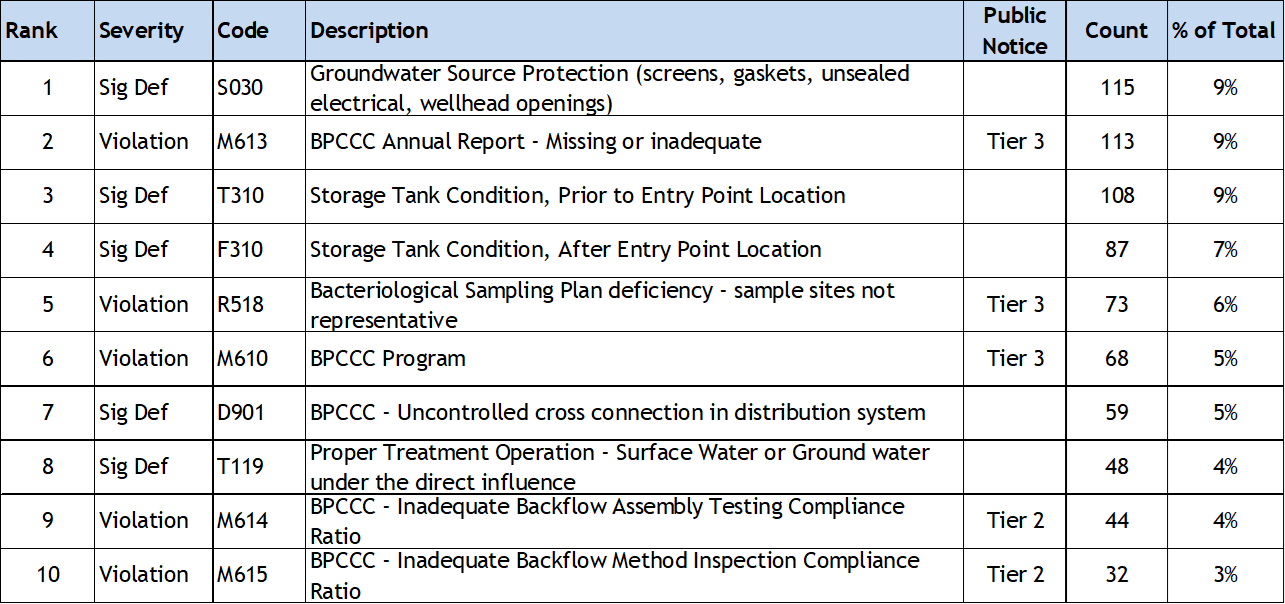
During the 2023 inspection year, 1,256 significant deficiencies and violations were cited in 491 sanitary surveys. The Top 10 most frequent inspection citations were:

Storage tank deficiencies (F310 and T310), in the distribution system and before the entry point (CT tanks) combined account for 16% of all citations in IY23 and 17% of all citations in IY22. Storage tank deficiencies can include improperly protected screens, hatches and overflows. This underscores the importance of robust routine tank inspections under the Storage Tank Rule and also for tanks that are used for contact time or before entry point. 

The next most frequently cited significant deficiency, with 9% of the total IY23 and IY22 citations, was for wellhead pathways of contamination (S030). This can include loose wellhead seals, missing or damaged vent screens, missing gaskets, broken/open electrical boxes/conduit, cracked sanitary seal plates and wellheads. 

Backflow prevention and cross connection control (BPCCC) has four violations and a significant deficiency that make the Top 10 list, including failure to develop BPCCC annual reports, failure to develop or implement the BPCCC program (both Tier 3 public notice violations), and failure to meet the assembly testing ratio and method inspection ratio which were a Tier 2 public notice violations. Combined, all the BPCCC violations and significant deficiencies make up 26% of the citations in IY23. In 2023 the Division streamlined the BPCCC rule with the Water Quality Control Commission and the assembly and method compliance ratios were combined. In IY24 the M614 and M615 violation codes were replaced with one code, the M619 for Inadequate Backflow Prevention Annual Compliance Ratio due to combining assembly testing ratios and method inspection ratio.

A newcomer to the Top 10 is the Bacteriological Sampling Plan R518 violation which can include not performing representative sampling of the distribution system, not having a sampling plan, not rotating sample locations or not following the plan. 

In IY24 to date, 673 significant deficiencies and violations have been cited. The majority of these citations are the same as the IY23 Top 10 with the addition of two other findings:

  • Violation R536 - MONITORING DISINFECTION (T3); Failure to Monitor Groundwater EP Residual Disinfectant.
  • Significant Deficiency T116 - GROUND WATER TREATMENT; Supplier could not demonstrate adequate operation of approved groundwater treatment processes which are being used for compliance with Regulation 11.

Please check your water systems for these issues to protect public health and avoid significant deficiencies and violations during your next sanitary survey. If you would like additional assistance on technical issues or sanitary survey preparation, please sign up for individualized coaching here.  For any questions or concerns about sanitary surveys please email our Field Services team at cdphe_wqcd_fss_questions@state.co.us. Thank you for all your efforts to protect public health!

➽ Heather Young, PE, CWP, Field Services Section Manager

Wednesday, March 27, 2024

Spring Training: Stormwater Management, Protecting Our Source Waters

The spring thaw is a perfect time to consider getting in shape for healthy drinking water sources through effective stormwater management. Stormwater runoff, generated from rain and snowmelt that flows over land or impervious surfaces, such as paved streets, parking lots, and building rooftops, does not soak into the ground. Runoff picks up and deposits harmful pollutants like trash, chemicals, and dirt/sediment into streams, lakes, and groundwater, that can pollute our drinking water sources if not properly managed. From construction and management professionals to municipalities to local communities to youth leadership, Colorado spring training has something for you.

Water Quality Improvement Fund (WQIF)

The Water Quality Improvement Fund (WQIF) is a Colorado state grant program funded by civil penalties collected for water quality violations. It is part of the Water Quality Control Commission’s Regulation 55 - State Funded Water and Wastewater Infrastructure Programs. The WQIF supports the Colorado Water Control Division’s (WQCD) culture of health by providing grant funds for water quality improvement projects and stormwater management training and best management practices (BMP). Projects offering stormwater management training and best management practices fall under Category 1. Over the years, grantees have offered educational opportunities for a variety of projects, including stormwater management training and experience for youth leadership for the South Platte by Lincoln Hill Cares. Both the Associated General Contractors of Colorado (AGC) and the Stormwater Center of Colorado State University (CSU) have been constants in providing training and certifications. Under the most recent 2022-2023 Request for Applications for Category 1, WQIF funding is supporting programs by AGC, CSU, and newcomer, the Home Builders Association of Metro Denver (HBA).

Stormwater Training Resources

American General Contractors, Colorado

The Colorado Stormwater Excellence Program is a CDPHE partnership with AGC for compliance assistance and recognition of demonstrated excellence. It offers an agency recognized, industry  self-policing stormwater compliance management system. 

An integral part of the program, AGC’s Basic Stormwater Training and Advanced Stormwater Training courses are specifically designed for sediment and erosion control in Colorado and to meet CDPHE General Construction Management to prevent pollution of surface waters. AGC partners with Stormwater Risk Management to conduct the training classes each month.

The Basic Stormwater Course covers conventional topics while preparing trainees with a foundation of stormwater knowledge needed for the Advanced Stormwater managers course. The Advanced course teaches the Uniform Stormwater Management System (USMS) 6-Step Preplanning and Budgeting method, USMS Design and Jobsite Binder Set-up, and the USMS 4-Step Field Compliance method. The Advanced course also provides trainees with all of the standardized, step-by-step processes and forms that support these management systems, including Municipal separate storm sewer systems (MS4) permit requirements.

The Home Builders Association of Metro Denver (HBA)

Proper training and education of stormwater compliance along with BMP during the homebuilding construction process assists in reducing the pollution of state waters.

HBA’s Home Building Stormwater Excellence Program (HSEP) offers the first residential homebuilding stormwater course ever implemented in Colorado. The training offered through the program focuses on stormwater compliance and Best Management Practices (BMPs) unique to each stage of the homebuilding construction process, from land development through vertical construction. Through examples and phasing of BMPs the program fosters relationship building between permit holders and regulators.

Topics include land sub phases 1-3, vertical sub phases, history of the Clean Water Act, state & local MS4s, land and vertical construction, and ponds and sediment basins.

Colorado State University - Colorado Stormwater Center

The Colorado Stormwater Center is housed in the Department of Civil and Environmental Engineering at Colorado State University (CSU) under the One Water Solutions Institute. Education and training events are conducted by a variety of experienced professionals that work with non-profit organizations, private industry/consulting firms, and government agencies to bridge the gap between academia and practice. 

The most recent WQIF grant projects focus on the Colorado MS4 permits - Construction Stormwater Discharge Permit and the Statewide Standard MS4 General Permit. Permits are issued to reduce and eliminate the stormwater discharge of pollutants that occur from construction activities. Due to the acute risk for pollutant discharge that construction activities pose to receiving water bodies, the CDPHE MS4 permit requires local agencies to have a level of oversite for construction activities, especially as relating to municipal capital improvement projects. 

The Center is developing and implementing a  professional training course, Colorado Construction Stormwater permits Training and Certification Course. It will be offered online and translated and offered in Spanish, and in person at the 2024 Symposium.

The 2024 Symposium, a stormwater professionals meeting, focuses on water quality control in stormwater and MS4 systems. It will be hosted at the CSU spur campus and available via videoconferencing, and recorded in English and Spanish. All 2024 Colorado Stormwater Symposium presentations will be recorded and those recordings and presentation materials will be available on the Center website which is hosted and maintained by the CSU One Water Solutions Institute (OWSI).

Two other certification programs targeting industry professionals are offered through the Center -    Stormwater Control Measure Inspection and Maintenance Certification; and Stormwater Control Measure Design/Design Review Certification. The Stormwater Education Series has included community outreach and residential-scale stormwater control measures (English and Spanish) virtually and in person. 

Additional Resources

➽ Margaret Bauer, Project Manager CDPHE WQCD Local Assistance Unit

Wednesday, December 20, 2023

Wellhead Deficiencies

In this article, we continue our discussion of the Top 10 most frequently cited significant deficiencies and violations to raise awareness and help operators identify and correct issues before they become a potential health threat or citations in a sanitary survey. At #2 in the Top 10, source construction deficiencies (S030) were cited 9% of the time during sanitary surveys for the 2022 inspection year and 9% in the 2023 inspection year. Groundwater wells are the most common sources of drinking water used in Colorado (70% of public water systems use groundwater wells) and are perhaps one of the most overlooked parts of water systems. Wells can go unnoticed for years since they are often located away from most activities and may only be noticed when the flow of water is altered. The most commonly discovered significant deficiencies with wells are related to electrical conduits, gaskets, vents and vaults.

What are the minimum standards for a properly constructed well? In the “State of Colorado Design Criteria for Potable Water Systems” (Policy DW005), CDPHE actually primarily refers to the Colorado Division of Water Resources’ (DNR) latest edition of “2 CCR 402-2 Rules and Regulations for Water Well Construction, Pump Installation, Cistern Installation, and Monitoring and Observation Hole/Well Construction” (a.k.a. Colorado Well Driller Regulations). The purpose of these regulations is to ensure public health and the safety of groundwater resources. The regulation outlines minimum construction standards for all types of wells in all types of environments, and it defines minimum well height, screening, minimum distance from potential sources of contamination, grouting standards, pump installation and much more.

There are many variations to well heads, but the two primary ones that inspectors come across are the “split-cap” and the “well-cap” (see image below for reference). The “split-cap” has the discharge line, vent and electrical conduit all protruding from the wellhead. The well head is comprised of two metal plates with a rubber gasket in between. When installed, the two plates are compressed, the rubber gasket expands and creates a watertight seal. The “well-cap” has a pitless water connection (below frostline) and a designated female electrical connection, a set of gaskets and a built-in vent (which are typically screened).


*photo courtesy of Oregon State University https://wellwater.oregonstate.edu/well-water/wells/well-check-list

Well head

Well heads must be designed and constructed at the top of well casings to prevent the entry of contaminants into the well. The majority of the wells that the department inspects are located outdoors and are exposed to the elements. It is vital that the wells are constructed and maintained in a manner that will protect the raw water. Some common issues that inspectors observe are missing/damaged gaskets, missing bolts, broken or loose well caps (bolts are missing or not tightened), split-caps not seated on the well casing properly and a split-cap with a rope (used to hold the well pump in position or to assist in pulling the pump out) coming out of the well that is not properly sealed.

The split-cap well head was not properly sealed to the well casing. The supplier applied caulking between the split-cap and the well casing.

The bottom of the well head cap was broken and did not allow for a tight seal. A new well head was installed.

Well Vents

Vents are an integral part of a well as they permit air to freely enter and exit the well. Vents need to be located at a minimum of one foot above ground level, be turned down and be covered with a non-corrodible screen. Screens may not have openings that exceed 0.07 inches (typically 12 or 16 mesh screen). 

The two most common issues observed with vents on wells are that they are broken or missing.


The well-cap has a built-in vent that was broken/corroded. The supplier replaced the broken screen with an acceptable mesh screen.

Electrical Conduit

According to the Colorado Well Driller Regulation, electrical connections are to meet the standards of the NFPA 70: National Electric Code (2014). Some common electrical conduit issues that are observed during sanitary surveys are where the electrical conduit has separated from the well head or the junction box which can typically occur due to the ground settling. Another common finding is missing or partially attached cover plates on electrical junction boxes. Split-cap wells can also have electrical wires penetrating the well top without a properly constructed conduit or a proper seal between the wire and the rubber gasket. All of these situations present a pathway for contaminants to enter the well, which pose a health risk and are significant deficiencies that will be cited during a sanitary survey.


The electrical conduit separated from the electrical junction box, creating an opening. The supplier installed a conduit sleeve to provide a watertight junction.


The electrical junction box was missing a screw. The supplier sealed the hole with caulk.


Split-cap well had the electrical wire enter from an unsealed port. The supplier sealed the gap with caulk.

Well Vaults

Although well vaults are not a common practice these days, the department still observes wells located in vaults. Placing a well in a vault was a common practice to protect the well from the elements. However, having a well in a vault can subject the well to flooding. If a well is located in a vault, the vault cover or lid must be watertight and the vault must either drain to daylight or have a sump. Evidence of water accumulating in the vault and potentially submerging the wellhead is a significant deficiency.


Well vault was subject to flooding. Supplier installed a sump pump.

Concrete Pads

Inspectors are frequently asked if concrete pads are required? The Colorado Well Driller Regulation along with the department do not recommend that wells have concrete pads with the exception of hand-pumped wells. Well pads were commonly installed if well depths were less than 100 feet or to keep vegetation down around the well head. However, the department has observed that concrete pads tend to attract animals that burrow underneath the pad creating a source of contamination. Concrete pads also tend to crack and shift, which can create a funnel effect and divert surface water to the well casing. Minor cracks can be repaired; however, the department recommends that a supplier remove their existing concrete pad if they notice animals burrowing or if the concrete pad begins to divert surface water to the well casing. Evidence of burrows under a concrete pad or severely damaged pads capable of channeling surface water to the well casing are significant deficiencies that would be cited during a sanitary survey.


Burrow located under the concrete pad, the burrow was filled in and will be monitored in the future.

Drainage and Slope

According to the Colorado Well Driller Regulation, well locations should incorporate proper positive drainage from the well casing. As a rule of thumb, the department has historically viewed positive drainage 20 feet in all directions from the well if possible. Wells should not be located in depressions as surface water can pool around the well casing and be a source of contamination. If a well is built on a slope, a berm is recommended uphill to divert runoff and surface water away from the well casing. 


Well was located in a depression that could allow for water to pool around the well casing. The supplier added pea gravel around the well head and created positive drainage away from the well casing.

For more information the department recommends that suppliers utilize DNR’s latest edition of “2 CCR 402-2 Rules and Regulations for Water Well Construction, Pump Installation, Cistern Installation, and Monitoring and Observation Hole/Well Construction” for proper well construction, maintenances and fixes. In addition, suppliers may email the Field Services team at cdphe_wqcd_fss_questions@state.co.us if they have any questions or concerns.

➽ Tom Valenta, CWP, Field Services Work Group Leader

Wednesday, June 15, 2022

Drinking Water Contamination Following Wildfires


In recent years we’ve seen an increase in frequency of wildfires occurring along wildland-urban interfaces across the western United States. Because of the increased incidence of wildfire causing large-scale loss of structures, more efforts by universities, water districts, and state regulators have been made to study the effects on drinking water infrastructure and the resulting water quality. When large-scale structure loss occurs, the type of chemical contamination that results is found primarily in the distribution system. Traditionally, most wildfire water quality concerns relate to source water contamination, especially when the wildfire primarily affects the watershed. However in recent years, contamination in distribution systems has also been observed. The distribution system chemical contamination being detected in some cases is made up of primarily volatile organic compounds (VOCs) such as benzene. Short term exposure to high concentrations of such chemicals is a public health concern.

By observing trends from the recent fires in California, Oregon, and Colorado, we have been able to determine factors that appear to lead to higher levels of VOC contamination. These factors include:

  • A loss of pressure combined with burned structures and service connections
  • Entry of smoke into broken or damaged water lines
  • Plastic piping or other distribution system materials that have been exposed to high temperatures

In addition to observing factors that lead to contamination, there have also been important lessons learned that can help prevent or minimize contamination:

  • Isolating damaged portions of the distribution system and service connections as soon as safely possible can prevent the spread of contamination
  • Use unidirectional flushing when bringing damaged areas back on line and avoid flushing contaminated water through uncontaminated areas
  • Contamination appears to be more severe in areas that experienced depressurization as well as damage. So extra caution should be taken when bringing these areas back on line. For example, issuing a drinking water advisory and completing additional sampling should be considered. 

In areas where depressurization occurs typical follow up sampling (coliform bacteria and disinfectant residual) should take place, as well as additional testing for VOCs. Water systems should work with CDPHE and their local public health agency to create a sampling plan that  identifies target contaminants, sample collection protocols, sampling locations (in the distribution system and surviving buildings), and data quality and management. 

In recent fires we have observed that contamination tends to absorb into distribution system piping and can leach out over time. Because of this, it is important to let the water stagnate, with no movement or flow in the line before sampling. Ideally, the stagnation period should be 72 hours but if that is not feasible shorter times are acceptable. 

Remediating VOC contamination can be a long term process. Flushing is the primary method of removal but at times, infrastructure replacement may be necessary. 

Don’t hesitate to reach out to us if you have any questions, would like more information on this topic, or would like any input on activities such as emergency planning and tabletop exercises. For additional information see the EPA’s guidance on Addressing Contamination of Drinking Water Distribution Systems from Volatile Organic Compounds (VOCs) After Wildfires

➽ Chelsea Cotton, P.E. Source Water and Emerging Contaminants Engineer


Wednesday, December 29, 2021

Wildfire: Effects from recent fires and division resources

The 2021 fire season included three of the largest wildfires in Colorado’s history:

  • Cameron Peak Fire
  • East Troublesome Fire
  • Pine Gulch Fire
Many other areas were impacted by wildfires also:
  • Grizzly Creek Fire
  • Williams Fork Fire 
These natural disasters have significant and long lasting impacts on water quality such as sediment/debris flows, decreased soil infiltration and erosion potential, and higher levels of nutrients and metals. The Water Quality Control Division (division) is one of many federal/state and local partners that provide resources and technical assistance when these impacts occur. The division response involves multiple disciplines including public water system acute team support, source water data sharing/evaluation and technical/financial assistance on watershed restoration efforts. 

These fires significantly impact watershed functions and necessitate collaborative work groups in impacted regions. One example is the Grizzly Creek State Recovery Task Force that is focused on the post wildfire effects in Glenwood Canyon and downstream on the Colorado River. In late July/early August of 2021, the post wildfire impacts caused mudslides and highway closures on the I-70 Glenwood Canyon corridor. The division is currently working with the Office of Emergency Management, Colorado Department of Transportation, Colorado Water Conservation Board, and a diverse range of local governments/stakeholders to develop a downstream notification system for Colorado River water users. This system is meant to provide downstream users on the Colorado River with early warning and notification of hazards and potential water quality impacts from watershed events and cleanup operations. This notification system will assist water users to make operational decisions to reduce impacts from the post wildfire conditions.

Other wildfire restoration activities involve the division’s Nonpoint Source (NPS) Program that has provided over $5 million in funding for wildfire related work in the past 20 years. Last year the Nonpoint Source Program’s Request for Applications provided priority points for post-wildfire projects and a waiver from the EPA for the watershed based plan requirement. This year the nonpoint source program is providing additional post-wildfire funding for 2022 projects thanks to the Power Authority Board. To provide context of the long-term process of restoration efforts, a recent Nonpoint Source Post-wildfire project success story is the Hayman Restoration Project. Horse Creek and West Creek were added to the 303(d) list of impaired waters for aquatic life due to post-fire flooding and erosion a decade after the Hayman fire. After the implementation of numerous best management practices, these waterbodies were successfully restored and removed from the 303(d) list for aquatic life in 2020. The NPS Program is also incorporating wildfire risk when prioritizing protection projects into it’s updated NPS Management Plan, such as a source water protection project in Southwest Colorado.

To further assist water providers, counties, tribes and municipalities impacted by wildfires, the Source Water and Emerging Contaminants Unit in the Water Quality Control Division worked with a large stakeholder group led by the City of Boulder Water Utilities Department to develop a Post-Fire Playbook. The playbook is a guidance document to help navigate the complexities surrounding post-fire rehabilitation. For the playbook and other post-fire resources please visit the post-fire playbook website.


 ➽  Kristen Hughes, Source Water Protection Specialist