Pages

Showing posts with label Storage Tanks. Show all posts

Wednesday, December 17, 2025

Coaches Classroom: Writing and Implementing a Storage Tank Plan


Over the last decade, since the Storage Tank Rule was adopted into the Colorado Primary Drinking Water Regulations, much progress has been made by Public Water Systems to protect their finished water quality by conducting more frequent and thorough tank inspections. 

Since that time, rule implementation has been clarified and improved via policies and tools as questions have arisen. These policies can be accessed through the Colorado Department of Public Health and Environment’s (CDPHE) storage tank website or by searching your favorite web browser for “CDPHE drinking water storage tank rule.” You can also try use these useful links: 

For new operators or systems who are unaware, a significant aspect of the rule specifies that systems create and implement a written plan for their inspections of these vital distribution assets. The written plan is a requirement that ensures all storage tanks after the entry point are adequately inspected and maintained, and that work is done within the timelines set forth in the regulation and done by qualified personnel. The importance of a written plan is that it helps guide you and your team through the entire storage tank rule by providing a roadmap that defines procedures and outcomes of the process.

Common questions operators and systems have regarding the Storage Tank Rule include:

Q: Who does it apply to?

A: Section 11.28 of the Storage Tank Rule states that all Public Water Systems (PWS) that utilize finished water storage tanks located after the entry point must comply with the requirements specified in this rule.

Q: Are storage tanks now inspected as part of the sanitary survey process?

A: Yes. The division reviews the tank inspection work being done by the public water system during sanitary surveys. All storage tanks, including finished water storage tanks, are subject to inspection during a sanitary survey, but these inspections do not take the place of the inspections that water systems need to complete. In addition, the system’s storage tank plan will be reviewed during the sanitary survey. 

Q: What are some of the other requirements of the rule?

A: As part of the rule, all public water systems must create a written storage tank plan, including inspection intervals.

  • Other aspects of the written plan are;
    • An inventory of finished water storage tank(s), including the following information for each:
    • Tank type and construction materials (e.g., elevated, buried, etc.). 
    • Volume in gallons. 
    • Approximate dimensions. 
    • Location. 
    • Number of inlets, outlets, overflows, hatches, and vents. 
    • Coating systems. 
    • Date put in service. 
    • Rehabilitation and major maintenance history. 

Q: Who oversees the certification requirements for storage tank inspections?  

A: In summary, there is no certification/license required for personnel conducting either periodic or comprehensive storage tank inspections. The PWS is responsible for vetting the individual or contractor that is inspecting their tanks to ensure that they are qualified and will be using the correct methods for inspection. More detailed information can be found in the Policy 15 if you have further questions.

Q: Is a tank cleaning the same thing as doing a comprehensive inspection?

A: No. Tank cleanings regardless of how robust do not constitute comprehensive inspections. Regardless of whether hired contractors or internal personnel are used to perform comprehensive inspections, a written preparation plan needs to be developed and utilized. To have the inspection count as a comprehensive inspection it must include a documented evaluation of sanitary, structural and coating systems conditions, as well as security and safety concerns. Please see Policy DW-015 section 4.11 for more information.

Q: Does the Storage Tank Rule apply to my clearwell?

A: Although the rule applies only to tanks after the designated entry point (EP), CDPHE recommends using a similar approach for all storage prior to the EP such as clearwells. When conducting Sanitary Surveys, inspectors are finding significant deficiencies associated with clearwells that are  similar to those found on tanks in the distribution system.

Q: What are some of the common tank deficiencies during sanitary inspections?

A: Common findings during Sanitary Survey Inspections of storage tanks include:

  • Improperly screened vents, damaged vent screens
  • Access hatches without complete gaskets or gaskets that have shrunk and do not seal against the frame.
  • Overflow pipes with missing screens or flap valves that do not seat and form a seal when closed. 
  • Failures of interior coatings 
  • Sediment buildup exceeding 1-inch

Q: What is a sanitary defect? If a sanitary deficiency or defect is found, how long do I have to fix the problem?

A: A Sanitary Defect as defined in Regulation 11, section 11.3(68) means a defect:

  • That could provide a pathway of entry for microbial contamination into the distribution system; or
  • That is indicative of a failure or imminent failure in a barrier that is already in place.

Examples of common sanitary defects found at storage tanks can be found in the CDPHE”s storage tank inspections checklists and drinking water policy 10 section 4.2. 

The timeline for fixing sanitary defects is determined by the supplier in the corrective action schedule section of the supplier’s storage tank inspection plan.  The schedule should be both reasonable and practical and is affected by various factors including: severity of the sanitary defect, complexity of the correction, tank accessibility and corrective action costs. Corrective action schedules range from short turnarounds for quick and easy corrections such as vent screen replacements to longer scheduled completions such as hatch replacements and possible longer completions for more complex corrections such as replacing a tank roof. We recommend identifying potential sanitary defects in DW policy 10 and the storage tank handbook to draft your corrective action schedule. 

Q: What should I do if I or my system finds something that is concerning during a routine inspection or an issue is reported to us?

A: In cases where contamination or defects are discovered within the distribution system that could adversely affect public health, suppliers of water should immediately notify CDPHE by calling the 24-hour incident Reporting Line at 1-877-518-5608. 


If you are looking for additional easy read information regarding the Storage Tank Rule, previous articles of Aqua Talk can be found by using the “Search This Blog” function at the right of this article.  

If you have not started the process of creating a storage tank plan or are stuck and needing assistance, the Local Assistance Unit (LAU) Coaches are here to help. Please reach out to us via the Online Assistance Request form and we will be happy to assist you through the process.

Steve Folle, Drinking Water Coach 

Thursday, December 26, 2024

Design Criteria Update 2024

The Design Criteria for Potable Water Systems (Safe Drinking Water Program Policy 5) are a key policy document for the department to make decisions on approval of new designs for water sources, treatment, and storage facilities. The document also serves as a guideline for repairing or upgrading waterworks that are cited as significant deficiencies during the department’s sanitary surveys. While systems are not required to modify their waterworks to meet the design criteria unless their current waterworks are deficient, they are required to consider the criteria as acceptable fixes whenever their current waterworks are found to be deficient.

The Design Criteria were last updated in 2022. While the Department generally performs updates every 4-5 years, the department decided that a limited update was needed in 2024 because the Environmental Protection Agency (EPA) set maximum contaminant levels (MCLs) for five per and polyfluoroalkyl substances (PFAS) in April 2024. 

This update incorporated PFAS treatment criteria into Chapter 4 - Treatment, and added PFAS to the source water testing requirements in Chapter 1.2.3 Water Quality Data. The Department also used the update project as an opportunity to address internal and external feedback on Chapter 7 - Storage Tanks, and Appendix A, and align these sections more accurately with our existing business processes. Editorial changes were made throughout these sections to correct errors and inconsistencies and clarify language.

Like in previous updates, the department convened groups of stakeholders to work on the criteria. There were two external workgroups and one internal workgroup: Storage Tanks, PFAS Treatment, and Appendix A (design review submittal requirements). Generally, the overall structure of this document remained the same between 2013, 2017, 2022, and 2024 including section headings and names. The following describes the updates to each section that came out of the workgroups:

  • PFAS Treatment: The PFAS treatment workgroup incorporated treatment requirements for PFAS removal to align with EPA’s PFAS MCL. This update primarily focused on 4.10 Adsorptive Media. The updates to this section include minimum empty bed contact times and maximum flow rates for granular activated carbon, non regenerating ion exchange, and engineered resin media. Additional design submittal requirements were added for media selection justification, design capacity, operations and control strategy. Language was also added outlining when piloting is and is not required for adsorptive media treatment systems. The workgroup took into consideration the impacts that the updated requirements would have on small public water systems. 
  • Storage Tanks: The storage tank workgroup focused on updating Chapter 7. The workgroup added language in 7.0.10 Roof and Sidewall that no longer allows corrugated roofs on storage tanks and clarified the requirements for storage tank interior construction materials due to difficulty protecting these types of roofs from contamination. The workgroup also further clarified requirements for vents, overflows, drains, and access openings after gathering internal and external feedback since the last update. 
  • Appendix A: The internal Department workgroup updated Appendix A which covers the design review submittal requirements. This workgroup aligned Appendix A with the current Department business practices. Appendix A, Table A.1 was updated and now outlines if a waterworks project needs: Department design review, monitoring plan updates, professional engineer for community water systems, and the corrosion category. The workgroup's effort resulted in changes to the Design Criteria and not just Appendix A. 
    • The Introduction and Chapter 1 were updated to reflect the changes to Appendix A including the removal of the limited scope process. 
    • Chapter 4, Section 4.4.2 was updated related to 4-log virus inactivation capacity for triggered groundwater systems. Section 4.4.2 was updated to align with the Regulation 11 requirement for groundwater systems to maintain 0.2 mg/L at the entry point instead of requiring the capacity for 4-log virus inactivation. The Department still strongly recommends 4-log virus inactivation for triggered groundwater systems but the Department does not have staff resources to devote to this requirement given the limited amount of Fecal Indicator-Positive monitoring events in Colorado. The Department also has a strong and long-standing approach to evaluating water sources for being under the direct influence of surface water, so we do not view this change as jeopardizing public health protection.
➽Chelsea Cotton, Lead Drinking Water Engineer


Wednesday, July 24, 2024

Storage Tank Roofs - Issues with Metal and Corrugated Metal Roofs

Since Colorado’s storage tank rule went into effect in 2016 we have published many articles on different aspects of finished water storage tanks. Today we would like to focus on another important potential avenue of contamination, corrugated and metal storage tank roofs. 

In recent inspections for systems that have tanks with sheet metal and corrugated metal roofs, the water quality control division (division) has seen an increase in issues with seals between the roof of the tank, and the tank walls, vents, and access hatches. Corrugated tank roofs are of particular concern due to the gaps created by their corrugated ridges. Below are some of our most important lessons learned about metal and corrugated tank roofs.

Corrugated Tank Roofs Can be Difficult to Seal

The voids created between the ridges of a corrugated roof and the walls of a tank can be difficult to effectively seal and may be a desirable shelter for rodents and other small animals. It is also much more challenging to correctly seal roof penetrations for things like tank vents in a corrugated roof. If your system has a preexisting tank with a corrugated roof the division recommends more frequent periodic inspections of these tanks with a particular focus on the seals around the corrugated materials. 


Figure 1 - Improper seal between two corrugated panels


Figure 2 & 3 - Gaps left between corrugated roof and tank walls that can allow rodents and bugs to enter the tank, creating a public health risk.


Figure 4 - Light is visible from the interior of a tank around a vent in a corrugated roof showing that it is improperly sealed.


Figure 5 - Improper seal around a tank hatch.

Expanding Foam is not an Effective Method to Seal Gaps in Tank Openings

Figure 6 - Foam used to seal the interior of a tank.

It is not uncommon to see expanding foam used to seal gaps in corrugated tanks because it can easily fill large gaps. The use of this foam can lead to potential public health risks and sanitary defects. Foam used in exterior gaps can degrade rapidly due to weather and may be used by small animals as nesting material. Foam that is used as a sealant on the interior of tanks may deteriorate and flake off into the water posing a contamination risk itself over time. Condensation collecting on the foam can leach contaminants and then drip into the drinking water.


Metal Tank Roofs Can be Challenging to Inspect

We have seen tanks with metal roofs where it isn’t possible to examine the interface between the walls of the tanks and the metal roof without an interior inspection. A dislocation or break in the gasket material or a warpage or dislocation of the metal panels could allow the entrance of contaminants such as plants, insects, birds, and small animals into the tank. A brief walk around a tank is not effective in finding potential openings. An extendable mirror can be helpful for looking at tough to see locations around all storage tanks.

Drinking Water Design Criteria for Tanks

The division has outlined the requirements for tank roofs in the design criteria. This section of the criteria is currency undergoing a stakeholder update process. If you are interested in receiving updates on this process or getting involved you can find more information on our Drinking Water Design Criteria webpage

New or modified storage tanks being submitted to the Department for approval must meet the design criteria. Also, the Department intends to update the design criteria to clarify that we will not approve tanks moving forward with corrugated metal roofing. However, during a sanitary survey an inspector will not issue a significant deficiency solely based on your existing tank not meeting the current design requirements unless there is a condition identified during the sanitary survey that is a potential threat to public health (examples include unprotected openings to tanks, missing/damaged screens, unsealed/un-gasketed hatches, improperly sealed tank roofs, etc.).


Figure 7 - Excerpt from the current Design Criteria for Potable Water Systems (2022 Edition)

Identification of Sanitary Defects and Risks to Public Health

If a supplier finds an animal or other concerning debris in an improperly sealed storage tank please contact the division’s emergency line at 1-877-518-5608 as soon as possible but within 24 hours of discovery. The drinking water acute team will consult with you on next steps.

If suppliers identify a sanitary defect, it must be documented upon discovery. Also, a corrective action schedule in accordance with the Storage Tank Plan must be developed to fix it as soon as possible. Take photographs before and after making repairs. By doing so, suppliers can avoid a violation for not correctly implementing the storage tank rule.

Sanitary defects that are discovered during sanitary surveys may be cited as significant deficiencies or possibly even as a Tier 2 (treatment technique) violation of the storage tank rule for permitting a known sanitary defect. The risk of violations is especially present for defects that should be ‘obvious’ to anyone performing a periodic tank inspection.

Additionally, if suppliers do not follow the corrective action schedule that they developed, they will also be in violation of the storage tank rule. Avoid violations of the storage tank rule by proactively identifying sanitary defects and then documenting that the supplier is following a corrective action schedule to fix them.

➽ Chelsea Cotton, P.E., Lead Drinking Water Engineer

Wednesday, June 26, 2024

Most Frequently Cited Significant Deficiencies and Violations - Inspection Year 2023

The Field Services Section (FSS) wrapped up the 2023 inspection year (IY 23) in September 2023 and the new IY 24 inspection year started and is almost halfway over! We appreciate all the assistance from public water systems in completing 491 sanitary surveys in 2023. IY24 started October 1, 2023 and FSS inspectors have completed 297 site visits to date. In this article we will share the top 10 most frequently cited significant deficiencies and violations from IY23 and a sneak peek into IY24 trends to raise awareness and help operators identify and correct issues before they become a potential health threat or citations in a sanitary survey. 

According to Regulation 11, Section 11.3(72), a significant deficiency means: any situation, practice, or condition in a public water system with respect to design, operation, maintenance, or administration, that the state determines may result in or have the potential to result in production of finished drinking water that poses an unacceptable risk to health and welfare of the public served by the water system. Field-based Violations of Regulation 11 have either Tier 2 or Tier 3 public notice requirements that are dependent upon the severity of the violation and any potential public health effects, pursuant to Regulation 11, Sections 11.33(1)(a,b), 11.33(2)(a), 11.33(3)(a) and 11.33(4)(a). All issued notifications must comply with the general content and distribution requirements and notice reporting requirements that are included in Regulation 11.33(5),(6) and (7).

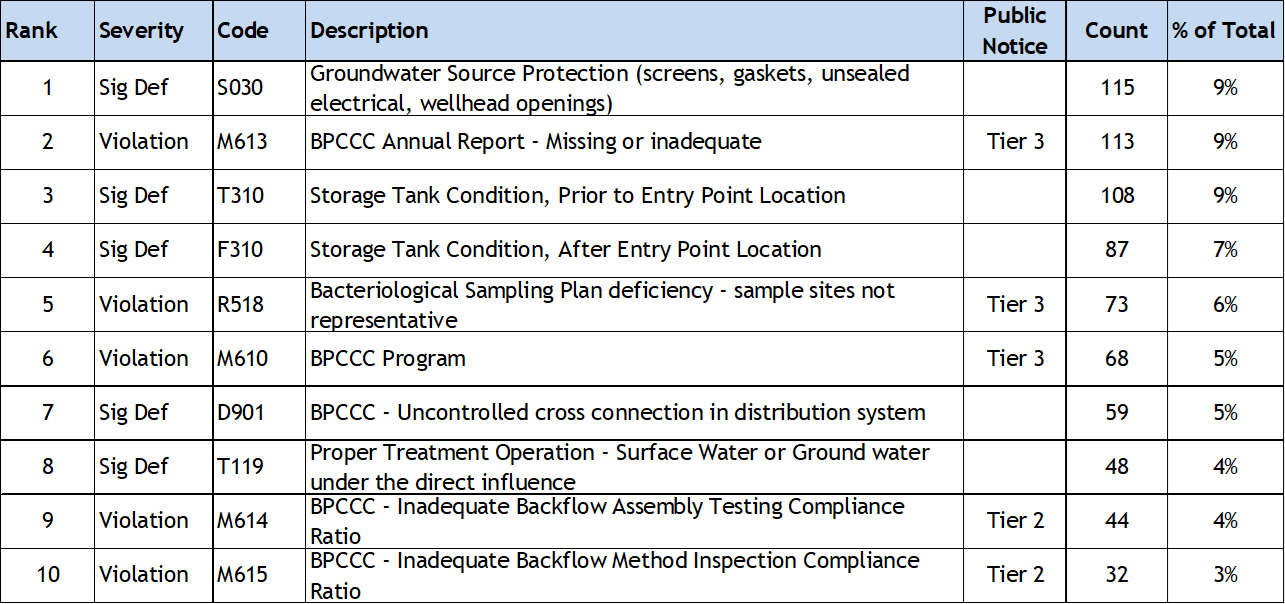
During the 2023 inspection year, 1,256 significant deficiencies and violations were cited in 491 sanitary surveys. The Top 10 most frequent inspection citations were:

Storage tank deficiencies (F310 and T310), in the distribution system and before the entry point (CT tanks) combined account for 16% of all citations in IY23 and 17% of all citations in IY22. Storage tank deficiencies can include improperly protected screens, hatches and overflows. This underscores the importance of robust routine tank inspections under the Storage Tank Rule and also for tanks that are used for contact time or before entry point. 

The next most frequently cited significant deficiency, with 9% of the total IY23 and IY22 citations, was for wellhead pathways of contamination (S030). This can include loose wellhead seals, missing or damaged vent screens, missing gaskets, broken/open electrical boxes/conduit, cracked sanitary seal plates and wellheads. 

Backflow prevention and cross connection control (BPCCC) has four violations and a significant deficiency that make the Top 10 list, including failure to develop BPCCC annual reports, failure to develop or implement the BPCCC program (both Tier 3 public notice violations), and failure to meet the assembly testing ratio and method inspection ratio which were a Tier 2 public notice violations. Combined, all the BPCCC violations and significant deficiencies make up 26% of the citations in IY23. In 2023 the Division streamlined the BPCCC rule with the Water Quality Control Commission and the assembly and method compliance ratios were combined. In IY24 the M614 and M615 violation codes were replaced with one code, the M619 for Inadequate Backflow Prevention Annual Compliance Ratio due to combining assembly testing ratios and method inspection ratio.

A newcomer to the Top 10 is the Bacteriological Sampling Plan R518 violation which can include not performing representative sampling of the distribution system, not having a sampling plan, not rotating sample locations or not following the plan. 

In IY24 to date, 673 significant deficiencies and violations have been cited. The majority of these citations are the same as the IY23 Top 10 with the addition of two other findings:

  • Violation R536 - MONITORING DISINFECTION (T3); Failure to Monitor Groundwater EP Residual Disinfectant.
  • Significant Deficiency T116 - GROUND WATER TREATMENT; Supplier could not demonstrate adequate operation of approved groundwater treatment processes which are being used for compliance with Regulation 11.

Please check your water systems for these issues to protect public health and avoid significant deficiencies and violations during your next sanitary survey. If you would like additional assistance on technical issues or sanitary survey preparation, please sign up for individualized coaching here.  For any questions or concerns about sanitary surveys please email our Field Services team at cdphe_wqcd_fss_questions@state.co.us. Thank you for all your efforts to protect public health!

➽ Heather Young, PE, CWP, Field Services Section Manager

Wednesday, May 22, 2024

Questions from Q&A Session during CRWA Annual Conference

The Water Quality Control Division Field Services Section participated in the Colorado Rural Water Conference on March 18th during the WQCD round table discussions and received really great questions and feedback from operators attending the session. We wanted to share some of the questions related to Backflow Prevention and Cross Connection Control and Storage Tanks for those operators that were not participating in the conference. 

Backflow Prevention and Cross Connection Control Rule (BPCCC)

BPCCC Resources 

1. Under the new Backflow Rule updates, do I still have 15 months to get 100% of all my devices tested every year?

This question relates to the untested 2-year rule in the 2023 updated regulation as opposed to the 90-day rule from the old BPCCC regulation. With the 2023 regulation update, the “90 day rule” is gone. Under the updated rule, the supplier must achieve a backflow prevention annual compliance ratio of greater than or equal to (≥) 0.90 and with that remaining 0.10, the supplier must ensure that no backflow prevention assembly is present for more than two consecutive calendar years without being tested, service being suspended to the customer, or the cross-connection being removed.

2. What happens if a device fails a test and tests good 7 days later? What if the device fails and is fixed and passes on the same day?

This is a great question and the backflow policy DW007 helps answer this. An assembly that fails testing and is repaired and receives a passing test will be reported in the combined compliance ratio (Report lines 8-10) AND as an uncontrolled cross connection that has been controlled (Report Line 7.A) in the annual report. A violation does not occur for a failed assembly unless the assembly is not repaired within the required timeline. If an assembly fails but is repaired and passes a test on the same calendar day, the supplier may exclude reporting the assembly as having failed in the annual report and only count it in the compliance ratio (Report Lines 8-10) in the annual report. 

3. How do I handle if a place closes and is no longer in use but they had a backflow device?

If it was in use at any time during the year it must be included in the annual report. The supplier can suspend service to the location to remove the cross connection concern for future years while the business is not occupied or using water.

4. Can PWSs have their operators certified as backflow testers? What are the pros/cons?

There are no Colorado state limitations on whether an operator can also be the certified backflow tester. Some utilities administer their backflow program where the operators perform device testing. Other utilities consider it to be a conflict of interest. Each water system can work with their management and legal team to decide the best path for their water system. Some pros to having operators test backflow devices may include having some level of control over the timing of when the assembly is tested, immediate test results, and prioritized testing. However some of the “Cons” of having operators test devices are potential conflicts of interest, it’s another certification to test and maintain.

5. How do I become a certified backflow tester?

Regulation 11 allows for two certification organizations; ASSE and ABPA. They are national organizations with testing/certifications in Colorado. Just google ASSE or ABPA backflow tester and it will bring up testing, schools and how to sign up.

6. Yard hydrants - I installed one with a “Y” adapter with a hose attached to one end with a HBVB installed. Is this ok?

When not in use, the hydrant can be shut down with the non-used side of the “Y” left open to allow for the yard hydrant’s weep hole to work correctly. As long as the non-used side of the “Y” has no hose attached this should be acceptable.

7. Do I have to use your forms?

No, suppliers can develop their own forms as long as they meet the Regulatory requirements and include all the required information.

8. Can I use GIS to track my methods/assemblies?

WQCD does not mandate how suppliers track their methods/assemblies. As long as all required information needed in completing the annual report and maintaining a backflow program are achieved we see no issue with using GIS. One area of concern when using locational software to track assemblies/methods is that one location may have multiple assemblies/methods (isolation versus containment or multiple service connections).

Storage Tank Rule

Storage Tank Rule Resources 

1. Overflows - do I need a flap and a screen or are screens banned? Are you going to issue me a significant deficiency during my next sanitary survey for this? 

This highlights the difference between a significant deficiency associated with Sanitary Surveys and changes in the design criteria for designs submitted to the Engineering Section. New or modified water facilities must meet the design criteria, but the Field Services Section does not issue significant deficiencies if an existing tank does not meet the current design requirements unless there is a condition that is a potential threat to public health (flap valve is stuck open, screen is torn or missing). During a sanitary survey, tank overflows with flap valves or screens are fine as long as they are in good operating condition (flap valve functions, seats completely, flap valve is not propped open/submerged; screens are non-corrodible 12-16 Mesh and intact).

2. Do I have to use 24-Mesh non corrodible screen - I can’t find it.

Screens may not have openings that exceed 0.07 inches (typically 12 or 16 mesh) and have to be non-corrodible.

3. Can I use actual plastic window screen to screen my vents, overflows, etc?

Plastic window screen can be easily damaged/torn by rodents and should not be used. Non-corrodible metal screen should be used.

4. My tank is 20 years old and does not meet the current design criteria. Are you going to cite me for a significant deficiency or violation during my next sanitary survey?

New or modified water facilities must meet the design criteria, but your inspector will not issue a significant deficiency if your existing tank does not meet the current design requirements unless there is a condition that is a potential threat to public health (examples include unprotected openings to tanks, missing/damaged screens, unsealed/un-gasketed hatches, etc.).

5. Does the Storage Tank Rule apply to all my tanks?

The storage tank rule applies to finished water storage tank(s). “FINISHED WATER” or “FINISHED DRINKING WATER” means water that is supplied to the distribution system of a public water system and intended for distribution and human consumption without further treatment, including disinfection contact time, except treatment as necessary to maintain water quality in the distribution system (e.g., booster disinfection, addition of corrosion control chemicals). If you need help determining if a tank is considered to be part of the treatment system or part of the distribution system, please email us at: cdphe_wqcd_fss_questions@state.co.us

6. What should I do to maintain my Contact Time tanks that are not part of the distribution system?

We recommend that you consider following the Storage Tank Rule guidelines for Contact Time (CT) tanks to avoid a potential risk to public health but it is not a requirement. Your inspector will be looking at all tanks including the contact time tanks during your next sanitary survey and any potential risks to public health (example: unprotected openings, missing/damaged screens, unprotected overflows, sediment buildup) will be cited as significant deficiencies.

7. When are you going to make me do the Storage Tank Rule for my Contact Time Tanks?

The Division does not have any current plans to re-open the Storage Tank Rule however, the tanks must still be maintained and will be inspected during sanitary surveys.

We hope sharing these questions and answers from the Colorado Rural Water Association helps all operators. If you have any questions please feel free to reach out to us at: cdphe_wqcd_fss_questions@state.co.us.

➽ Tom Valenta Field Services Section Work Group Lead, Unit 3 

➽ Heather Young Field Services Section Manager

Wednesday, May 3, 2023

Storage Tank Findings

In this article, we continue our discussion of the Top 10 most frequently cited significant deficiencies and violations to raise awareness and help operators identify and correct issues before they become a potential health threat or citations in a sanitary survey. Coming in at #1 in the Top 10, storage tank significant deficiencies (F310 and T310) were the most common findings cited during sanitary surveys for the 2022 inspection year. Storage tanks can be used for treatment to achieve log inactivation by providing contact time, or in the distribution system to help with water demand and pressure (tanks in distribution are subject to the Storage Tank Rule). The most commonly discovered significant deficiencies with tanks are related to access hatches and vents.

Access Hatches:

All water storage tanks must have at least one access opening to allow for routine inspections and, if applicable, inspections required under the Storage Tank Rule (Section 11.28 of Regulation 11). The access opening must be designed to protect the tank from contaminants such as: surface water infiltration, stormwater runoff, insects, rodents, and birds.

Access Hatches - Common Significant Deficiencies to check for and correct if found:

  • Improper use of gasketing or lack of gasket on the hatch lid 
  • Infiltration of water, debris or dirt from the hatch
  • Degrading or corroding hatch lids with pathway(s) for contamination
  • Hatches with unsealed penetrations (bolts missing, unsealed openings for level sensors, etc.)
  • Hatches flush with the ground or surface of the tank that can allow water, dirt or debris to enter the tank.

It is important to note that access hatches located outdoors or exposed to the elements must be fitted with a solid, water and insect tight, gasketed cover. It is recommended that the hatch overlap the framed opening, extend down around the frame, be hinged on one side, and have a locking device.

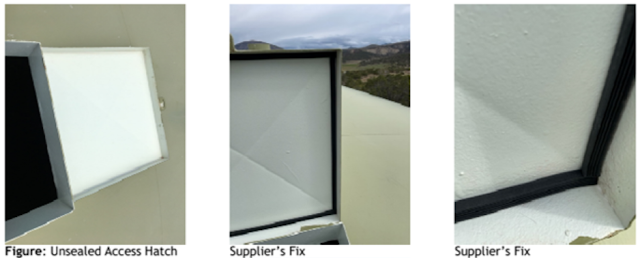
Below is a photo of an unsealed access hatch followed by a set of photos of a newly installed gasket. The supplier created a water and insect tight seal, effectively resolving the significant deficiency.


Below is a photo of a flush mounted hatch, which allows for potential contamination due to the lack of an overlapping framed opening. Note the channel on the interior of the hatch that can allow for water accumulation that can seep into the tank. These hatches are vulnerable to extreme weather conditions and contain potential points of failure. 

For additional discussion about flush mounted hatches - see our September, 2022 article.

Flush mounted hatches often contain drains, which frequently clog with debris, dust, dirt and insects. During heavy weather events, these clogged drains can cause water to pass through the gasket and leak into the storage tank, as seen below. 

The hatches above and below allow for insect activity and debris buildup close to or on the gasket, creating a potential for contamination. In the photo below, there are substantial spider webs surrounding the gasketed area of the hatch. 


Vents: 

Vents must be designed to protect the tank from contaminants such as: surface water, stormwater runoff, insects, rodents, birds, etc. All openings must be protected by a non-corrodible screen. Screens may not have openings that exceed 0.07 inches (typically 12 or 16 mesh screen). The screen must be installed within the vent at a location least susceptible to vandalism. The screen must be accessible for replacement. Vents must be designed for unobstructed air flow into and out of the tank.

Common Significant Deficiency to check for and correct if found (the following air vent conditions are not allowed):

  • Storage tanks with unscreened, open construction between the sidewall and the roof
  • Air vents that are not screened or that have damaged or blocked screens
  • Air vents with screens with openings that exceed 0.07 inches (typically 12 or 16 mesh screen)
  • Outdoor tanks with air vents that do not open downward or are not fully covered to protect from rainwater

Please keep in mind, the use of steel wool and/or stuffing steel wool into vents is not accepted as a proper form of screening a vent.

Below are photos of an interior tank lid that is improperly vented. The venting for these commonly found tanks function as a labyrinth preventing potential contaminants; however, the vent does not contain a mesh screen with openings that do not exceed 0.07 inches. With the addition of the mesh screen, the supplier now meets the requirement. Please note that indoor tanks must be vented and must be located at or above the highest point of the tank.


Vents on outdoor tanks must open downward. Downturned vents can be candy cane, mushroom style, or where no portion of the vent screen is visible from a horizontal position (e.g. vent in the side of a hatch assembly with louver protecting the vent). Any vent cover must overlap so that no horizontal pathway exists. Candy cane or downturned vents are allowed to have a visible screen (i.e. not covered) below the bottom of the vent opening as long as no direct horizontal pathway exists between the vent opening and the tank. When a mushroom type vent is used, the minimum opening distance must be measured from the lowest point on the vent cap to allow for air flow to enter the screened area. Integral vents on tanks (e.g., threaded cap on a polyethylene tank access lid) that do not have downturned screening are not allowed outdoors.

For outdoor elevated tanks, the vent elevation from the top of the roof should be a minimum of 24-inches above the top of the roof to prevent snow from clogging vents. The photos below show air vents on an outdoor tank that are screened but not downturned or fully covered to protect contamination from rainwater. 


Please note there are resource online to assist water systems in the operation and maintenance of storage tanks:

The supplier is responsible for complying with  Section 11.28 (Storage Tank Rule) of Regulation 11. Please note that if an inspector identifies any of these issues during a sanitary survey and they have not been previously identified as sanitary defects with a written corrective action schedule, they will be cited as significant deficiencies. If sanitary defects were identified by the supplier during a Storage Tank Rule periodic or comprehensive inspection but are not under a corrective action schedule or were not fixed in accordance with a corrective action schedule, a violation of the Storage Tank Rule may be cited during the sanitary survey.  It is highly recommended that the supplier’s inspection documentation include pictures of the “before” and “after” corrections for each sanitary defect.

Prior to making any alterations to tank venting the department recommends that the supplier consult with an engineer or a professional with expertise in potable water storage tanks to ensure that the tank’s venting capability is not compromised. Alternatively, the supplier can check with the manufacturer of the storage tank to see if any limitations exist for the component in need of alteration or repair. 

➽ Connor Clarke, CWP, Field Services Section

Wednesday, December 14, 2022

New Storage Tank? Prior Approval Required

Prior to 2010, the Department did not consistently inspect, review, or approve storage tanks within distribution systems. The Department did however approve storage tanks located at drinking water treatment plants for the purpose of achieving necessary disinfection for treatment. The Department would like to use this opportunity to remind systems that all new storage tanks and major modifications to storage tanks must obtain prior approval from the Department’s Engineering Section. Obtaining prior approval will help ensure public health is adequately protected and help make sure that hatches, vents, and overflows will be acceptable to Department inspectors on future sanitary surveys. This can save your system the time and money associated with having to repair or replace these items in the future.

The two articles below were published in 2009 and 2019 respectively. In the 2009 article, the Department introduced the concept of requiring storage tanks to receive prior approval from the Department before being constructed. A decade later in 2019, the Department realized that some pump station wet wells (which are considered storage tanks) were being installed without approval and reminded the regulated community that those structures are considered storage tanks as well.

As with all design-related questions, should you have a concern or question about which types of projects should be submitted to the Department, please visit our design approval website or feel free to contact us CDPHE.WQEngReview@state.co.us.

➽ Tyson Ingels, Lead Drinking Water Engineer


1. 2009 Aquatalk Article: Submitting Plans for Storage Tanks (updated references in parentheses have been added):

Prior Design Review and Approval Requirement Extended to All Storage Facilities

➽ Gary Soldano

Starting in January 2010, the Safe Drinking Water Program will require prior approval of all such projects as required by Article 1.11 (current regulatory reference is Section 11.4(1)) of the Colorado Primary Drinking Water Regulations. This requirement has been in place for many years for storage vessels that are actively used to provide disinfection contact time. The requirement will be extended to all storage tanks in an effort to address issues preventatively rather than upon discovery during sanitary surveys or, worse yet, waterborne disease outbreak investigations.

The applicable design criteria for storage facilities can be found in Appendix I of "Design Criteria for Potable Water Systems ... " (current reference is Chapter 7 of the Colorado Design Criteria for Potable Water Systems, 2022 version). As many readers know, a stakeholder group process has been established to update that document and will resume work to finalize a revised document in the near future. Until that process is completed, the current criteria will continue to be used (criteria were updated in 2013, 2017, and again in 2022).

To prepare a complete submittal, water system staff and consultants should review the design criteria and obtain an "Application for Construction Approval" form from engineering section staff or the section's Web page links that can be found at https://cdphe.colorado.gov/design (hyperlink updated to be active).

Applicable design calculations should be bundled with design drawings and specifications for submittal to the engineering section unit manager whose geographic area includes the county in which the water system is located. For community water systems, a professional engineer's seal and signature is required on the documents.

If you have any questions about the process, please contact an engineering section staff member or unit manager. We look forward to working together with water systems to ensure safe drinking water throughout storage and distribution systems in this effort.

2. 2019 Aqua Talk Article: Submitting Plans for Pump Station Wet wells to be approved as Storage Tanks

Tuesday, November 22, 2022

Most Frequently Cited Significant Deficiencies and Violations - Inspection Year 2022

The Field Services wrapped up the 2022 inspection year (IY 22) in September and the new IY 23 inspection year started on October 1, 2022. We appreciated all the assistance from public water systems in completing 469 sanitary surveys in 2022! We anticipate completing over 550 sanitary surveys in 2023. In this article we will share the top 10 most frequently cited significant deficiencies and violations to raise awareness and help operators identify and correct issues before they become a potential health threat or citations in a sanitary survey. 

According to Regulation 11, Section 11.3(72), a significant deficiency means: any situation, practice, or condition in a public water system with respect to design, operation, maintenance, or administration, that the state determines may result in or have the potential to result in production of finished drinking water that poses an unacceptable risk to health and welfare of the public served by the water system. Field-based Violations of Regulation 11 have either Tier 2 or Tier 3 public notice requirements that are dependent upon the severity of the violation and any potential public health effects, pursuant to Regulation 11, Sections 11.33(1)(a,b), 11.33(2)(a), 11.33(3)(a) and 11.33(4)(a). All issued notifications must comply with the general content and distribution requirements and notice reporting requirements that are included in Regulation 11.33(5),(6) and (7).

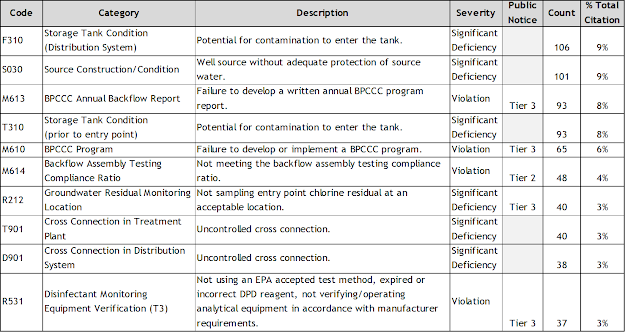
During the 2022 inspection year, 1,155 significant deficiencies and violations were cited in 469 sanitary surveys. The Top 10 most frequent inspection citations were:

Storage tank deficiencies (F310 and T310), in the distribution system and before the entry point (CT tanks) lead the pack with 17% of all citations in 2022. Storage tank deficiencies can include improperly protected screens, hatches and overflows. This underscores the importance of robust routine tank inspections under the Storage Tank Rule and also for tanks that are used for contact time. 

The next most frequently cited significant deficiency, with 9% of the total 2022 citations is for wellhead pathways of contamination (S030). This can include loose wellhead seals, missing or damaged vent screens, missing gaskets, broken/open electrical boxes/conduit, cracked sanitary seal plates and wellheads. 

Backflow prevention and cross connection control (BPCCC) has several violations and two significant deficiencies that make the Top 10 list, including failure to develop BPCCC annual reports, failure to implement the BPCCC program and failure to meet the assembly testing ratio which is a Tier 2 public notice violation.

Groundwater entry point chlorine monitoring (R212) accounted for 40 significant deficiencies, including monitoring weekly entry point chlorine residual in the wrong location. Chlorine residual monitoring equipment practices (R531) which can apply to both groundwater and surface water systems rounded out the Top 10. Frequently encountered chlorine residual monitoring equipment violations include using expired DPD reagent, caked glassware (grayish tinged), not switching a colorimeter to High Range and using the appropriate vials when needed, and not performing weekly checks of online chlorine analyzers. In accordance with Regulation 11, Section 11.46, 40 CFR 141.74(a), and Policy 4 Guidance, suppliers must field verify online chlorine analyzers once each week by taking a grab sample and analyzing it for chlorine residual.

Please check your water systems for these issues to protect public health and avoid significant deficiencies and violations during your next sanitary survey. If you would like additional assistance on technical issues or sanitary survey preparation, please sign up for individualized coaching here.  For any questions or concerns about sanitary surveys please email our Field Services team at cdphe_wqcd_fss_questions@state.co.us. Thank you for all your efforts to protect public health!

➽ Heather Young, PE, CWP, Field Services Section Manager

Tuesday, September 20, 2022

Another Storage Tank Article? Here's why...

Colorado promulgated the first-of-its-kind finished water storage tank rule in 2015. By and large, the public water system community has done an outstanding job in the last few years improving storage tank oversight, cleaning, and maintenance. Systems have also taken measures such as installing tank mixers at key locations in order to keep water fresh and maintain proper water quality throughout distribution.  While everyone’s efforts are improving the protection of water quality by identifying and addressing potential pathways of contamination at tanks, this article focuses on a specific avenue that may allow for contaminants to enter protected water storage - flush-mounted roof hatches.

In subsequent years after the Storage Tank Rule went into effect, we have published a myriad of articles about finished water storage tanks, their importance, the purpose of the rule, key things to be planning for, and other guidance to help water systems stay on top of their storage tanks. To see just a sample of some of the articles we have published about storage tanks, follow these links:

Storage tank rule primer articles:

Prior to 2010, the division did not consistently review or approve storage tanks or storage tank appurtenances including hatches. We had published design criteria about roof hatch expectations (see Figure 1 below), but at the same time the division did not cite specific tank issues on design approvals. Therefore, for tanks designed and constructed prior to the 2000s, many different styles and types of hatches were installed and remain in use today. At this time, the department has identified challenges to provide adequate protection of tanks with the flush-mounted storage roof hatches installed outdoors. See Figures 2 and 3 below. The department has seen an uptick of significant deficiencies during sanitary surveys related to these flush mount systems installed outdoors.


Figure 1 - Excerpt from the Design Criteria for Potable Water Systems (2022 Edition) - Section 7.0.8.iii


Figure 2 - Outside pic of a flush-mount hatch installed on a concrete pedestal - the first hatch has a more robust seal than the second, but both are potentially subject to contamination based on the lack of an overlapping lid.


Figure  3 - Clean drainage channel - intact, robust gasket

At times, these outdoor hatches can be maintained and prevent contamination of the finished water as in the photos in Figures 2 and 3. However, the division has noted that properly maintained and protective flush-mounted tank hatches installed outdoors are more the exception than the rule. These hatches are not designed to keep contamination out of the tank in extreme weather conditions. The intrinsic hatch design has several key points of failure that need to be monitored quite frequently. During recent sanitary surveys that followed significant rain events, division staff observed points of failure in the hatches in question as shown in figures 4-7 below.:


Figure 4 - Flooded drain channel due to screen clogging - rainwater overwhelms the gasket and leaks into the storage tank as shown by the water mark due to drainage into the tank.


Figure 5 - Substantial insect activity in the drain channel - with insect intrusion and webs.


Figure 6 - Substantial insect activity inside a flush mounted hatch with webs and debris


Figure 7 - Evidence of a yellowjacket hornet nest inside the drainage channel - this can cause flooding of the hatch gasket and contamination

The Division recommends that systems proactively replace such hatches. At times, a second hatch can be mounted on the surrounding concrete to provide a proper seal and protect the finished water. However, on other occasions the hatch has to be completely replaced. As the storage tank rule enters its seventh year - there appears to be ample evidence that most flush-mount hatches do not provide a reliable seal for outdoor environments and must be carefully monitored and maintained. While they may be able to provide an adequate seal indoors, in the elements many points of failure make them arguably an unacceptable risk to public health.

The division will continue to communicate with the regulated community about our intention to cite these hatches that allow potential contamination as significant deficiencies each time we encounter them during sanitary survey site visits. However, don’t wait until your next sanitary survey to evaluate replacement as an proactive option to protect finished water and in the meantime, make sure to evaluate them during periodic inspections to ensure proper protections from contamination are in place. If you have any questions, please reach out to the Field Services Section at cdphe_wqcd_fss_questions@state.co.us or the Engineering Section at CDPHE.WQEngReview@state.co.us.  Figure 8 demonstrates the proper hatch systems that should be installed on outdoor storage tanks.

Figure 8 - Ideal hatch design for outdoor installations

➽ Tyson Ingles, Lead Drinking Water Engineer

Wednesday, February 23, 2022

Storage Tank Comprehensive Inspections


We hope 2022 is off to a good start for you! Do you have storage tanks in the distribution system (after the Entry Point sampling location) and when was the last time the tanks had a comprehensive inspection? The Storage Tank Rule (
Regulation 11.28) requires Comprehensive Inspections of each finished water storage tank at least every five calendar years or on an department acceptable alternative schedule. A comprehensive inspection is a in-depth tank inspection that includes both an internal and external inspection that covers all aspects of the condition of the storage tank including but not limited to sanitary, structural, and coating systems conditions, as well as security and safety concerns. Periodic tank inspections are mainly a visual external storage tank inspection that is typically performed by the supplier to identify evident sanitary defects (e.g., lack of screens on vents). Most water suppliers hire contractors to perform comprehensive tank inspections.

Policy DW-012 - Storage Tank Rule Alternate Inspection Schedule Justification, Section 4.6 specifies that with the Storage Tank Rule becoming effective April 1, 2016, suppliers of water are required to perform a comprehensive inspection of their finished water tanks within five years of this date and subsequently at least every five years thereafter. Please note, the five-year interval between comprehensive inspections is calculated on the calendar year rather than a specific month or date. For example, if a comprehensive inspection was completed anytime within calendar year 2016, then the following comprehensive inspection must have been completed by the last day of 2021 in order to be in compliance with the Storage Tank Rule. For another example, if a comprehensive inspection was completed anytime within calendar year 2018, then the next comprehensive inspection must be completed by the last day of 2023.

Please note! The water supplier must have conducted a comprehensive inspection on all distribution system tanks before the end of 2021 and every five years thereafter (Policy DW-012). Effective 2022, unless your distribution system tank was built after 2016 or was on a department acceptable alternate inspection schedule, a comprehensive inspection must have been completed. If a comprehensive inspection was not completed, then it is a treatment technique violation that requires Tier 2 public notice. The Field Services Section will be evaluating your documentation of your comprehensive tank inspections during your next Sanitary Survey. Please be prepared with the following information:

  • When the tank(s) in the distribution system went into service
  • Were comprehensive inspections completed every 5 years or are they on a department acceptable alternate schedule
  • Copy of the comprehensive inspection report(s)
  • Water supplier review of the comprehensive inspection report and any sanitary defects (Policy DW-010) identified (e.g., sediment exceeding 1-inch, holes, vent screens missing, etc.).
  • Documentation demonstrating that any sanitary defects were corrected or are on a corrective action schedule to resolve.

Additional resources for comprehensive tank inspections, include the following: Comprehensive inspection checklist, Comprehensive inspection checklist instructions and Storage tank guidance handbook. The division’s intranet also has more information at https://cdphe.colorado.gov/dwtank.

Comprehensive inspections are important to protect storage tanks from sanitary defects and provide safe drinking water to customers. If you have any questions or concerns, please reach out to the Field Services Section at CDPHE_WQCD_FSS_Questions@state.co.us and thank you for all your efforts!

➽ Heather Young, PE, CWP