Pages

Showing posts with label CCWP. Show all posts

Wednesday, September 23, 2026

Colorado's Water & Wastewater Operators

Reliable drinking water (DW) and effective wastewater (WW) treatment are among the most essential public services a community depends on. Behind every glass of safe drinking water and clean body of water is a team of qualified, dependable, and certified operators whose knowledge and commitment to protect public health and preserve the environment ensure regulatory compliance. Choosing the best operator for your system can have a huge, lasting impact on the wellbeing of local communities.

To alleviate the strain of looking for an Operator in responsible charge (ORC) the Water Quality Control Division maintains a list of certified operators. This list details information about the operators’ level of certification and service area. If you are a system looking for a qualified operator, please visit the WQCD’s contract operator list to assist you in your search. 

Please note that this list is a voluntary listing of organizations and individuals available for hire. Participation in listing your services doesn't constitute a recommendation or endorsement by the state.

If you are an operator who would like to offer your services to public water systems, you can do so by adding your contact information to our voluntary contract operator list using the Contract Operator Listing Form. 

Operators who are using this listing form, please be mindful of the following when enlisting your services:

  • Only select:
    • Alphabetic entries (A-D) for DW treatment, WW treatment, and Industrial WW treatment.
    • Only add numeric entries (1-4) for DW distribution and WW collection.
  • There is a small systems certification available for systems serving less than 3,300 people in both wastewater and drinking water. When listing your S certification you will answer yes under DW and/or WW small systems.
    • This certificate is not equivalent to carrying a class 1 or class D certification. So if you only carry an S certification do not add anything to the other categories. 

You can review the Water Operator certification types by visiting our website: Which certificate is right for you. 

Before adding a contract operator to this list we verify that all certifications are active. Expired certifications or operators actively under disciplinary action will not be accepted. If you are using this list to look for a qualified operator, we strongly advise you to always verify the status of an operator's certificate(s) using the CCWP public search page to ensure certifications have not expired or been revoked, as we update this list twice per year.

Having access to experienced and reliable operators is essential to a community's success. A poor DW or WW operator can severely compromise public health, devastate local aquatic ecosystems, and trigger legal and economic crises for a municipality or community. If you need assistance finding an operator in your area you can request help using the link to our coaching request form.

➽ Elicia Vigil - Drinking water coach - Water Infrastructure Improvements for the Nation (WIIN) program manager


Wednesday, May 6, 2026

Listening to the Certified Operators: Updates on the Operator Certification Experience


In 2025, the Water and Wastewater Facility Operators Certification Board (WWFOCB) issued a survey to the water sector to learn about your experience with the certification exam process. We’ve heard your feedback, and we want to ensure you have the most up-to-date information on the changes and resources available to you.

Enhancing Accessibility and Efficiency

We are committed to making the certification process as smooth and inclusive as possible. To that end, we have implemented several key updates:

  • Spanish Language Exams: As of August 2025, both Class D and Class 1 examinations are available in Spanish. Operators can request this option during the scheduling process with PSI.
  • Application Turnaround: We know you're eager to get to work. Between June 2024 and May 2025, our team reviewed 5,965 applications. We are proud to report that 91% of all applications were reviewed in less than 10 days.

Evolving the Exam Process

The Board recently revised Regulation 100 to better balance workforce entry with high professional standards.

Important Change: The eligibility period for retaking an exam has been shortened
 from 180 days to 100 days.

This change allows for three testing attempts under a single application while ensuring operators take sufficient time to study and prepare between tries. Our goal is to ensure the program produces quality operators, not just good test-takers.

Resources and Support

We understand that preparing for exams can be daunting. To help, we recommend utilizing the Need-to-Know Criteria on the WPI website. However, please ensure you are using the correct versions; Colorado operators should not use the new 2025 criteria yet, as they are not currently aligned with the exams our state administers.

If you run into trouble, knowing who to contact can save you a lot of time:

Looking Ahead

We are currently working on a public matrix of approved roles and narrative job descriptions to clarify experience categories. We also recognize the interest in partial credit for related backgrounds (like military or lab experience). While current regulations do not allow for this, we are exploring the regulatory changes that would be required to make it a reality.

Your feedback continues to shape how we serve the operator community. Thank you for your continued professionalism and for being the backbone of Colorado's public health.

➽ Kyra Gregory, Local Assistance Unit Manager

Wednesday, March 4, 2026

Thank you to Colorado’s Certified Operators


To Colorado’s Certified Operators: Thank You for What You Do

From all of us on the staff of Colorado’s Water and Wastewater Facility Operators Certification program, we want to take a moment to speak directly to you – the certified operators who keep Colorado’s water systems running safely, reliably, and with professionalism every single day. 

Quite simply: what you do matters, and it matters a lot.

Every time a community turns on the tap expecting clean, safe drinking water or flushes a toilet without a second thought, it’s because of your expertise. Behind the scenes, often unnoticed and sometimes underappreciated, you protect public health and safeguard the environment across our beautiful state. Colorado’s quality of life depends on you.

A Profession Built on Skill, Commitment, and Trust

Water and wastewater operations are not “just jobs.” They are professions that demand technical knowledge, sound judgment, adaptability, and a deep sense of responsibility. From managing complex treatment processes and regulatory requirements to responding to emergencies at all hours, operators are asked to do more with less and to do it flawlessly. 

Obtaining certification isn’t easy, and it isn’t meant to be. It represents your commitment to learning, accountability, and excellence. When you earn and maintain your certification, you demonstrate to your community, your employer, and your peers that you are a trusted professional. We see the effort that goes into studying, testing, continuing education, and staying current in a field that is constantly evolving. 

Showing Up When It Counts

Whether you work for a large utility on the Front Range or a small system in a rural mountain or plains town, your role is critical. During wildfires, floods, droughts, freezes, power outages, and equipment failures, operators are among the first to respond and often the last to leave. You show up when conditions are difficult, when systems are stressed, and when communities need stability the most.

In recent years especially, operators have navigated staffing shortages, aging infrastructure, tightening regulations, and increasing public expectations. Through it all, you’ve kept systems compliant and water safe. That resilience does not go unnoticed. 

More than Compliance

While regulations and certifications are part of the job, the heart of this profession goes beyond compliance. It’s about stewardship – of water resources, public health, and future generations. It’s about pride in doing work that truly serves people.

We also recognize that many of you mentor new operators, share knowledge across systems, and contribute to a culture of professionalism in Colorado’s water sector. That willingness to teach, learn, and support one another strengthens the entire industry. 

Our Commitment to You

As a program, we see our role as partners in your success. Our goal is to support a fair and credible certification process that upholds high standards while acknowledging the realities of the work you do. We continually work to improve guidance, communication, and outreach, as a strong operator workforce is essential to the strength of our water systems. 

Your feedback matters to us. Your experience in the field helps shape how we do our work, and we value the dialogue we have with operators across the state. 

Operator Certification Program staff can be reached at (719) 225-7339, info@coloradocwp.com, cdphe.facilityoperator@state.co.us, or cdphe.wwfocb@state.co.us. 

You can also find everything you need to know about Colorado operator certification using the Operator Resources webpage. 

Thank You

So, to Colorado’s certified water and wastewater operators: thank you for your dedication, your professionalism, and your service. Thank you for the long hours, the problem-solving, the vigilance, and the pride you bring to your work. Thank you for protecting public health and the environment, often without recognition and always with integrity. 

On a personal note, I (Jessica Morgan) also want to share my gratitude as I prepare to step away from public service after nine years, including three and a half years with the Water and Wastewater Facility Operators Certification program. It has been an honor to serve the operator community and to support the important work you do every day. I am deeply grateful for the opportunity to have worked alongside such knowledgeable, committed professionals, and I will carry a lasting appreciation for this field and the people in it. 

We are proud of the operator community in Colorado, and we are grateful to work alongside you – supporting a profession that is as essential as it is honorable. Keep doing what you do. Colorado is better because of it. 💧


➽ Jessica Morgan, Liaison for the Water & Wastewater Operator Certification Board 

➽ Larisa Oringdulph, Program Director of Colorado Certified Water Professionals


Wednesday, December 10, 2025

Why the Delegation of Duties is so Important

Resources: 

A written delegation plan is a tool that an ORC can use to authorize certified or uncertified individuals at a facility to perform specific tasks or activities related to the operation of the system. When used correctly, it enables an ORC to meet the regulatory responsibility of supervision over the operation of the facility and over the operational activities and functions of other facility operators, without having to be on-site 24-7. This may translate into cost savings, especially for smaller systems that don’t need and cannot afford a full-time ORC.

The written delegation plan also helps certified or uncertified operators understand the limits of their tasks and activities. That is, they know when they have to consult with the ORC. Keep in mind that only the ORC is authorized to make process control and system integrity decisions!

What makes an effective delegation plan? 

  • Name of the facility/system, including the PWSID number or Permit number
  • Name of the ORC who is delegating the task or activity
  • Date range of delegation (delegation plans must be reviewed, and if appropriate, updated annually)
  • Name and/or brief description of the task or activity
  • Person(s) or Position Title of the individual(s) being authorized to perform the task or activity at the system
  • Delegation limits identifying when the individual(s) must contact the ORC for further instructions
  • Date of training provided by the ORC to the individual(s) being authorized to perform the task or activity
  • If the task or activity isn’t already included in writing in the individual’s job description, the delegation plan should document the individual’s written acceptance of the delegated task or activity (regardless, this is best practice)
  • Written standard operating procedures (SOPs) that provide detailed, step-by-step instructions for performing the task or activity.

A blanket statement delegating all operational responsibilities to an on-site individual does NOT meet the minimum requirements for a delegation plan because it does not identify specific tasks, nor does it identify the limits of each task.

Delegation is a specific ORC responsibility. An ORC cannot authorize a system owner or anyone else to delegate tasks to subordinate personnel. An ORC cannot delegate any responsibilities that are reserved to the ORC, such as process control or system integrity decisions. 

Keep in mind that an ORC is accountable for the consequences of tasks performed by individuals acting under a written delegation plan. Therefore, it is necessary for the ORC to provide adequate training and to routinely verify that each individual to whom tasks are delegated is performing the tasks correctly. Written SOPs are a best practice to help ensure consistency of performance.

Because the ORC has supervisory responsibility, the ORC needs to train the individual, verify the person’s understanding of the task, verify the individual knows where the written SOPs are kept and how to refer to them if memory fails, and confirm the individual’s willingness to follow the instructions. If an individual trained by the ORC is unwilling or unable to perform in accordance with the ORC’s verbal and written instructions, the ORC needs to take back the delegated tasks or activities from that person. Then the ORC must then perform the tasks personally or find another person to perform them.

Regulation 100 states that “certified operators in responsible charge shall protect the public health and the environment in the conduct of their duties.” An ORC who allows untrained or inadequately trained individuals to continue performing tasks or activities incorrectly is not protecting public health and the environment. An ORC who allows workers who do not adequately adhere to the training and follow established SOPs to continue performing delegated tasks or activities is not protecting public health and the environment.

Division field and compliance staff are seeing an influx of inadequate delegation by ORCs, uncertified operators making process control and system integrity decisions, or even instances where the ORC is a so-called “paper operator.” These are operators who are designated as operators in responsible charge (ORCs) but fail to adequately supervise the operation of their facilities. They are ORCs on paper only, or “an operator in name only.” The Water and Wastewater Facility Operators Certification Board (board) has revoked operators’ certificates for posing risks to public health and the environment when, as the certified operator in responsible charge, they have been inadequately and/or inappropriately delegating essential ORC duties and/or failing to provide adequate supervision of a facility. In Colorado, this behavior is considered negligence; it constitutes operator misconduct that can result in loss of certification. 

The bottom line is that the written delegation plan, when used correctly, is a great resource with benefits for the ORC, other facility operators, and system owners. When used correctly, it provides a lot of flexibility while still protecting the people we serve. Let’s keep our mission in mind and take the time to delegate responsibly and effectively!

➽ Jessica Morgan, Liaison for the Water/Wastewater Operator Certification Board 

Wednesday, May 28, 2025

Coaches Classroom: How to Take a Water/Wastewater Operator Certification Exam?

Did you know that to become certified as a water/wastewater professional in Colorado or to take an exam to obtain a higher certification, you will work with a company called Professional Service Industry (PSI)?

As mentioned in previous Aqua Talk articles (4/2/25 article, 10/30/24 article), to become a certified water professional, you will first determine which certification you need and then work within the Colorado Certified Water Professionals (CCWP) portal to submit an examination application. Once CCWP approves the exam application, applicants have 100 days to sit for and pass the exam. If an applicant doesn’t pass the exam, they may schedule a re-test at any time, however, the operator must wait 30 days to retake the exam.

Notes on working within PSI’s website

After you receive your application approval from the folks at CCWP, you will receive an email from PSI letting you know that you can now create a login and schedule your exam. You can follow the link and instructions provided in the email. Once you have logged in, select “New Booking” if you need to schedule your exam or “Reschedule” if you need to move the date you originally planned to sit for the exam. 

This will take you to a list of tests you are eligible to schedule based on your exam application through CCWP. 


What if I have issues with my PSI account? 

PSI customer service is best accessed through their “Contact Us” email form. To access this, click on the “Contact Us” icon in the upper right-hand corner of the screen. Be sure to provide the correct email address and phone number for them to reach you and a clear explanation of the issue you are encountering.  You can also visit their Quick Start Guide website, which offers specific information on how to navigate their platform. 

Additional tips and good information: 

  • Where/how do I take an exam: You can either go to a testing center (Find a Testing Center) or use PSI’s remote proctoring option (PSI Online Proctoring Compatibility Check) to take your certification exam. Be sure to know the rules and expectations before you choose which option is best for you. More information can be found on CCWP’s website or in PSI’s Candidate Handbook for Colorado. 
  • Plan accordingly! Winter weather can greatly impact travel to test centers, and PSI may not issue refunds due to inclement weather. Consider contacting PSI to verify your test center is open before you travel. 
  • The CCWP exam application fee is $50; the PSI examination fee is $104 per exam attempt. All payment for the exams is managed through the PSI portal. 
  • Formula sheets - Please note there are two formula sheets, one for water and one for wastewater. It's the test-taker’s responsibility to be sure that the proctor gives them the correct formula sheet.
  • Test takers cannot leave the testing site with notes or scratch paper.
  • CCWP is happy to help all operators as they become certified and advance in their profession. However, the CCWP staff does not have access to PSI's system nor can we help with remotely proctored tech support.

What resources are available to help me study for my exam? 

PSI does a great job at proctoring exams for Colorado’s certified water professionals, but they don’t provide the testing materials. CCWP contracts with Water Professionals International (WPI) to write and standardize exams. So, to study, we recommend visiting WPI’s  Examination Study Resources website. Here you can  access important information that will help you plan your studying process: 

  • Need-to-Know Criteria
  • Formula/Conversion Tables
  • Exam References
  • Study Guides
  • Sample Exam Questions

Once you know what information you need to study and how the questions will be asked, you can form a study plan that is right for you! Below are some examples of helpful resources. This is by no means an exhaustive list. We recommend that you mix a variety of study materials! 

  1. Textbooks 
  2. Courses 
  3. Other resources 
    • Water Sifu - online training resources with videos and podcast-style training


Please don't ever hesitate to reach out to our coaches! 

➽ Kyra Gregory, Drinking Water Training Specialist 

Wednesday, April 17, 2024

Colorado Certified Water Professional Code of Conduct

As the Colorado certified operator community continues to grow, there also needs to be a growing emphasis on professionalism. To acknowledge that water facility operations require a set of demanding professional and technical skills, more than the simple word “operation” may suggest, operators are deservedly referred to as “certified water professionals.” As facilities continue to take advantage of the many technological advances in the industry, certified water professionals need to be computer literate, gain knowledge of how to protect their water systems from cybersecurity threats, as well as be able to apply biological and chemical principles to transform raw water into safe water for drinking and/or recreation. They need to use mathematical equations to calculate appropriate chemical dosages, flows, pressure, etc. The qualifications for certification, including education, experience, ongoing training, and sufficient knowledge to pass a specialized examination, separate certified water professionals from unskilled laborers. 

In 2018, the Water and Wastewater Facility Operators Certification Board (board) adopted the Colorado Certified Water Professionals Code of Conduct, to which every applicant for certification or certificate renewal must agree. A code of conduct clarifies a profession’s mission, values, and principles. It is both an internal guideline and an external statement of values and commitments. Internally, a written code of conduct provides benchmarks against which individual performance can be measured. Externally, it serves as a public statement of the profession’s commitment to high standards and right conduct.

The Colorado Certified Water Professional Code of Conduct emphasizes the profession’s commitment to protecting public health and the environment. It holds certified water professionals to standards of behavior that include honesty, excellence, responsibility, and compliance with state and federal laws, rules, regulations, and permits. At all times, certified water professionals are expected to use their knowledge to help safeguard water quality for Colorado residents and visitors.

The importance of this professional code is underscored by the fact that every certified water professional must agree to it. Failure to follow the code of conduct can be grounds for disciplinary action by the board. If you haven’t reviewed the Colorado Certified Water Professional Code of Conduct lately, take a couple of minutes to do so now.

For questions related to any of these updates, feel free to contact 

➽ Jessica Morgan, Liaison to the Water & Wastewater Facility Operators Certification Board

Wednesday, February 7, 2024

OpCert Program: Updated TU Matrix


The previous version of the TU Topic Matrix (“the matrix”) had not been updated since 2018 and was due for a refresher. The Water Wastewater Operator Certification Board’s current contractor, Colorado Certified Water Professionals (CCWP) sought and obtained board approval to update the matrix with two goals in mind: 

  1. To update and streamline the tool to make it easier for operators and trainers to use and to ensure it aligns with Regulation 100; and
  2. To encourage further education on topics specific to an operator’s discipline. 

There are two categories for TU topics: Core and Flexible (“Flex”) 

  • Core TUs are those course materials that cover topics that are directly applicable to aspects of water and wastewater facility operations that may affect public health and the environment, or the need to maintain compliance with established requirements. A few examples are physical, chemical, or biological treatment, disinfection, and hydraulics. 
  • Flex TUs are training that is not essential for an operator to perform their routine job duties but is useful in the performance of those duties. A few examples of these are safety courses (OSHA), natural and manmade disasters, and technical writing.

The updated matrix reduces the Flex TU topics down to these 3 categories: 

  1. Administrative Related Topics - including but not limited to planning, customer service, computer software, technical writing
  2. Emergency Preparedness and Response - including but not limited to National Incident Management System (NIMS), Incident Command System (ICS), natural and manmade disasters, threat and vulnerability assessments
  3. Safety Program Topics - including but not limited to Occupational Safety and Health Administration (OSHA) topics, Personal Protective Equipment (PPE), risk management

Effective January 1, 2024, all safety, management, and emergency management courses are now approved for Flex TUs instead of Core TUs. 

Please note that all TUs earned prior to January 1, 2024, will retain the 2023-approved TU classification and values. For example, if an operator completed a PPE class in 2023, he or she will be able to use those 2023 TUs to meet the core training unit requirement for upcoming renewals.

This update to the matrix will be rolled out in three phases. The emergency management and safety courses were the first to be updated, the next phase will be general maintenance and equipment operators courses, and lastly, the final phase will be for those courses covering each individual discipline (water treatment/distribution; wastewater treatment/collections). The target for completion of all updates is October 1, 2024. 

For questions on the updates to the TU matrix, feel free to contact CCWP info@coloradocwp.com or Jessica Morgan cdphe.facilityoperator@state.co.us. 

➽ Jessica Morgan, Facility and Operator Outreach and Certification Board Liaison


Wednesday, January 10, 2024

A friendly reminder of a valuable resource! - CCWP Operator Certificate Search

Colorado Certified Water Professionals (CCWP) provides an easy way to verify an operator’s certification status. On CCWP’s public search page, you simply enter an operator’s name, the operator’s ID number, or a certificate number and click the search button. The search should return an operator’s ID number, name, certificate number, certificate type and class, the expiration date of the certificate, and the status of the certificate. If no information is returned, you should contact the CCWP Office for confirmation of your search results.

This feature is not just helpful to certified operators. Facility owners should also be verifying the status of certified operators in the CCWP Portal to ensure they’re not putting an unqualified person in charge of their facility. Doing so could have disastrous consequences for public health and the integrity of the facility. The public search page is the only valid way to verify the status of an individual’s certification and is a quick and easy way of doing so. 

For questions on how to use the CCWP Portal certified operator search feature, feel free to contact Jessica Morgan (cdphe.facilityoperator@state.co.us) or CCWP (info@coloradocwp.com). 

➽ Jessica Morgan, Facility and Operator Outreach and Certification Board Liaison


Wednesday, August 2, 2023

Cause for Concern: A Trend in the Submission of False or Misleading Application Information

So, What’s the Issue?

The Colorado operator certification program is seeing an increase in the submission of false or misleading certification application information by those applying to take exams. Colorado Certified Water Professionals (CCWP) office staff are seeing: 

  • Expired identification information; 
  • Forged education documentation; and/or
  • False work experience information, such as:
    • Inaccurate start/end dates. 
    • False employers. 
    • False self-employment information. 
    • Misclassification of job roles (such as incorrect percentages applied or claiming small water or wastewater system experience when one’s work history is not reflective of that). 
    • Misrepresentation of duties performed.
    • Providing false, outdated, or incomplete supervisor contact information. 

Keep in mind that…

Submitting false or misleading application information on any relevant document provided to the Colorado Department of Public Health and Environment (Department), the Water Quality Control Division (Division), the Water or Wastewater Facility Operators Certification Board (Board), or its contractor (CCWP) is grounds for disciplinary action. 

Every time you submit an application through the CCWP Portal, you must affirm your agreement with the Colorado Certified Water Professionals Code of Conduct and with the Terms and Conditions, which includes your agreement to a thorough review of your application material. CCWP staff thoroughly review each and every application submitted by an operator to sit for an exam or to renew a certificate, and are obligated to submit a formal complaint of operator misconduct to the division upon identifying the submission of such false or misleading information. 

Disciplinary action can have serious consequences for an operator, not only negatively affecting their standing in the workplace and the community, but potentially their livelihood as well.

How to Avoid Submitting False or Misleading Application Information?

CCWP staff are extremely knowledgeable and more than happy to assist you in understanding the portal application process or to answer any questions you may have, including whether or not the information on an application is being accurately represented. If you’re not sure whether you’re accurately representing information on your application, don’t hit submit just yet. Contact CCWP for assistance. 

You can reach CCWP staff at (719) 225-7339 or info@coloradocwp.com. 

Set a Good Example and Uphold the Operator Profession

To become certified you had to meet specific regulatory requirements, demonstrate your special knowledge by passing an examination, agree to the Colorado Certified Water Professionals Code of Conduct, which insists that you protect the environment and the public health of the people you serve, and to maintain your certification by obtaining continuing education credit in the form of training units. If you hold an operator certificate, you are a professional and the Board holds operators to a high standard of professionalism. It also views as unacceptable any misconduct that undermines the integrity of the certified operator profession or puts the public health or the environment at risk. 

Be a good example for your fellow colleagues. If you see someone walking that fine line, stand up and say something; don’t turn a blind eye. The Board, CCWP, and the Division are your allies and we’re here to help you be successful, and we all want to uphold the operator profession. 

➽ Jessica Morgan, Facility and Operator Outreach and Certification Board Liaison


Wednesday, June 1, 2022

Highlights of the CCWP and Operator Certification Board websites

The Colorado Certified Water Professionals (CCWP) website contains a wealth of information to answer frequently asked questions about the operator certification program. From the home page, you can move to two other main sections: one dealing with the CCWP Portal and the other concerning certification and other operator issues. The home page also includes links to:

  • Contact information for the CCWP office
  • Search engine for looking up certified operators 
  • Course catalog for training opportunities approved for continuing education credit
  • List of jobs boards that post certified operator positions

The CCWP Portal page provides links to:

  • The CCWP Portal Log In
  • Free, online courses approved to meet the mandatory regulatory training requirement
  • Video tutorials to help operators and course providers navigate the portal and enter data 

The CCWP Program section answers the most common certification and operator questions. It links to pages that: 

  • Provide step-by-step instructions for becoming certified in Colorado, including information about:
    • Submitting applications through the CCWP Portal
    • Fees
    • Scheduling exams
    • Remote testing option
    • Exam preparation
    • PSI test center guidance for exam candidates
  • Explain the certification options and process for operators coming to Colorado from other states to seek reciprocity 
  • Detail the requirements for upgrading certificates
  • Explain the criteria and process for certificate renewals
  • Provide information about accommodations for military and veterans, including how credit is calculated for military training and experience

The CCWP Program section links to a page for operators in responsible charge. From this page, ORCs can find information to help with the development of written delegation plans for subordinate operators, as well as information about the required written agreement between ORCs and facility owners. There is also a link to ORC contact update forms.

From the CCWP Program page, you can open a link to a listing of contract operators who provide services in Colorado. Finally, the CCWP Program page includes information and a form for operator misconduct complaints.

The Water and Wastewater Facility Operators Certification Board maintains its own website. In addition to meeting and hearing information, the board’s website posts the following documents you may be interested in:

  • Current version of Regulation 100 
  • Colorado Certified Water Professionals Code of Conduct
  • WWFOCB board’s formal policies, guidance and procedures

➽ Nancy Horan, Facility and Operator Outreach and Certification Board Liaison


Wednesday, October 13, 2021

Equipping Operators with Skills to Manage and Overcome Testing Anxiety


We have all experienced it, that feeling of dread and foreboding before taking an exam; a myriad of scenarios running through your head outlining the worst possible outcomes.

These feelings of testing anxiety are very real and can have detrimental effects on an operator’s exam performance. In fact, a recent survey of operators conducted by the Ohio Water Environment Association found that nearly 30 percent of respondents cited testing anxiety as a main cause for not passing the exam.

To examine why testing anxiety is such a prevalent phenomenon, especially in high stakes vocational testing such as an operator certification exam, I spoke with Dr. Ian MacFarlane of Elizabethtown College. Dr. MacFarlane is an Assistant Professor of Psychology, as well as a clinical psychologist. With more than 1,000 hours of therapy work with college students and adults, he has helped countless individuals recognize and overcome testing anxiety.

Why do Operators worry?

Taking a certification exam is different from a high school biology or chemistry final: the stakes are exponentially higher. Psychologically, operators may feel that taking an exam related to their everyday job duties raises a question about their professional competence. This spark of anxiety will be fanned further if a passing score on the exam is mandated for their current job or required for promotion potential.

When asked how test anxiety manifests, Dr. MacFarlane pointed to both cognitive and physical (or somatic) symptoms stating, “The most detrimental effects of anxiety are cognitive. The human brain is limited to a certain amount of processing power at one time. The more your brain is occupied with the anxiety of the exam, the less ability it has to process the exam content. It would be akin to going into a wrestling match with one hand tied behind your back. Anxiety is a ‘mental suck’ or leech draining your brain power and limiting your ability to recall information or facts that might be as familiar to you as the names of your parents.”

One particularly common manifestation of testing anxiety Dr. MacFarlane cited is detachment–an operator is likely to avoid the discomfort of test anxiety by simply not thinking about the exam. Just as your body will pass out instead of coping with a lack of oxygen, you are likely to avoid the discomfort of test anxiety by simply not thinking about the exam.  He noted, “This can be quite detrimental as this avoidance loop can cause you to disengage from exam preparatory practices which can seriously hinder performance on the exam.”

Other effects of anxiety can be seen as physiological symptoms such as nausea, stomach cramps, or lightheadedness. To explain this, Dr. MacFarlane offered, “Our bodies lack the ability to differentiate between real life and mental simulations. So, if we are extremely worried or anxious about something, our minds can create physiological manifestations that are directly associated with the negative mental simulations.”

Why do some operators who excel in their jobs perform poorly on the exam?

Even though the exam is measuring the knowledge and application of tasks that an operator performs daily, while in the testing environment, they lose the contextual cues that would normally assist them in everyday operations.

Without those additional sources of information, operators must work harder to draw parallels between the tasks on the exam and the tasks they perform in their job. In other words, because an operator is not being tested in the environment in which he/she normally performs a task (a water or wastewater system), it can be difficult to recognize and solve the same problem in a test environment.

What can operators do to help with testing anxiety?

Practice, Practice, Practice

There is no better way of reducing test anxiety than to spend an adequate amount of time preparing and practicing. Test-taking is a skill—one that must be practiced and honed. Dr. MacFarlane noted that in many cases, due to inefficient study techniques, people have a tendency to work on areas in which they are already proficient and to avoid areas that could use improvement. Operators should make better use of their study time by taking periodic practice tests to help gauge the areas they need to work on. As an added benefit, the practice tests will train them to work under the pressure of a time constraint. Because the time limit on most certification exams can create a state of panic, it is important that operators learn to perform under these stressors and to control the feelings of unease.

Don’t “cram”

Countless studies have been done over the years on the ineffectiveness of “cramming,” or waiting until the last available opportunity to study for an exam. Say an operator spends the last six hours before the exam reviewing material. It is easy for them to think that they have everything committed to memory; the material is “fresh” in their mind. The reality is that nothing could be further from the truth. Reviewing this way gives an operator a familiarity with the material, meaning he/she will be able to recognize it when they see it on paper. Unfortunately, the ability to recognize concepts is not the same as being able to recall it. The ability to recall or reconstruct information accurately when an operator needs it requires exposure to the information over a long period of time.

The best course of action is to build a study plan that spans the course of several weeks prior to the exam. The more time an operator spends reorganizing the material so it has a structure, the more likely they are to commit the information to long term memory. Operators should aim for 45-60 minutes per day with their study material for at least six weeks prior to the exam.

How can an operator cope with anxiety on test day?

Even the most prepared test-takers can feel anxiety on test day, but there are proven methods to counteract the effects. Operators should start with getting adequate sleep the night before. Studies have shown that people perform better on memory tasks when they are well-rested. Some people will suffer from interrupted sleep when particularly worried about something. To help with this, operators can try exercising for 30 minutes before bed. Doing so will help their bodies release excess cortisol (stress hormone) in their systems caused by anxiety and will allow them to sleep better.

An operator should ensure their body is well nourished the day of the exam. This means do not skip breakfast and eat healthy foods such as grains or fruit and avoid foods with high fat content. The goal here is to eliminate as many distractors as possible so an operator can dedicate all their attention to the exam. If an operator is tired or his/her body does not have enough fuel, it can drastically hinder their performance.

Breathing – The 5-5-7 Method

During the exam, it can be extremely beneficial to stop at regular intervals (perhaps every five questions) and take deep breaths. The 5-5-7 is a breathing exercise performed by inhaling for five seconds, holding your breath for another five seconds, then exhaling for seven seconds. Dr. MacFarlane suggested that completing this exercise at regular intervals during a test session can physiologically stimulate the central nervous system, which can heighten an operator’s awareness and push anxiety from their mind. He also stressed the importance of practicing this technique for several weeks prior to the exam during their preparation, saying “The more practiced you are in this technique, the more effective it will be during exam time. Your body and mind will have a Pavlovian response to the exercise which increases its effectiveness.”

Muscle Relaxation

Another proven technique outlined during our discussion was progressive muscle relaxation, or PMR. This is done by deliberately applying tension (by clenching) to certain muscle groups and then releasing the induced tension. During this process, all of an operator’s attention should be focused on how their muscles feel as the tension is released. As operators learn to distinguish the feelings of a tense muscle as compared to a completely relaxed one, they are able to recognize the physical effects anxiety has on their bodies and can quickly alleviate it with this technique. Operators should be encouraged to practice PMR both when preparing for the exam and on the day of testing. They should spend 15-20 minutes at a time performing this technique on their major muscle groups (feet, legs, hands, arms, neck, and shoulders) and it will help mitigate anxiety.

The Bottom Line

While these methods have been shown to help with anxiety, they may not work for everyone. There are many more techniques that may offer relief, and operators can use these tips as a starting point to find what works best for them. Above all, operators should make sure they spend adequate time studying and reviewing the material. The better command they have of the content, the less anxious they will be about the exam, and the better they will perform.

➽ Tom Healy, Director of Certification Services for The Association of Boards of Certification

Note: This article has been reposted with permission from the author, Tom Healy, Director of Certification Services for The Association of Boards of Certification 

Original article published here: Summer 2021 Arkansas Drinking Water Update.

Wednesday, March 17, 2021

Facility Reclassification: Make sure you have an ORC with the correct level of certification!


In November 2018, the Water and Wastewater Facility Operators Certification Board updated the criteria for facility classification in Regulation 100. These revisions are important because treatment facility and distribution/collection system classification establishes the minimum certification level for operators who act as the certified operator(s) in responsible charge (ORC). 

All facilities are required to have an operator certified at the appropriate level on file with the department who is performing the required duties as specified in Regulation 100. To change operators, a contact form must be submitted to the department (links below for drinking water and wastewater). The division has gathered information and resources to assist operators and facilities meet the ORC requirements for their systems: 

Upgrade operator certificate through examination

Hire a contract operator until your ORC tests up: 

Be sure to keep designated ORC contact info up to date with division 

Any additional questions

  • If you have additional questions  please contact: 
    • Drinking water: contact your facilities compliance officer. To find your compliance officer visit the Compliance Assurance website and select your county from the drop down list. 
    • Wastewater: contact your facilities compliance officer. To find the compliance officer appropriate for the permit type, please see the list on the last page of the DMR Guidance document on the Clean Water Guidance website.

Do you think your classification is incorrect?

  • To find the information on which your facility classification is based:
    • Drinking water: Use the drinking water monitoring plan generator form and select your treatment processes. You will then receive an emailed template that lists your facilities treatment specifications the division has on file. 
    • Wastewater: contact David Kurz david.kurz@state.co.us to discuss what the division has on file for your facility
  • To learn more about facility classification visit the division’s facility classification website and the factsheet
  • To find the criteria for classification in Regulation 100: 
    • Drinking water: 100.4
    • Distribution: 100.8
    • Waste water: 100.5
    • Collection: 100.9
  • If you think your facility classification was made in error please contact:
➽ Kyra Gregory Drinking Water Training Specialist


Wednesday, September 2, 2020

CCWP Portal: How to manage TUs


How to Manage Training Units Through the CCWP Portal?

The Colorado Certified Water Professionals (CCWP) Portal has been designed to help operators manage their training units. To accommodate a variety of situations, there are multiple processes for getting information about completed courses into an operator’s account. This article will teach you how to: 

1. Request Catalog TUs 
2. Claim Catalog TUs
3. Apply for Non-Catalog TUs

For more information about the CCWP Portal, please visit the Colorado Certified Water Professionals website or contact the CCWP Office, info@coloradocwp.com, 719-225-7339.


1. Operator requests catalog training units

This process should be used by operators who have received a paper or electronic course completion certificate, rather than having their TUs awarded by the instructor directly through the CCWP Portal. In the Portal, operators need to:

a) Click on the TUs & Credits navigation in the blue bar at the top of the page. 


b) Find and select the “Request Catalog TUs” button.

c) Search for the course number from the course completion certificate. Note: Courses were given new numbers when data were migrated into the Portal. However, the original course numbers (used on completion certificates) are associated with the new Portal course numbers. If more than one option is returned when the original course number is entered, select the correct option by matching the course name.

d) Click “Request TUs”


e) Click the button next to the course and verify or enter the course completion date.

f) Upload a copy of the course completion certificate.

g) Manually enter the training unit values from the completion certificate.


2. Operator claims catalog training units

For the most part, operators who complete catalog courses after May 2019 will use this process.  Instructors will upload participant rosters into the Portal shortly after a course is completed. This will trigger an email to participants that training units have been issued and must be claimed. 

a) In the Portal, click on the TUs & Credits navigation in the blue bar at the top of the page.


b) Find and select the “Claim TUs” button.

c) Operators must verify they took the course by claiming the TUs, or indicate a mistake was made by rejecting the TUs. Note: It is a lie for operators to claim TUs for courses they did not take. There is a high likelihood of being caught because the operators who DID take the course will be looking for their TUs. Operators who claim TUs they are not entitled to risk suspension or revocation of their certificates.

d) Once claimed, the training units are automatically added to the operator’s TU library and no further action (such as uploading the course completion certificate) is required.


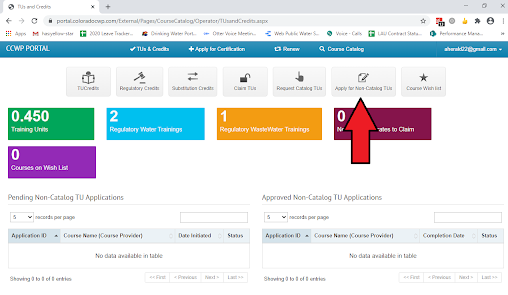
3. Operator applies for non-catalog training units

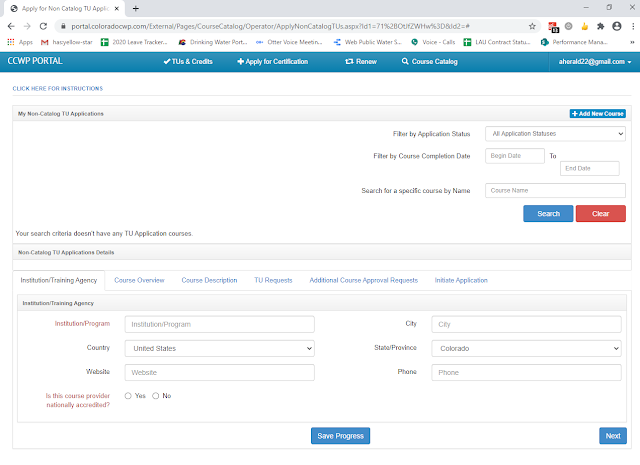
An operator who has taken relevant classes from an accredited institution, such as a community college, can use the “Apply for Non-Catalog TUs” button on the TUs & Credits page if the classes are not in the course catalog. An operator should always check the course catalog before applying for non-catalog TUs.


a) The operator needs to use the blue “Add New Course” button to provide information about the class. 


b) Operators will need to upload documentation verifying their participation in the training.

There is no charge to the operator for courses taken from accredited institutions.

An operator who has participated in a non-catalog training event, such as a conference in another state, will also apply for training units using the “Apply for Non-Catalog TUs” button. The operator must provide information about the course provider, as well as details about the training event. There is a $25 fee to cover the review of the training event for TU approval. 


➽Nancy Horan, Operator Certification Board Liaison