Pages

Showing posts with label Inspections. Show all posts

Wednesday, December 17, 2025

Coaches Classroom: Writing and Implementing a Storage Tank Plan


Over the last decade, since the Storage Tank Rule was adopted into the Colorado Primary Drinking Water Regulations, much progress has been made by Public Water Systems to protect their finished water quality by conducting more frequent and thorough tank inspections. 

Since that time, rule implementation has been clarified and improved via policies and tools as questions have arisen. These policies can be accessed through the Colorado Department of Public Health and Environment’s (CDPHE) storage tank website or by searching your favorite web browser for “CDPHE drinking water storage tank rule.” You can also try use these useful links: 

For new operators or systems who are unaware, a significant aspect of the rule specifies that systems create and implement a written plan for their inspections of these vital distribution assets. The written plan is a requirement that ensures all storage tanks after the entry point are adequately inspected and maintained, and that work is done within the timelines set forth in the regulation and done by qualified personnel. The importance of a written plan is that it helps guide you and your team through the entire storage tank rule by providing a roadmap that defines procedures and outcomes of the process.

Common questions operators and systems have regarding the Storage Tank Rule include:

Q: Who does it apply to?

A: Section 11.28 of the Storage Tank Rule states that all Public Water Systems (PWS) that utilize finished water storage tanks located after the entry point must comply with the requirements specified in this rule.

Q: Are storage tanks now inspected as part of the sanitary survey process?

A: Yes. The division reviews the tank inspection work being done by the public water system during sanitary surveys. All storage tanks, including finished water storage tanks, are subject to inspection during a sanitary survey, but these inspections do not take the place of the inspections that water systems need to complete. In addition, the system’s storage tank plan will be reviewed during the sanitary survey. 

Q: What are some of the other requirements of the rule?

A: As part of the rule, all public water systems must create a written storage tank plan, including inspection intervals.

  • Other aspects of the written plan are;
    • An inventory of finished water storage tank(s), including the following information for each:
    • Tank type and construction materials (e.g., elevated, buried, etc.). 
    • Volume in gallons. 
    • Approximate dimensions. 
    • Location. 
    • Number of inlets, outlets, overflows, hatches, and vents. 
    • Coating systems. 
    • Date put in service. 
    • Rehabilitation and major maintenance history. 

Q: Who oversees the certification requirements for storage tank inspections?  

A: In summary, there is no certification/license required for personnel conducting either periodic or comprehensive storage tank inspections. The PWS is responsible for vetting the individual or contractor that is inspecting their tanks to ensure that they are qualified and will be using the correct methods for inspection. More detailed information can be found in the Policy 15 if you have further questions.

Q: Is a tank cleaning the same thing as doing a comprehensive inspection?

A: No. Tank cleanings regardless of how robust do not constitute comprehensive inspections. Regardless of whether hired contractors or internal personnel are used to perform comprehensive inspections, a written preparation plan needs to be developed and utilized. To have the inspection count as a comprehensive inspection it must include a documented evaluation of sanitary, structural and coating systems conditions, as well as security and safety concerns. Please see Policy DW-015 section 4.11 for more information.

Q: Does the Storage Tank Rule apply to my clearwell?

A: Although the rule applies only to tanks after the designated entry point (EP), CDPHE recommends using a similar approach for all storage prior to the EP such as clearwells. When conducting Sanitary Surveys, inspectors are finding significant deficiencies associated with clearwells that are  similar to those found on tanks in the distribution system.

Q: What are some of the common tank deficiencies during sanitary inspections?

A: Common findings during Sanitary Survey Inspections of storage tanks include:

  • Improperly screened vents, damaged vent screens
  • Access hatches without complete gaskets or gaskets that have shrunk and do not seal against the frame.
  • Overflow pipes with missing screens or flap valves that do not seat and form a seal when closed. 
  • Failures of interior coatings 
  • Sediment buildup exceeding 1-inch

Q: What is a sanitary defect? If a sanitary deficiency or defect is found, how long do I have to fix the problem?

A: A Sanitary Defect as defined in Regulation 11, section 11.3(68) means a defect:

  • That could provide a pathway of entry for microbial contamination into the distribution system; or
  • That is indicative of a failure or imminent failure in a barrier that is already in place.

Examples of common sanitary defects found at storage tanks can be found in the CDPHE”s storage tank inspections checklists and drinking water policy 10 section 4.2. 

The timeline for fixing sanitary defects is determined by the supplier in the corrective action schedule section of the supplier’s storage tank inspection plan.  The schedule should be both reasonable and practical and is affected by various factors including: severity of the sanitary defect, complexity of the correction, tank accessibility and corrective action costs. Corrective action schedules range from short turnarounds for quick and easy corrections such as vent screen replacements to longer scheduled completions such as hatch replacements and possible longer completions for more complex corrections such as replacing a tank roof. We recommend identifying potential sanitary defects in DW policy 10 and the storage tank handbook to draft your corrective action schedule. 

Q: What should I do if I or my system finds something that is concerning during a routine inspection or an issue is reported to us?

A: In cases where contamination or defects are discovered within the distribution system that could adversely affect public health, suppliers of water should immediately notify CDPHE by calling the 24-hour incident Reporting Line at 1-877-518-5608. 


If you are looking for additional easy read information regarding the Storage Tank Rule, previous articles of Aqua Talk can be found by using the “Search This Blog” function at the right of this article.  

If you have not started the process of creating a storage tank plan or are stuck and needing assistance, the Local Assistance Unit (LAU) Coaches are here to help. Please reach out to us via the Online Assistance Request form and we will be happy to assist you through the process.

Steve Folle, Drinking Water Coach 

Wednesday, July 24, 2024

Storage Tank Roofs - Issues with Metal and Corrugated Metal Roofs

Since Colorado’s storage tank rule went into effect in 2016 we have published many articles on different aspects of finished water storage tanks. Today we would like to focus on another important potential avenue of contamination, corrugated and metal storage tank roofs. 

In recent inspections for systems that have tanks with sheet metal and corrugated metal roofs, the water quality control division (division) has seen an increase in issues with seals between the roof of the tank, and the tank walls, vents, and access hatches. Corrugated tank roofs are of particular concern due to the gaps created by their corrugated ridges. Below are some of our most important lessons learned about metal and corrugated tank roofs.

Corrugated Tank Roofs Can be Difficult to Seal

The voids created between the ridges of a corrugated roof and the walls of a tank can be difficult to effectively seal and may be a desirable shelter for rodents and other small animals. It is also much more challenging to correctly seal roof penetrations for things like tank vents in a corrugated roof. If your system has a preexisting tank with a corrugated roof the division recommends more frequent periodic inspections of these tanks with a particular focus on the seals around the corrugated materials. 


Figure 1 - Improper seal between two corrugated panels


Figure 2 & 3 - Gaps left between corrugated roof and tank walls that can allow rodents and bugs to enter the tank, creating a public health risk.


Figure 4 - Light is visible from the interior of a tank around a vent in a corrugated roof showing that it is improperly sealed.


Figure 5 - Improper seal around a tank hatch.

Expanding Foam is not an Effective Method to Seal Gaps in Tank Openings

Figure 6 - Foam used to seal the interior of a tank.

It is not uncommon to see expanding foam used to seal gaps in corrugated tanks because it can easily fill large gaps. The use of this foam can lead to potential public health risks and sanitary defects. Foam used in exterior gaps can degrade rapidly due to weather and may be used by small animals as nesting material. Foam that is used as a sealant on the interior of tanks may deteriorate and flake off into the water posing a contamination risk itself over time. Condensation collecting on the foam can leach contaminants and then drip into the drinking water.


Metal Tank Roofs Can be Challenging to Inspect

We have seen tanks with metal roofs where it isn’t possible to examine the interface between the walls of the tanks and the metal roof without an interior inspection. A dislocation or break in the gasket material or a warpage or dislocation of the metal panels could allow the entrance of contaminants such as plants, insects, birds, and small animals into the tank. A brief walk around a tank is not effective in finding potential openings. An extendable mirror can be helpful for looking at tough to see locations around all storage tanks.

Drinking Water Design Criteria for Tanks

The division has outlined the requirements for tank roofs in the design criteria. This section of the criteria is currency undergoing a stakeholder update process. If you are interested in receiving updates on this process or getting involved you can find more information on our Drinking Water Design Criteria webpage

New or modified storage tanks being submitted to the Department for approval must meet the design criteria. Also, the Department intends to update the design criteria to clarify that we will not approve tanks moving forward with corrugated metal roofing. However, during a sanitary survey an inspector will not issue a significant deficiency solely based on your existing tank not meeting the current design requirements unless there is a condition identified during the sanitary survey that is a potential threat to public health (examples include unprotected openings to tanks, missing/damaged screens, unsealed/un-gasketed hatches, improperly sealed tank roofs, etc.).


Figure 7 - Excerpt from the current Design Criteria for Potable Water Systems (2022 Edition)

Identification of Sanitary Defects and Risks to Public Health

If a supplier finds an animal or other concerning debris in an improperly sealed storage tank please contact the division’s emergency line at 1-877-518-5608 as soon as possible but within 24 hours of discovery. The drinking water acute team will consult with you on next steps.

If suppliers identify a sanitary defect, it must be documented upon discovery. Also, a corrective action schedule in accordance with the Storage Tank Plan must be developed to fix it as soon as possible. Take photographs before and after making repairs. By doing so, suppliers can avoid a violation for not correctly implementing the storage tank rule.

Sanitary defects that are discovered during sanitary surveys may be cited as significant deficiencies or possibly even as a Tier 2 (treatment technique) violation of the storage tank rule for permitting a known sanitary defect. The risk of violations is especially present for defects that should be ‘obvious’ to anyone performing a periodic tank inspection.

Additionally, if suppliers do not follow the corrective action schedule that they developed, they will also be in violation of the storage tank rule. Avoid violations of the storage tank rule by proactively identifying sanitary defects and then documenting that the supplier is following a corrective action schedule to fix them.

➽ Chelsea Cotton, P.E., Lead Drinking Water Engineer

Wednesday, June 26, 2024

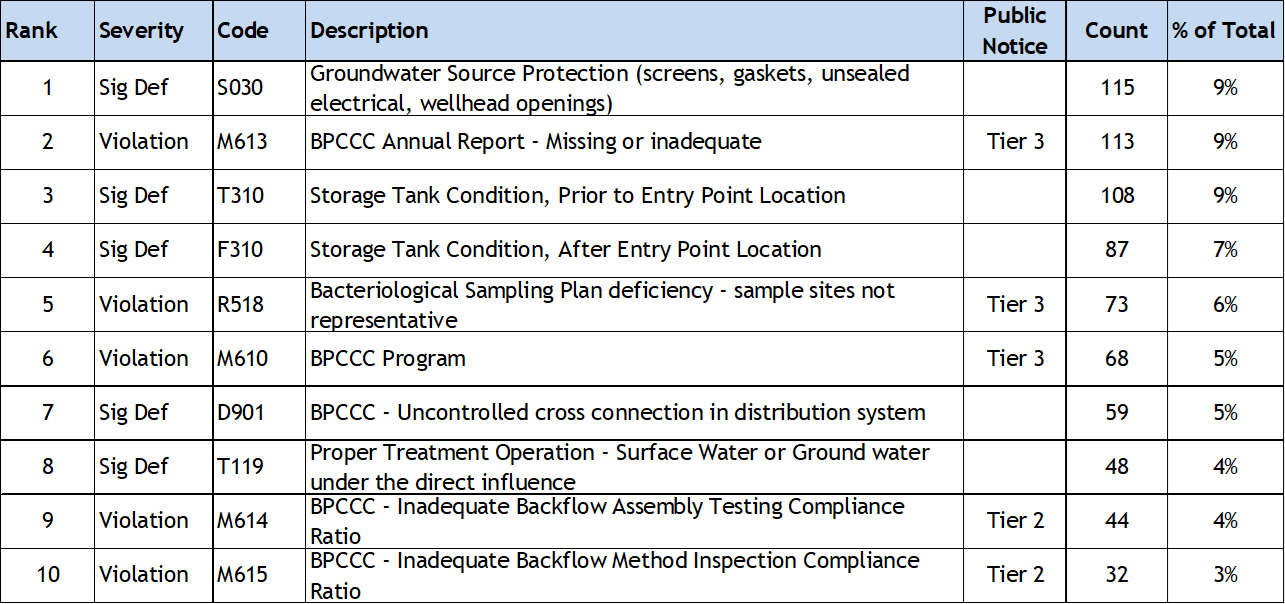
Most Frequently Cited Significant Deficiencies and Violations - Inspection Year 2023

The Field Services Section (FSS) wrapped up the 2023 inspection year (IY 23) in September 2023 and the new IY 24 inspection year started and is almost halfway over! We appreciate all the assistance from public water systems in completing 491 sanitary surveys in 2023. IY24 started October 1, 2023 and FSS inspectors have completed 297 site visits to date. In this article we will share the top 10 most frequently cited significant deficiencies and violations from IY23 and a sneak peek into IY24 trends to raise awareness and help operators identify and correct issues before they become a potential health threat or citations in a sanitary survey. 

According to Regulation 11, Section 11.3(72), a significant deficiency means: any situation, practice, or condition in a public water system with respect to design, operation, maintenance, or administration, that the state determines may result in or have the potential to result in production of finished drinking water that poses an unacceptable risk to health and welfare of the public served by the water system. Field-based Violations of Regulation 11 have either Tier 2 or Tier 3 public notice requirements that are dependent upon the severity of the violation and any potential public health effects, pursuant to Regulation 11, Sections 11.33(1)(a,b), 11.33(2)(a), 11.33(3)(a) and 11.33(4)(a). All issued notifications must comply with the general content and distribution requirements and notice reporting requirements that are included in Regulation 11.33(5),(6) and (7).

During the 2023 inspection year, 1,256 significant deficiencies and violations were cited in 491 sanitary surveys. The Top 10 most frequent inspection citations were:

Storage tank deficiencies (F310 and T310), in the distribution system and before the entry point (CT tanks) combined account for 16% of all citations in IY23 and 17% of all citations in IY22. Storage tank deficiencies can include improperly protected screens, hatches and overflows. This underscores the importance of robust routine tank inspections under the Storage Tank Rule and also for tanks that are used for contact time or before entry point. 

The next most frequently cited significant deficiency, with 9% of the total IY23 and IY22 citations, was for wellhead pathways of contamination (S030). This can include loose wellhead seals, missing or damaged vent screens, missing gaskets, broken/open electrical boxes/conduit, cracked sanitary seal plates and wellheads. 

Backflow prevention and cross connection control (BPCCC) has four violations and a significant deficiency that make the Top 10 list, including failure to develop BPCCC annual reports, failure to develop or implement the BPCCC program (both Tier 3 public notice violations), and failure to meet the assembly testing ratio and method inspection ratio which were a Tier 2 public notice violations. Combined, all the BPCCC violations and significant deficiencies make up 26% of the citations in IY23. In 2023 the Division streamlined the BPCCC rule with the Water Quality Control Commission and the assembly and method compliance ratios were combined. In IY24 the M614 and M615 violation codes were replaced with one code, the M619 for Inadequate Backflow Prevention Annual Compliance Ratio due to combining assembly testing ratios and method inspection ratio.

A newcomer to the Top 10 is the Bacteriological Sampling Plan R518 violation which can include not performing representative sampling of the distribution system, not having a sampling plan, not rotating sample locations or not following the plan. 

In IY24 to date, 673 significant deficiencies and violations have been cited. The majority of these citations are the same as the IY23 Top 10 with the addition of two other findings:

  • Violation R536 - MONITORING DISINFECTION (T3); Failure to Monitor Groundwater EP Residual Disinfectant.
  • Significant Deficiency T116 - GROUND WATER TREATMENT; Supplier could not demonstrate adequate operation of approved groundwater treatment processes which are being used for compliance with Regulation 11.

Please check your water systems for these issues to protect public health and avoid significant deficiencies and violations during your next sanitary survey. If you would like additional assistance on technical issues or sanitary survey preparation, please sign up for individualized coaching here.  For any questions or concerns about sanitary surveys please email our Field Services team at cdphe_wqcd_fss_questions@state.co.us. Thank you for all your efforts to protect public health!

➽ Heather Young, PE, CWP, Field Services Section Manager

Wednesday, December 20, 2023

Wellhead Deficiencies

In this article, we continue our discussion of the Top 10 most frequently cited significant deficiencies and violations to raise awareness and help operators identify and correct issues before they become a potential health threat or citations in a sanitary survey. At #2 in the Top 10, source construction deficiencies (S030) were cited 9% of the time during sanitary surveys for the 2022 inspection year and 9% in the 2023 inspection year. Groundwater wells are the most common sources of drinking water used in Colorado (70% of public water systems use groundwater wells) and are perhaps one of the most overlooked parts of water systems. Wells can go unnoticed for years since they are often located away from most activities and may only be noticed when the flow of water is altered. The most commonly discovered significant deficiencies with wells are related to electrical conduits, gaskets, vents and vaults.

What are the minimum standards for a properly constructed well? In the “State of Colorado Design Criteria for Potable Water Systems” (Policy DW005), CDPHE actually primarily refers to the Colorado Division of Water Resources’ (DNR) latest edition of “2 CCR 402-2 Rules and Regulations for Water Well Construction, Pump Installation, Cistern Installation, and Monitoring and Observation Hole/Well Construction” (a.k.a. Colorado Well Driller Regulations). The purpose of these regulations is to ensure public health and the safety of groundwater resources. The regulation outlines minimum construction standards for all types of wells in all types of environments, and it defines minimum well height, screening, minimum distance from potential sources of contamination, grouting standards, pump installation and much more.

There are many variations to well heads, but the two primary ones that inspectors come across are the “split-cap” and the “well-cap” (see image below for reference). The “split-cap” has the discharge line, vent and electrical conduit all protruding from the wellhead. The well head is comprised of two metal plates with a rubber gasket in between. When installed, the two plates are compressed, the rubber gasket expands and creates a watertight seal. The “well-cap” has a pitless water connection (below frostline) and a designated female electrical connection, a set of gaskets and a built-in vent (which are typically screened).


*photo courtesy of Oregon State University https://wellwater.oregonstate.edu/well-water/wells/well-check-list

Well head

Well heads must be designed and constructed at the top of well casings to prevent the entry of contaminants into the well. The majority of the wells that the department inspects are located outdoors and are exposed to the elements. It is vital that the wells are constructed and maintained in a manner that will protect the raw water. Some common issues that inspectors observe are missing/damaged gaskets, missing bolts, broken or loose well caps (bolts are missing or not tightened), split-caps not seated on the well casing properly and a split-cap with a rope (used to hold the well pump in position or to assist in pulling the pump out) coming out of the well that is not properly sealed.

The split-cap well head was not properly sealed to the well casing. The supplier applied caulking between the split-cap and the well casing.

The bottom of the well head cap was broken and did not allow for a tight seal. A new well head was installed.

Well Vents

Vents are an integral part of a well as they permit air to freely enter and exit the well. Vents need to be located at a minimum of one foot above ground level, be turned down and be covered with a non-corrodible screen. Screens may not have openings that exceed 0.07 inches (typically 12 or 16 mesh screen). 

The two most common issues observed with vents on wells are that they are broken or missing.


The well-cap has a built-in vent that was broken/corroded. The supplier replaced the broken screen with an acceptable mesh screen.

Electrical Conduit

According to the Colorado Well Driller Regulation, electrical connections are to meet the standards of the NFPA 70: National Electric Code (2014). Some common electrical conduit issues that are observed during sanitary surveys are where the electrical conduit has separated from the well head or the junction box which can typically occur due to the ground settling. Another common finding is missing or partially attached cover plates on electrical junction boxes. Split-cap wells can also have electrical wires penetrating the well top without a properly constructed conduit or a proper seal between the wire and the rubber gasket. All of these situations present a pathway for contaminants to enter the well, which pose a health risk and are significant deficiencies that will be cited during a sanitary survey.


The electrical conduit separated from the electrical junction box, creating an opening. The supplier installed a conduit sleeve to provide a watertight junction.


The electrical junction box was missing a screw. The supplier sealed the hole with caulk.


Split-cap well had the electrical wire enter from an unsealed port. The supplier sealed the gap with caulk.

Well Vaults

Although well vaults are not a common practice these days, the department still observes wells located in vaults. Placing a well in a vault was a common practice to protect the well from the elements. However, having a well in a vault can subject the well to flooding. If a well is located in a vault, the vault cover or lid must be watertight and the vault must either drain to daylight or have a sump. Evidence of water accumulating in the vault and potentially submerging the wellhead is a significant deficiency.


Well vault was subject to flooding. Supplier installed a sump pump.

Concrete Pads

Inspectors are frequently asked if concrete pads are required? The Colorado Well Driller Regulation along with the department do not recommend that wells have concrete pads with the exception of hand-pumped wells. Well pads were commonly installed if well depths were less than 100 feet or to keep vegetation down around the well head. However, the department has observed that concrete pads tend to attract animals that burrow underneath the pad creating a source of contamination. Concrete pads also tend to crack and shift, which can create a funnel effect and divert surface water to the well casing. Minor cracks can be repaired; however, the department recommends that a supplier remove their existing concrete pad if they notice animals burrowing or if the concrete pad begins to divert surface water to the well casing. Evidence of burrows under a concrete pad or severely damaged pads capable of channeling surface water to the well casing are significant deficiencies that would be cited during a sanitary survey.


Burrow located under the concrete pad, the burrow was filled in and will be monitored in the future.

Drainage and Slope

According to the Colorado Well Driller Regulation, well locations should incorporate proper positive drainage from the well casing. As a rule of thumb, the department has historically viewed positive drainage 20 feet in all directions from the well if possible. Wells should not be located in depressions as surface water can pool around the well casing and be a source of contamination. If a well is built on a slope, a berm is recommended uphill to divert runoff and surface water away from the well casing. 


Well was located in a depression that could allow for water to pool around the well casing. The supplier added pea gravel around the well head and created positive drainage away from the well casing.

For more information the department recommends that suppliers utilize DNR’s latest edition of “2 CCR 402-2 Rules and Regulations for Water Well Construction, Pump Installation, Cistern Installation, and Monitoring and Observation Hole/Well Construction” for proper well construction, maintenances and fixes. In addition, suppliers may email the Field Services team at cdphe_wqcd_fss_questions@state.co.us if they have any questions or concerns.

➽ Tom Valenta, CWP, Field Services Work Group Leader

Wednesday, May 3, 2023

Storage Tank Findings

In this article, we continue our discussion of the Top 10 most frequently cited significant deficiencies and violations to raise awareness and help operators identify and correct issues before they become a potential health threat or citations in a sanitary survey. Coming in at #1 in the Top 10, storage tank significant deficiencies (F310 and T310) were the most common findings cited during sanitary surveys for the 2022 inspection year. Storage tanks can be used for treatment to achieve log inactivation by providing contact time, or in the distribution system to help with water demand and pressure (tanks in distribution are subject to the Storage Tank Rule). The most commonly discovered significant deficiencies with tanks are related to access hatches and vents.

Access Hatches:

All water storage tanks must have at least one access opening to allow for routine inspections and, if applicable, inspections required under the Storage Tank Rule (Section 11.28 of Regulation 11). The access opening must be designed to protect the tank from contaminants such as: surface water infiltration, stormwater runoff, insects, rodents, and birds.

Access Hatches - Common Significant Deficiencies to check for and correct if found:

  • Improper use of gasketing or lack of gasket on the hatch lid 
  • Infiltration of water, debris or dirt from the hatch
  • Degrading or corroding hatch lids with pathway(s) for contamination
  • Hatches with unsealed penetrations (bolts missing, unsealed openings for level sensors, etc.)
  • Hatches flush with the ground or surface of the tank that can allow water, dirt or debris to enter the tank.

It is important to note that access hatches located outdoors or exposed to the elements must be fitted with a solid, water and insect tight, gasketed cover. It is recommended that the hatch overlap the framed opening, extend down around the frame, be hinged on one side, and have a locking device.

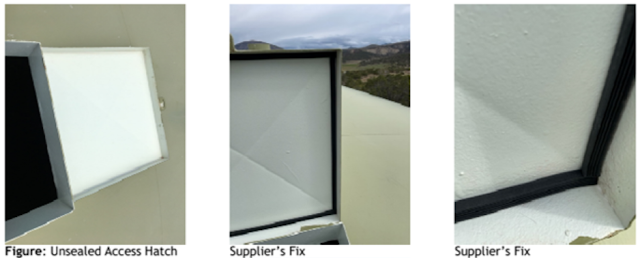
Below is a photo of an unsealed access hatch followed by a set of photos of a newly installed gasket. The supplier created a water and insect tight seal, effectively resolving the significant deficiency.


Below is a photo of a flush mounted hatch, which allows for potential contamination due to the lack of an overlapping framed opening. Note the channel on the interior of the hatch that can allow for water accumulation that can seep into the tank. These hatches are vulnerable to extreme weather conditions and contain potential points of failure. 

For additional discussion about flush mounted hatches - see our September, 2022 article.

Flush mounted hatches often contain drains, which frequently clog with debris, dust, dirt and insects. During heavy weather events, these clogged drains can cause water to pass through the gasket and leak into the storage tank, as seen below. 

The hatches above and below allow for insect activity and debris buildup close to or on the gasket, creating a potential for contamination. In the photo below, there are substantial spider webs surrounding the gasketed area of the hatch. 


Vents: 

Vents must be designed to protect the tank from contaminants such as: surface water, stormwater runoff, insects, rodents, birds, etc. All openings must be protected by a non-corrodible screen. Screens may not have openings that exceed 0.07 inches (typically 12 or 16 mesh screen). The screen must be installed within the vent at a location least susceptible to vandalism. The screen must be accessible for replacement. Vents must be designed for unobstructed air flow into and out of the tank.

Common Significant Deficiency to check for and correct if found (the following air vent conditions are not allowed):

  • Storage tanks with unscreened, open construction between the sidewall and the roof
  • Air vents that are not screened or that have damaged or blocked screens
  • Air vents with screens with openings that exceed 0.07 inches (typically 12 or 16 mesh screen)
  • Outdoor tanks with air vents that do not open downward or are not fully covered to protect from rainwater

Please keep in mind, the use of steel wool and/or stuffing steel wool into vents is not accepted as a proper form of screening a vent.

Below are photos of an interior tank lid that is improperly vented. The venting for these commonly found tanks function as a labyrinth preventing potential contaminants; however, the vent does not contain a mesh screen with openings that do not exceed 0.07 inches. With the addition of the mesh screen, the supplier now meets the requirement. Please note that indoor tanks must be vented and must be located at or above the highest point of the tank.


Vents on outdoor tanks must open downward. Downturned vents can be candy cane, mushroom style, or where no portion of the vent screen is visible from a horizontal position (e.g. vent in the side of a hatch assembly with louver protecting the vent). Any vent cover must overlap so that no horizontal pathway exists. Candy cane or downturned vents are allowed to have a visible screen (i.e. not covered) below the bottom of the vent opening as long as no direct horizontal pathway exists between the vent opening and the tank. When a mushroom type vent is used, the minimum opening distance must be measured from the lowest point on the vent cap to allow for air flow to enter the screened area. Integral vents on tanks (e.g., threaded cap on a polyethylene tank access lid) that do not have downturned screening are not allowed outdoors.

For outdoor elevated tanks, the vent elevation from the top of the roof should be a minimum of 24-inches above the top of the roof to prevent snow from clogging vents. The photos below show air vents on an outdoor tank that are screened but not downturned or fully covered to protect contamination from rainwater. 


Please note there are resource online to assist water systems in the operation and maintenance of storage tanks:

The supplier is responsible for complying with  Section 11.28 (Storage Tank Rule) of Regulation 11. Please note that if an inspector identifies any of these issues during a sanitary survey and they have not been previously identified as sanitary defects with a written corrective action schedule, they will be cited as significant deficiencies. If sanitary defects were identified by the supplier during a Storage Tank Rule periodic or comprehensive inspection but are not under a corrective action schedule or were not fixed in accordance with a corrective action schedule, a violation of the Storage Tank Rule may be cited during the sanitary survey.  It is highly recommended that the supplier’s inspection documentation include pictures of the “before” and “after” corrections for each sanitary defect.

Prior to making any alterations to tank venting the department recommends that the supplier consult with an engineer or a professional with expertise in potable water storage tanks to ensure that the tank’s venting capability is not compromised. Alternatively, the supplier can check with the manufacturer of the storage tank to see if any limitations exist for the component in need of alteration or repair. 

➽ Connor Clarke, CWP, Field Services Section

Wednesday, April 19, 2023

EPA Requirement to Address Cybersecurity in Sanitary Surveys

The US EPA Office of Water issued a memorandum, “Addressing PWS Cybersecurity in Sanitary Surveys or an Alternate Process” on March 3, 2023 to all State Drinking Water Administrators requiring cybersecurity evaluations during each sanitary survey. The EPA definition of sanitary survey is “an onsite review of the water source, facilities, equipment, operation, and maintenance of a PWS for the purpose of evaluating the adequacy of such source, facilities, equipment, operation, and maintenance for producing and distributing safe drinking water.” In Colorado, CDPHE conducts sanitary surveys of all public water systems (PWS) every 3 years for community systems and every 5 years for non-community systems. Colorado has been engaged with the Association of State Drinking Water Administrators (ASDWA) over the last year and with EPA’s issuance of the Memo, we are reviewing the newly published requirements and the below information summarizes what we know so far.

What systems are impacted?  

From the March 2023 EPA memorandum, cybersecurity evaluations must be included in the sanitary surveys for all PWSs that use industrial control system technology as part of the operation of the water system. In the EPA guidance document, “Evaluating Cybersecurity During Public Water System Sanitary Surveys” it states that industrial control systems include not only Supervisory Control and Data Acquisition (SCADA) systems, but also Programmable Logic Controllers (PLCs). Colorado does have some small transient water systems that are limited to a basic well and chlorinator, but the vast majority of PWSs in Colorado have industrial control systems in place.

What is being required?

In a nutshell, Colorado will be required to include cybersecurity as part of the sanitary survey process for all PWSs with industrial control system capabilities or establish a program outside of the sanitary surveys that is no less stringent than federal regulations and involves identifying and addressing significant deficiencies in cybersecurity. EPA outlined three options for conducting the assessments:

  1. PWS self assessments/third party assessments followed by a sanitary survey
  2. State conducted assessments during the sanitary survey
  3. An alternative program that meets the requirements. 

EPA recognizes that flexibility will be needed and states may choose one or more options to best meet their needs. For cybersecurity, EPA considers significant deficiencies to include the absence of a practice or control, or the presence of a vulnerability, that has a high risk of being exploited, either directly or indirectly, to compromise an operational technology used in the treatment or distribution of drinking water. The Colorado Primary Drinking Regulations (Regulation 11), Section 11.3(72) defines a significant deficiency as: any situation, practice, or condition in a public water system with respect to design, operation, maintenance, or administration, that the state determines may result in or have the potential to result in production of finished drinking water that poses an unacceptable risk to health and welfare of the public served by the water system. Water systems have to either fix significant deficiencies and violations no later than 120 days after the date of the inspection letter or request a corrective action plan (CAP). If the water system does not fix a significant deficiency by 120 days or an approved CAP schedule, a violation (type 45 violation) requiring Tier 2 public notice occurs. 

When is this taking effect?

EPA has stated that the memorandum was effective as of the date of publication, however, states will need time to build the capacity to implement the requirements. Colorado does not have the capacity to implement these requirements as part of the sanitary survey process during this current inspection year or the upcoming inspection year starting in October 2023. Colorado is evaluating the best path forward for our state at this time in coordination with CDPHE leadership, other states and ASDWA.

What can systems do in the meantime?

All PWSs with industrial control system capabilities should assess their cybersecurity programs with an established method if they have not already done so. EPA guidance recommends that self assessments be conducted with established methods such as those from the Department of Homeland Security (DHS), Cybersecurity and Infrastructure Security Agency (CISA), National Institute of Standards and Technology (NIST), the American Water Works Association (AWWA), International Organization for Standardization (ISO), or International Society of Automation/International Electrotechnical Commission (ISA/IEC). The PWS should implement measures recommended from any assessment to ensure continued production and distribution of safe drinking water. Depending on the approach CDPHE takes, the self assessment reports may be required to be submitted to the inspector prior to the sanitary survey in the future for determination of potential significant deficiencies. 

Additional resources can be found: 

Colorado recognizes that PWSs are among the  targets of malicious cyber activity and is committed to partnering with water suppliers on this issue going forward. Many large utilities have robust cybersecurity programs in place. Many small to medium size systems will need to build cybersecurity capacity. If you have any questions or concerns as we determine the implementation path, we’d like to hear from you. Please contact either Heather Young at heather.young@state.co.us or Cameron Wilkins cameron.wilkins@state.co.us of the WQCD Field Services Section. For cybersecurity training resources, please contact Kyra Gregory at kyra.gregory@state.co.us.

➽ Heather Young, PE, CWP, Field Services Section Manager

➽ Cameron Wilkins, PE, Field Unit II Manager

Wednesday, March 15, 2023

Coming Down the Pipe - TMF R541 Observation

During sanitary surveys, the Field Services Section (FSS) has encountered serious significant deficiencies at water systems such as tanks with collapsing roofs, major water loss in raw water transmission lines and distribution systems, or evidence at water treatment plants of a substantial lack of preventative maintenance. Many of the systems experiencing these major issues are small community water systems struggling to manage a water system and keep up with replacement of aging infrastructure. Fundamental to this issue is Technical, Managerial, and Financial (TMF) Capacity of a public water system (PWS). TMF capacity, also known as Capacity Development, is part of the 1996 Safe Drinking Water Act (SDWA) Amendments. Capacity Development is a process for PWSs to build technical, managerial and financial (TMF) capacity to be able to continuously provide safe drinking water to the public. Activities involved with developing adequate TMF capacity include items such as asset management, financial planning and water rate setting in addition to managerial and technical capacity as shown below:  

Source: US EPA - Building the Capacity of Drinking Water Systems

As inspectors work with PWSs during the sanitary survey process, they may ask basic questions regarding TMF actions that the PWS has implemented. If a PWS has TMF capacity areas of improvement, a new observation will be listed in the inspection report. This observation will be coded as R541 TMF and will explain the importance of TMF and provide links to resources that are available to PWSs. Water system operators may find it helpful to review this observation with system ownership and management to gain support to undertake needed TMF capacity development activities and get help as discussed below.  

Please note that Regulation 11.4.1 also requires all new community or non-transient, non-community water systems commencing operations after October 1, 1999 to receive Department approval of a TMF capacity assessment using the criteria found in the New Public Water System Capacity Planning Manual (Drinking Water Policy 11). Please reach out to the WQCD Engineering Section at CDPHE.WQEngReview@state.co.us for any questions regarding new PWS TMF requirements.

Resources: 

➽ Heather Young, PE, CWP, Field Services Section Manager

➽ Tom Valenta, Field Unit III Work Group Lead 

Wednesday, February 15, 2023

Drinking Water Sanitary Survey Follow Ups and Compliance - What you need to know

The Field Services Section (FSS) works with public water systems on sanitary survey inspections to ensure the production and distribution of safe drinking water. Just as water systems have inspections on a routine basis, our program also gets “inspected” by the Environmental Protection Agency (EPA) Region 8 to ensure that we meet federal requirements. Starting in 2021, EPA Region 8 conducted an audit of 86 sanitary surveys across 43 large community public water systems in Colorado. In September 2022, EPA Region 8 provided their final report. Overall, the report highlighted some of the WQCD sanitary survey processes as best practices such as public notice for field based violations, our online records system and our sanitary survey report quality. The report also  includes areas where we need to improve on sanitary survey follow ups. Going forward, we'll be working on those areas of improvement with a focus on the items below.


Type 45 Violations for Unresolved Significant Deficiencies:

Regulation 11, Section 11.3(72) defines a significant deficiency as: any situation, practice, or condition in a public water system with respect to design, operation, maintenance, or administration, that the state determines may result in or have the potential to result in production of finished drinking water that poses an unacceptable risk to health and welfare of the public served by the water system. Water systems have to either fix significant deficiencies and violations no later than 120 days after the date of the inspection letter or request a corrective action plan (CAP). If the water system does not fix a significant deficiency by 120 days or an approved CAP schedule, a violation (type 45 violation) occurs.

The EPA audit found that the WQCD was not consistently issuing 45-violations when necessary and must issue compliance advisories and treatment technique (type 45) violations in situations where a significant deficiency is overdue and unresolved. Please note that type 45 violations require Tier 2 public notice by the supplier within 30 days of receipt of the violation letter from the Compliance Assurance Section and every 90 days thereafter as long as the significant deficiency remains unresolved. Please avoid this situation and protect public health by fixing significant deficiencies. For significant deficiencies that need more time for engineering evaluations, financing and construction, a Department-approved CAP may be an option. 

Department-approved corrective action plans (CAPs):

For significant deficiencies and field violations that need more than 120 days to fix, the water system can request a Corrective Action Plan (CAP). The CAP request must include the actions the supplier will take to fix the significant deficiencies and/or violations and the schedule for completing the actions. Field Services then reviews the CAP proposal and, if appropriate, issues an approval letter. Any changes to the CAP or CAP schedule also need to be approved prior to the CAP expiring. If you are in compliance with your CAP, you may avoid the Type 45-violation with Tier 2 public notice. However, it is very important to know that community water systems still have to include any unresolved significant deficiencies and their approved CAP schedule in their annual Consumer Confidence Report.

CAP schedules are normally limited to a year unless special circumstances such as financing, engineering design and construction need additional time. Also, interim measures to protect public health may be required at any time during the CAP process. The EPA audit identified that extended timelines CDPHE allowed for unresolved significant deficiencies as a concern. As part of our follow up improvements, CAPs that are expired will no longer be repeatedly renewed. Please reach out to your inspector if you have any questions about CAPs. 

Thank you for all you do to protect your customers by resolving significant deficiencies and field violations. To see the compliance status for your water system, please look at your monitoring schedule available online at the division's monitoring schedule webpage. If you need help on technical issues or sanitary survey significant deficiencies and violations, please reach out to your inspector or sign up for individualized coaching hereFor any questions or concerns about sanitary surveys, please email our Field Services team at cdphe_wqcd_fss_questions@state.co.us.

Thank you for all your efforts to protect public health!

 Heather Young, PE, CWP, Field Services Section Manager

 Nicole Graziano, PE, Compliance Assurance Section Manager