Pages

Showing posts with label Coming down the pipe. Show all posts

Wednesday, July 8, 2026

PFAS Rule Updates: Extended Deadlines and What They Mean for Colorado Water Systems

The EPA is proposing revisions to the federal PFAS Drinking Water Rule, introducing significant changes that will provide Colorado drinking water systems with more flexibility and time to meet compliance standards. Here is what public water systems need to know about the upcoming changes and how the department is responding to keep Colorado aligned with federal standards.

What is changing for water systems?

Originally, the PFAS Rule required systems to comply with new maximum contaminant levels (MCLs) for six chemicals and a Hazard Index by April 1, 2029. Under the EPA’s proposed revisions announced in May 2026:

  • Four chemicals and the Hazard Index may be dropped: The EPA plans to rescind the regulatory requirements for PFHxS, PFNA, HFPO-DA, PFBS, and the Hazard Index mixture.
  • More time for PFOA and PFOS: The EPA is proposing a modified exemption process to give eligible water systems up to two additional years to meet PFOA and PFOS MCL requirements, pushing the compliance deadline to 2031. This extension framework is largely driven by the significant capital costs, supply chain constraints, and workforce limitations systems face when designing and installing new treatment facilities.
  • Interim measures and public notice: An exemption gives systems more time, but requirements during that extension period are dependent on a system's specific PFOA or PFOS levels: 
    • 12 parts per trillion (ppt) and above: If a system’s PFOA or PFOS levels equal or exceed 12 ppt, they must implement at least two interim control measures. These can include public education efforts and operational adjustments, like blending water sources, or providing point-of-use solutions directly to consumers, such as certified pitcher filters.
    • Between 4 ppt and less than 12 ppt: If a system's PFOA or PFOS levels are above 4 ppt and less than 12 ppt, the proposed framework does not require them to implement interim control measures during the exemption period.
    • Regardless of contamination levels, all exempted systems will be subject to public notice requirements to ensure their communities remain informed while long-term treatment solutions are built.

(Note: Without an approved exemption, suppliers will still be required to meet the original April 1, 2029 deadline).

What is the department doing?

Because the EPA signaled that these revisions would occur after the deadline for states to submit primacy applications, the EPA strongly encouraged states to request an extension. The department officially requested a six-month primacy extension this spring. This is an administrative step that provides us with the necessary time to review the EPA’s proposed changes and ensure Colorado’s exemption process aligns with the new federal framework. This extension does not impact public drinking water systems or alter the department’s enforcement oversight. It simply ensures our regulatory authority remains intact before the federal rule takes full effect in April 2027.

What are the next steps?

We will continue to update systems as the EPA finalizes these revisions. Currently, the department is communicating directly with the EPA regarding these drafts and the practical feasibility of implementing these PFAS exemptions at the state level.

Importantly, the proposed extensions and revisions do not change immediate testing deadlines. Suppliers must still comply with the initial monitoring requirements for the six PFAS chemicals by April 1, 2027. To satisfy this requirement, systems must complete monitoring and report the results of either two or four samples (depending on system size and source water type) per entry point. If a supplier has completed all required initial monitoring, they should check their monitoring schedule and AIMS Tool to ensure initial monitoring results have been accepted and marked complete. 

For more information, visit the department’s PFAS rule webpage, sign up for future PFAS Rule email notifications, or email cdphe_wqcd_DWrules@state.co.us.

➽ Bryan Pilson Technical, Regulatory Implementation and Coordination Unit Manager

Thursday, November 6, 2025

Inspection Year 26 is Here!

The Field Services Section (FSS) wrapped up Inspection Year 2025 (IY25), completing 496 sanitary surveys and four (4) Level 2 assessments/sanitary surveys. We would like to extend a big “Thank You” to all the water suppliers and operators for all their help in making IY25 a success! 

After one inspection year ends, another starts, and the new Inspection Year 2026 (IY26) started on October 1, 2025 and will end on September 30, 2026. A total of 555 sanitary surveys are planned for IY26. The list of suppliers included in the IY26 sanitary survey plan takes into consideration a number of factors including:

  • Last sanitary survey date and EPA required frequency for sanitary surveys - community water systems are required to have a sanitary survey every 3 years, non-community systems are required to have a sanitary survey every 5 years.
  • Recently activated public water systems are prioritized for sanitary survey.
  • Other conditions or concerns may also lead to a prioritized sanitary survey.

Please note that if your system is due for a sanitary survey, your inspector will be reaching out to you to schedule the survey anytime during the IY26 inspection year (October - September), and that the scheduling is not based on the date of the previous inspection (i.e., will not be in March or after March every 3 years).

The Field Services Section also performs Level 2 assessments or Level 2 sanitary surveys as they are triggered under the Total Coliform Rule. Level 2 assessments are triggered by either an E. coli MCL violation or two Level 1 assessment situations occurring within 12 consecutive months. Level 2 assessments are site visits that include review and identification of atypical events that could affect distributed water quality or indicate that distributed water quality was impaired. Items also evaluated include changes in distribution system maintenance and operation, including water storage, that could affect distributed water quality, source and treatment considerations that affect distributed water quality, existing water quality monitoring data, and inadequacies in sample sites, sampling protocol, and sample processing. Level 2 sanitary surveys (L2SS) are a combination of the Level 2 assessment and a sanitary survey. Level 2 assessments/sanitary surveys must be performed within 30 days of the date of issuance of the violation that triggered the Level 2 assessment. More information on Level 2 assessments can be found in Regulation 11.16 - the Total Coliform Rule. Thankfully, due to Colorado’s disinfection requirements and the great work by our operators, we had only four (4) L2SS occur in IY25, and typically we experience under five (5) of these events a year. Compared to other states that do not require a minimum disinfection concentration in the distribution system, this number is very low. 

Field Services recommends that suppliers take advantage of the free sanitary survey preparation course from the Local Assistance Unit. Operators who participate will receive 0.3 training units. The training provides concrete steps for your system to prepare for your next sanitary survey including:

The ability to recognize, address, and eliminate potential violations and system deficiencies

Actions to take to address potential violations and system deficiencies before your survey

If you are interested in this FREE training, please visit this document and click on the date that you would like to attend and fill out the associated registration form. Please reach out to cdphe.wqdwtraining@state.co.us with any questions or feedback, or if you do not receive an invitation email.

For any questions or concerns about sanitary surveys, please email our Field Services team at cdphe_wqcd_fss_questions@state.co.us. We look forward to working with you on your next sanitary survey, and thank you for all your efforts to protect public health!

➽ Heather Young, PE, CWP, Field Services Section Manager

Wednesday, July 30, 2025

EPA PFAS Rule Update: What Colorado Water Systems Need to Know

The division is closely monitoring recent developments from the EPA regarding its 2024 drinking water PFAS Rule. While the EPA has signaled potential changes to the regulation, the official rulemaking timeline remains unchanged, with Colorado’s adoption scheduled for August 11, 2025. The division is committed to maintaining clarity for water systems and intends to highlight this federal uncertainty in its Statement of Basis and Purpose that is part of the rulemaking. The division is committed to communicating with water systems when federal action occurs and proposing revisions to Colorado’s PFAS rule to align with federal requirements before the Water Quality Control Commission.

Resources: 

EPA’s Announced Changes

In May 2025, the EPA announced that it may significantly revise the 2024 PFAS Rule. Proposed changes include:

  • Removing and reconsidering regulations for four PFAS compounds: PFNA, PFHxS, HFPO-DA (GenX), and PFBS.
  • Retaining Maximum Contaminant Levels (MCLs) and monitoring requirements for PFOA and PFOS only.
  • Eliminating the Hazard Index concept and its associated MCL for PFAS mixtures.
  • Extending the compliance deadline for PFOA and PFOS MCLs from 2029 to 2031.

These changes are planned to occur via a revised PFAS Rule proposal in Fall 2025, and anticipated finalization in Spring 2026.

It’s important to note that, so far, EPA’s announcement has not indicated changes to the requirements for initial monitoring of six PFAS compounds by the April 2027 compliance deadline.

Colorado’s Approach

Colorado is moving forward with adopting the PFAS rule this summer to retain full Safe Drinking Water Act primacy. This ensures that the division, not EPA, will continue to oversee PFAS compliance, monitoring, and enforcement across Colorado systems.

To account for the evolving federal landscape, the division has included a “federal flexibility provision” in its rule language. This provision allows for the automatic extension or stay of any deadlines or requirements altered by the final federal PFAS Rule, minimizing disruption for water systems.

Why Primacy Matters

Colorado’s decision to adopt the rule in 2025 avoids a primacy extension agreement with EPA. Under such an agreement, EPA would have authority over PFAS compliance while the state catches up. This would fragment regulatory oversight, complicate compliance for Colorado’s water systems, and limit our decision-making authority during this period. We believe that the division can provide the best decisions for water systems and their customers in Colorado.

The division’s experience with the Lead and Copper Rule Revisions (LCRR) demonstrated the benefit of timely rule adoption. Being one of the few states to implement LCRR on schedule allowed the division to retain control and better support systems through technical and operational challenges. The same advantages apply here.

Operational Implications for Water Systems

Drinking water data across Colorado shows that PFOA and PFOS are the primary PFAS compounds detected in public water supplies in Colorado. The removal of other compounds from the federal rule should not change which systems require PFAS treatment in Colorado. However, there may be impacts to treatment plant design and operation, which the division will work to consider during rule implementation.

In the meantime, systems are encouraged to stay engaged and continue monitoring for PFAS to meet initial monitoring requirements. The division will provide ongoing updates and technical assistance throughout this evolving process.

Stay Informed

The division is committed to supporting Colorado’s water systems during this transition. As the revised federal rule develops, Colorado will adapt, but always with the goal of maintaining clarity, consistency, and strong public health protections.

➽ Haley Orahood, Regulatory Development and Implementation Specialist

Wednesday, December 11, 2024

Coming in 2025: Renewing the General Permit for Water Treatment Plant Wastewater Discharges (COG641000)

The division is in the process of renewing the general permit for Water Treatment Plant Wastewater Discharges (COG641000). This permit was last renewed on November 1, 2005 and has been administratively continued and remains in effect beyond the expiration date of October 31, 2010. The general permit covers discharges of wastewater from drinking water treatment plants such as filter backwash water, to surface waters of the state and/or groundwater that is hydrologically connected to surface water. For this renewal, the division conducted a stakeholder process that included public meetings on March 14, 2023, April 5, 2023, June 6, 2023 and April 2, 2024. All current permittees were invited to participate in the stakeholder engagement process. Once a draft of the general permit is complete, it will be noticed for public comment in 2025. Following the public comment period, the division will respond to public comments in writing and make any applicable changes to the draft. Then the division will issue the final general permit and begin the process of renewing all the existing permit certifications.  

For more information, consult the division’s webpage about the COG641000 updates.

➽ Engineering Section and Clean Water Program Permits Section

Wednesday, October 2, 2024

Storage Tank Rule Guidance and Checklist Updates Underway

In 2020, the division worked with stakeholders to develop the updated Storage Tank Rule regulation and Policies DW-010, DW-012 and DW-015 that accompany the regulation updates. The Commission approved all proposed modifications in August 2020 and the regulation updates were effective on October 1, 2020. The Storage Tank Rule (Regulation 11, Section 28) protects public health and public water systems from potential contamination associated with unprotected storage tanks within the public water system’s drinking water distribution system. 

The Field Services Section is actively working on finalizing the Storage Tank Guidance and the periodic and comprehensive inspection checklists to reflect the 2020 Storage Tank Rule updates. The updates to the checklist will incorporate feedback inspectors have received from operators in the field during sanitary surveys. We hope that the updated checklist will be a clear, concise and useful tool for operators when conducting the periodic and comprehensive inspections that are key in ensuring safe drinking water.   

The goal for publishing the updated Storage Tank Rule guidance and checklists on our website is December 2024. If you have questions regarding implementation of the Storage Tank Rule, please email the Field Services Section at cdphe_wqcd_fss_questions@state.co.us. The department, operators and the supplier share the same goal – “Always Safe Drinking Water”.  

➽ Heather Young, PE, CWP, Field Services Section Manager

Wednesday, August 7, 2024

PFAS Wastewater/Biosolids Sampling - SB20-218


Image courtesy of Michigan Department of Environment, Great Lakes, and Energy

The Department of Public Health and Environment (CDPHE) is pleased to announce a new program offering wastewater and biosolids facilities free lab analysis of wastewater and biosolids samples for PFAS. The program will be available during fiscal year 2025 (July 1, 2024 thru June 30, 2025) and funding dependent moving forward. To request a sample kit, please complete the Wastewater/Biosolids PFAS Sampling Request form located on the PFAS grant program webpage

The division has been implementing a proactive approach to control PFAS contributions to the environment that includes measuring and trying to understand levels of PFAS in biosolids and wastewater. The concept is to identify and reduce significant sources of non-domestic PFAS entering wastewater treatment facilities.

For more information visit the CDPHE's PFAS website and PFAS and Biosolids website

➽ Sierra Mitchell, PFAS Program Coordinator

Wednesday, June 12, 2024

Optimize corrosion control treatment NOW! Get it done now to put yourself in the best position for LCRI

In late 2023, EPA released the proposed Lead and Copper Rule Improvements (LCRI). See this article for more information on the proposed LCRI.The LCRI is intended to improve upon the requirements promulgated in early 2021 in the Lead and Copper Rule Revisions (LCRR). The LCRR/LCRI will affect more than 1,050 community and non-transient, non-community public water systems in Colorado, serving nearly 6.5 million people. The LCRI public comment period is closed and EPA is planning to finalize the rule in October 2024. The LCRI compliance date is estimated to be late 2027. This gives water systems time to prepare and optimize their corrosion control treatment (CCT) before the LCRI requirements take effect. 

What is corrosion control treatment (CCT)? CCT is chemical treatment at the water treatment plant that makes the potable water less corrosive to water lines and premise plumbing. CCT is typically achieved by adding a phosphate-based corrosion inhibitor or with pH/alkalinity adjustment. The Lead and Copper Rule (Section 11.26 of Regulation 11) requires installation of CCT for systems with action level exceedances (ALE) and requires optimal corrosion control treatment (OCCT) for all systems serving more than 50,000 people. Approximately 65 systems in Colorado are operating OCCT with Department set optimal water quality parameters (OWQP) to comply with the current Lead and Copper Rule. 

Several changes in the proposed LCRI may impact systems that either have corrosion control treatment (CCT) installed currently or that may need to install CCT as a result of elevated lead or copper levels. Proposed LCRI changes that may impact CCT include:

  • Setting a lower lead action level at 10 parts per billion (ppb).
  • 1st and 5th liter lead sampling at lead service lines may result in higher lead levels than seen under the current rule. 
  • Corrosion control study required for large systems without OCCT that exceed the practical quantitation limit (PQL) of 5 ppb based on 90th percentile lead levels.
  • Medium and large systems with lead service lines that are required to conduct a corrosion control study must use harvested lead pipe in a pipe loop rig.
  • Deferred OCCT installation or re-optimization for systems that replace 100 percent of lead service lines within five years of the date they trigger CCT steps.
  • Removal of hardness as a corrosion control treatment option and specifies any phosphate inhibitor must be orthophosphate.
  • Small system compliance options (e.g., point of use devices, replacement of all lead-bearing plumbing materials) for community water systems with 3,300 people or less and all non-transient, non-community systems.
  • Review of CCT during sanitary surveys.

While these changes were part of the proposed LCRI, we will need to wait for the final rule to see if all of these items are included and if new items are added. Also, under the proposed LCRI, water systems will also have to provide Tier 1 public notice to consumers within 24 hours after a lead action level exceedance.

Possible actions to take:

  • Review your 90th percentile lead results: One of the key changes in the draft LCRI is setting the lead action level at 10 ppb; the current lead action level is 15 ppb. Since 2010, approximately 115 systems had 90th percentile lead levels that were between 10 ppb and 15 ppb. Investing in operational controls, treatment, and/or treatment optimization now may allow you to lower your lead levels below the 10 ppb action level before the LCRI takes effect.  
  • Evaluate treatment at large systems that are deemed optimal: Systems that have a population of more than 50,000 people “large systems” are required to have optimal corrosion control treatment (OCCT). The majority of Colorado’s systems that serve over 50,000 people have been “deemed” to have OCCT based on low source water lead and 90th percentile lead concentrations less than 5 ppb. The proposed LCRI requires large systems with a 90th percentile lead value greater than 5 ppb to complete a corrosion control study (CCS). For systems with lead service lines, the proposed LCRI requires the CCS be completed using harvested lead lines in a pipe loop. Many large systems have treatment processes that may impact corrosion. If possible, you should work on optimizing any existing treatment to lower lead levels as much as possible. 
  • For systems with CCT,  determine if you can optimize your treatment process: Analyze your treatment process and determine if your corrosion control treatment could be optimized. A great tool for this is a bench scale immersion coupon study.  
    • pH/alkalinity CCT systems: Systems using pH/alkalinity adjustment may want to more tightly control pH and/or find the optimal target pH. The EPA guidance document recommends a pH range at the entry point of 0.4 s.u. (for example: 7.8 to 8.2 s.u.) and a 0.6 s.u. range within the distribution system. Maintaining a tighter pH range may also improve other water quality contaminants such as disinfection byproducts. Conducting an immersion study to determine the optimal pH target may also be beneficial.
    • Phosphate-based inhibitor systems: Phosphate-based inhibitor systems may want to optimize their dosing. Orthophosphate is the chemical that is effective at corrosion control and the EPA generally recommends a minimum orthophosphate concentration of 1.0 mg/L as PO4 in the distribution system. Blended phosphate inhibitors are a blend of orthophosphate and polyphosphates, which are typically used to sequester iron and manganese. These systems may want to review the percentage of orthophosphate in their chemical to better control corrosion. A bench scale immersion coupon study may be advantageous to determine the more effective dose and/or chemical.  
  • Systems with CCT and OWQPs should review their OWQPs: Systems with OWQPs should review their monitoring schedule to verify the required OWQPs at the entry point(s) and in the distribution system. You may want to request an OWQP modification if you have additional water quality data or immersion coupon study results. 

Making changes to your CCT now can help you meet the LCRI requirements that are coming down the pipe. If you have any questions, please contact Melanie Criswell at melanie.criswell@state.co.us.

Resources:

➽ Melanie Criswell Lead Service Line, Corrosion, and Emerging Contaminants Engineer

➽ Haley Orahood Regulatory Development and Implementation Specialist

Wednesday, March 13, 2024

Coming Down the Pipe: Lead and Copper Rule Revisions Components Effective October 2024

Image: lead goosenecks 
We recently published this article about the proposed Lead and Copper Rule Improvements (LCRI). In general, LCRI is intended to improve upon the requirements promulgated in early 2021 in the Lead and Copper Rule Revisions (LCRR). EPA is planning to finalize the LCRI in October 2024 and extend the compliance dates for most of the requirements that were initially placed in LCRR. However, EPA plans to retain the October 16, 2024 compliance date for several requirements associated including: submitting the initial Lead Service Line Inventory (LSLI), Tier 1 public notice after a lead Action Level Exceedance (ALE), and notification of service line material. Let’s take a closer look at what is Coming Down the Pipe (pardon the pun) in 2024 with respect to these key provisions.

Colorado is one of just a handful of states that adopted LCRR into its primary drinking water regulations. Collectively, the department and stakeholders learned a lot about the rule during that process, so we are well-positioned to tackle LCRI after it becomes final later this year. The Water Quality Control Commission replaced the Lead and Copper Rule in Section 11.26 with the Lead and Copper Rule Revisions in Section 11.17 in the Colorado Primary Drinking Water Regulations (Regulation 11). The department carefully structured LCRR so that different elements of the rule will have effective dates that align with LCRI. The requirement to complete an initial lead service line inventory by October 16, 2024 will go into effect immediately, whereas requirements that may be modified by LCRI, such as tap sampling requirements, could have a delayed effective date.

The requirements associated with the initial LSLI can be found in Section 11.17(2) and these cover inventory development, public availability, and consumer notification and reporting. The LCRI includes enhanced requirements for the LSLI including more regular updates and adding service line connectors (e.g., pigtails and goosenecks) to the inventory, plus additional requirements to confirm non-lead status. These enhanced requirements will likely need to be included in a “baseline inventory” due in 2027. Water systems can still complete their initial LSLI under the requirements specified in LCRR.  To help water systems meet LSLI requirements, the department (in consultation with stakeholders and the help of contract support) developed drinking water Policy 018 to guide that process. Additionally, the department has a grant program in place to help larger systems serving 7,500 people or more with inventory efforts and has already awarded about $550,000 to help water systems. Systems serving 15,000 people or less can request LSLI technical assistance from the department's contractor, WSP and Sunrise Engineering, at no cost to the system.. While the LCRI is not fully effective, we recommend that systems keep the draft rule in mind as they develop their inventories. If opportunities arise to collect information on connectors, for example, we believe that it would be a good idea to gather and retain that information.

A key aspect of LCRR that will become effective in October 2024 is the requirement for 24-hour Tier 1 public notification of a lead ALE, outlined in section 11.17(3)(k). Water systems must notify the department of the exceedance as soon as possible but no later than 24 hours after the exceedance occurs, and distribute Tier 1 public notice as specified in 11.33. The LCRI is also proposing to reduce the lead action level from 15 to 10 parts per billion (ppb), but it is not entirely certain when the effective date for that change will be. However, the provision in 11.17(3)(k) will apply to whatever action level is in effect at the time of the exceedance. We recommend that systems prepare for this possibility even if they do not have lead service lines as about half of the ALEs in Colorado occur at systems without lead service lines. Additionally, taking steps to improve corrosion control can improve public health protection and lower the risk of an ALE. Talk to your compliance specialist to determine if any planned modifications necessitate a design review by the department. 

Another element of the LCRR that will become effective in October 2024 is the requirement for water systems to notify consumers with a lead, galvanized requiring replacement, or unknown service line of the material type, ways to reduce lead exposure from drinking water, and opportunities for replacement or identification of the line (see section 11.17(2)(c)). The department encourages water systems to notify consumers of their service line material as soon as possible after the material is identified. 

Navigating the complicated landscape established by LCRR and then LCRI will be challenging for all of us. By working together, we can do our best to protect public health by lowering lead levels in tap water. 

Thank you.

➽ Ron Falco, P.E. Safe Drinking Water Program Manager 

➽ Haley Orahood Regulatory Development and Implementation Specialist

Wednesday, January 17, 2024

Program Manager Message: Draft Lead and Copper Rule Improvements (LCRI) Considerations

In late 2023 EPA published its draft Lead and Copper Rule Improvements (LCRI). The intent of this update to the Lead and Copper Rule Revisions (LCRR) is, as the name implies, an effort to improve the nation’s approach to reducing lead exposure in drinking water. The LCRR was the first major update to the Lead and Copper Rule since its inception in the early 1990s. This effort is the first time EPA has tried to strengthen and improve a rule, before many of its compliance dates. This has complicated the approach to certain aspects of the LCRR, such as Lead Service Line Inventory (LSLI) efforts because the LCRI proposes to make some changes to the inventory requirements. The LCRI is currently in the draft stage, with comments due in early February. EPA is planning to finalize the rule in October 2024 and extend the compliance dates for most of the requirements that were initially placed in LCRR. This is not the case for the LSLI requirement, which is still due in October 2024. A bit confusing? Let’s take a look at some key elements, though as we all know, the details involved with lead and drinking water often need painstaking review and consideration. 

The LCRI proposed rule contains several key initiatives that EPA believes will improve upon the LCRR including: 

  • Enhanced requirements around Lead Service Line Inventories including more regular updates and adding lead service line connectors to the inventory, plus additional requirements to confirm non-lead status.
  • Full Lead Service Line Removal (LSLR) within ten years.
  • Modeling the tap sampling requirements after those that Michigan deployed a few years ago that involve using the highest lead result from 1st and 5th liter sample draws.
  • Lowering the lead action level from 15 parts per billion (ppb) to 10 ppb.
  • Requiring systems with multiple action level exceedance to enhance public outreach and make filters available to the public.

In addition, EPA took state’s implementation concerns with LCRR Specifically, EPA matched the lead testing in schools sampling procedure with its 3Ts Sampling Guidance that schools routinely use. There were also some changes to the “Find and Fix” provisions, which are being renamed and as well as changes to the small system flexibility options.

As with any new rule proposal challenges also lie within the details, and some of the items we are concerned about include:

  • Adding connectors into the inventory requirements at this relatively late stage when many systems have already started or completed inventory efforts.
  • Requiring pipe loop studies to evaluate corrosion control in more circumstances than necessary, as these studies are difficult, time consuming and expensive to conduct and may not yield better study results.
  • Not fully allowing for an alternative approach to Optimum Corrosion Control Treatment (OCCT) similar to the variance that Denver Water received in 2019.

The bottom line is that this rule will still be more challenging than the current lead and copper rule for water systems to comply with and states to oversee. There is a significant need for guidance and training on this rule and its many new requirements. States also need database capabilities to manage all the information and compliance data that will be needed to support implementing this rule.

EPA also estimates that LCRI will involve 38 new reviews by states, the need to develop and utilize at least eight new templates and five new system-state consultations. LCRI will require significant new resources to implement. Colorado implemented several new rules the last decade involving disinfection, water haulers, storage tanks, backflow prevention and cross connection control, and the revised total coliform rule without adding program resources for implementation. However, with LCRI coming in the same year as the new PFAS rule and Consumer Confidence Rule (CCR) revisions, the division must obtain additional resources to support maintaining primacy into the future.  

As always, we will be engaging stakeholders in developing the LCRI rule for Colorado. Fortunately, we learned a lot from moving forward with adopting LCRR and can bring that knowledge to bear on the LCRI rulemaking process. We will work to identify assistance, policy and training needs and strive to help water systems meet the LCRI requirements as best we can considering our funding and resource levels. I suggest that water systems learn about the new draft LCRI rule and take steps to prepare your water system for it. Specifically, will your system be impacted by the changed sampling requirements and lower lead action level? How will your system respond to the requirements involving any test result above the action level? Getting in front of this now is the best approach to keeping tap water safe for your customers. 

Thank you.

➽ Ron Falco, P.E. Safe Drinking Water Program Manager

Wednesday, July 5, 2023

Program Manger's Message: Draft CCR Rule Considerations

We recently published an article about the draft PFAS rule published by EPA in March 2023. EPA also published a draft rule in March 2023 to revise the Consumer Confidence Report (CCR) Rule. EPA was required to undertake this action when Congress passed and the President signed America’s Water Infrastructure Act (AWIA) of 2018. AWIA amended the Safe Drinking Water Act and required EPA to revise the CCR rule to:
  • Increase the accuracy and readability of CCRs;
  • Provide more information about lead;
  • Require systems serving more than 10,000 people to provide CCRs twice per year; and,
  • Allow for electronic CCR delivery.

EPA also decided to include a provision in the rule requiring states to provide direct compliance monitoring data to EPA as opposed to the current practice of reporting summary information and violations only. We are concerned about this provision leading to EPA micromanaging states with primacy and frequently questioning us about specific water systems that may have issues particularly with per- and polyfluorinated alkyl substances (PFAS) or lead or whatever contaminant may be perceived as a hot topic at the moment.

In reviewing the draft rule we identified some items of concern that the Association of State Drinking Water Administrators (ASDWA) highlighted in its comments on the draft rule. While EPA was certainly required by AWIA to increase the CCR frequency for large systems, specific provisions in the draft rule appear to require water systems to duplicate efforts and communications already undertaken when water systems provide information to the public as part of the Public Notice Rules. We hope EPA elects to reduce those duplicative activities. 

The draft CCR rule also placed a heavy emphasis on translating CCRs into alternate languages and requires states to assist water systems in this process. We support helping people get information they need in a language they best understand. We are happy to assist water systems in achieving this goal. However, we are concerned that the draft rule could be construed as requiring states to undertake translation services in some instances. We believe that EPA must take the lead in helping states and water systems with translation. But states should not be directly required to take on this task by EPA; doing so can create an inherent conflict of interest with states' oversight role. 

Although EPA was tasked in AWIA with improving readability, ASDWA still believes that some of the revised language, such as the nitrate and arsenic education statements, are reading at a 12th -14th -grade level, which is too high for the general public. To improve readability, EPA should simplify much of its new language to a lower reading level. 

EPA also had some concerning language in the draft rule about “misleading statements.” We agree that it is unacceptable for water systems to put misleading statements in CCRs that underplay the health risks from violation or similar circumstances. In Colorado, we review CCRs and require that misleading statements be corrected. However, EPA used an example of a misleading statement as characterizing the drinking water as “safe.” We have serious concerns about this example. Considering that the Maximum Contaminant Level Goals (MCLGs) for many contaminants are zero, we understand that many contaminants can impart a very low health risk even if below the MCL. However, we do not believe that stating the water is safe to drink when a system is in compliance is a misleading statement that must be corrected. 

The timeline for this proposed rule is also concerning. EPA plans to finalize this rule in 2024, and then have it go into effect in 2025. This is not enough time and very challenging from a feasibility standpoint. For most drinking water rules, states have two years to adopt the rule and then the compliance date is one year out from that. Specifically, this is not enough time for states to adopt the rule and attain primacy. This is also not enough time for states to develop the needed policies, guidance, and business processes to support implementation. This is not enough time for states and water systems to develop translation assistance efforts and materials needed. We hope that EPA takes a more reasonable approach to the timing of the final rule.

Lastly, this rule will also require new resources for the division to implement. Colorado has been able to implement several new rules the last decade involving disinfection, water haulers, storage tanks, backflow prevention and cross connection control, and the revised total coliform rule without adding program resources for implementation. However, with this CCR rule coming essentially at the same time as the Lead and Copper Rule Revisions (LCRR) and the PFAS rule, the division must obtain additional resources to support maintaining primacy into the future.  

As always, we will engage with stakeholders in developing the CCR rule for Colorado. We already have a very strong program with respect to public notice, the current CCR rule and translation, especially into Spanish. We will do our best to help water systems comply with the CCR rule considering our funding and resource levels. I advise you to learn about the new draft CCR rule and take steps to prepare your water system for it. 

Thank you,

➽ Ron Falco, P.E. Safe Drinking Water Program Manager


Wednesday, June 21, 2023

Program Manager's Message: Draft PFAS Rule Considerations

We finally reached the stage where EPA is nearing the completion of the process that leads to a new drinking water rule being added to the Safe Drinking Water Act to address per- and polyfluorinated alkyl substances (PFAS). This has been a long journey, and there is still a ways to go before a rule is in place and implemented. Several years ago two PFAS compounds, PFOA and PFOS, were part of the third Unregulated Contaminant Monitoring Rule (UCMR3). We started working to address PFAS in drinking water in 2016 after we became aware of their presence in drinking water at several communities in El Paso County. Our efforts continued through the 2020 sampling project and today in implementing the updated PFAS health advisory EPA issued in June 2022.

EPA made the decision to regulate PFAS under the Safe Drinking Water Act in late 2021 and in March 2023 published a draft rule for public comment. The draft rule for PFAS establishes Maximum Contaminant Levels (MCLs) for PFOA and PFOS at 4 parts per trillion (ppt) and a novel (at least within the Safe Drinking Water Act) Hazard Index approach to address four more PFAS compounds - PFNA, PFHxS, GenX and PFBS. Of these, PHHxS which is often associated with firefighting foam has been detected most often in Colorado. During its fifth Unregulated Contaminant Monitoring Rule (UCMR5) testing EPA is again sampling for multiple PFAS compounds, so more of these may be addressed in future rule revisions. 

EPA indicated that after the public comment period on the draft rule, it anticipates finalizing the PFAS rule in early 2024. States typically have two years to adopt a final rule, and then the compliance date follows a year of initial monitoring. So the compliance date for this rule would be sometime in 2027 if the normal schedule is followed.

EPA structured this draft rule to model other chronic organic contaminants with quarterly monitoring and compliance based on a running annual average of those results. Reduced monitoring options are available. Violations of the MCL or Hazard Index would result in Tier 2 public notice. We support this approach as compared to a possible approach treating violations as an acute health risk warranting Tier 1 public notice.

There is a significant need for EPA guidance on this rule that addresses treatment design and conduction pilot studies, residual waste handling and disposal, reduced monitoring and the trigger level, public notice and communications and much more. This is very important to foster state implementation and water system compliance. 

We believe that there are many feasibility concerns associated with addressing PFAS contamination in drinking water generally, and these become even more challenging with MCL values set at the practical quantitation limit that many laboratories can reliably achieve. Although the laboratory Colorado has been using can get lower values than the MCLs, this one laboratory will not be able to serve all the water systems that need to test. Lab capacity could become a significant problem, and the turnaround time to obtain results could also become very slow.

This rule will also require significant new resources to implement. Colorado has been able to implement several new rules the last decade involving disinfection, water haulers, storage tanks, backflow prevention and cross connection control, and the revised total coliform rule without adding program resources for implementation. However, with this PFAS rule coming essentially at the same time as the Lead and Copper Rule Revisions (LCRR) and the Consumer Confidence Rule (CCR) revisions, the division must obtain additional resources to support maintaining primacy into the future.  

In addition to feasibility concerns with laboratory capacity and program resources, financial resources for water systems to secure compliance will also be needed. The State Revolving Fund and Bipartisan Infrastructure Law have provided a boost, but this will not be enough funding for all the needed projects. These funding sources help with initial design and construction activities, but do not help with the long-term operating and maintenance costs. For PFAS, residual handling and disposal costs are likely to be high, and these costs will need to be borne by water utilities and ultimately rate payers. Small systems will face special challenges with the costs and need for higher operator certification levels if treatment needs to be installed. 

As always, we will be engaging stakeholders in developing the PFAS rule for Colorado. Fortunately, we have many staff that are experienced with PFAS that understand the issues and challenges, and have been helping water systems address contamination. This will enable us to identify assistance, policy and training needs. We will strive to help water systems meet the requirements of the PFAS as best we can considering our funding and resource levels. Our goal will be to get as many systems as possible into compliance before the required deadline. I advise you to learn about the new draft PFAS rule and take steps to prepare your water system for it. If you have not yet collected PFAS samples from your system, I advise you to contact us and we will test your water for free. Getting in front of this now while funding is available is the best approach to keeping tap water safe for your customers. 

Thank you,

➽ Ron Falco, P.E. Safe Drinking Water Program Manager


Wednesday, April 19, 2023

EPA Requirement to Address Cybersecurity in Sanitary Surveys

The US EPA Office of Water issued a memorandum, “Addressing PWS Cybersecurity in Sanitary Surveys or an Alternate Process” on March 3, 2023 to all State Drinking Water Administrators requiring cybersecurity evaluations during each sanitary survey. The EPA definition of sanitary survey is “an onsite review of the water source, facilities, equipment, operation, and maintenance of a PWS for the purpose of evaluating the adequacy of such source, facilities, equipment, operation, and maintenance for producing and distributing safe drinking water.” In Colorado, CDPHE conducts sanitary surveys of all public water systems (PWS) every 3 years for community systems and every 5 years for non-community systems. Colorado has been engaged with the Association of State Drinking Water Administrators (ASDWA) over the last year and with EPA’s issuance of the Memo, we are reviewing the newly published requirements and the below information summarizes what we know so far.

What systems are impacted?  

From the March 2023 EPA memorandum, cybersecurity evaluations must be included in the sanitary surveys for all PWSs that use industrial control system technology as part of the operation of the water system. In the EPA guidance document, “Evaluating Cybersecurity During Public Water System Sanitary Surveys” it states that industrial control systems include not only Supervisory Control and Data Acquisition (SCADA) systems, but also Programmable Logic Controllers (PLCs). Colorado does have some small transient water systems that are limited to a basic well and chlorinator, but the vast majority of PWSs in Colorado have industrial control systems in place.

What is being required?

In a nutshell, Colorado will be required to include cybersecurity as part of the sanitary survey process for all PWSs with industrial control system capabilities or establish a program outside of the sanitary surveys that is no less stringent than federal regulations and involves identifying and addressing significant deficiencies in cybersecurity. EPA outlined three options for conducting the assessments:

  1. PWS self assessments/third party assessments followed by a sanitary survey
  2. State conducted assessments during the sanitary survey
  3. An alternative program that meets the requirements. 

EPA recognizes that flexibility will be needed and states may choose one or more options to best meet their needs. For cybersecurity, EPA considers significant deficiencies to include the absence of a practice or control, or the presence of a vulnerability, that has a high risk of being exploited, either directly or indirectly, to compromise an operational technology used in the treatment or distribution of drinking water. The Colorado Primary Drinking Regulations (Regulation 11), Section 11.3(72) defines a significant deficiency as: any situation, practice, or condition in a public water system with respect to design, operation, maintenance, or administration, that the state determines may result in or have the potential to result in production of finished drinking water that poses an unacceptable risk to health and welfare of the public served by the water system. Water systems have to either fix significant deficiencies and violations no later than 120 days after the date of the inspection letter or request a corrective action plan (CAP). If the water system does not fix a significant deficiency by 120 days or an approved CAP schedule, a violation (type 45 violation) requiring Tier 2 public notice occurs. 

When is this taking effect?

EPA has stated that the memorandum was effective as of the date of publication, however, states will need time to build the capacity to implement the requirements. Colorado does not have the capacity to implement these requirements as part of the sanitary survey process during this current inspection year or the upcoming inspection year starting in October 2023. Colorado is evaluating the best path forward for our state at this time in coordination with CDPHE leadership, other states and ASDWA.

What can systems do in the meantime?

All PWSs with industrial control system capabilities should assess their cybersecurity programs with an established method if they have not already done so. EPA guidance recommends that self assessments be conducted with established methods such as those from the Department of Homeland Security (DHS), Cybersecurity and Infrastructure Security Agency (CISA), National Institute of Standards and Technology (NIST), the American Water Works Association (AWWA), International Organization for Standardization (ISO), or International Society of Automation/International Electrotechnical Commission (ISA/IEC). The PWS should implement measures recommended from any assessment to ensure continued production and distribution of safe drinking water. Depending on the approach CDPHE takes, the self assessment reports may be required to be submitted to the inspector prior to the sanitary survey in the future for determination of potential significant deficiencies. 

Additional resources can be found: 

Colorado recognizes that PWSs are among the  targets of malicious cyber activity and is committed to partnering with water suppliers on this issue going forward. Many large utilities have robust cybersecurity programs in place. Many small to medium size systems will need to build cybersecurity capacity. If you have any questions or concerns as we determine the implementation path, we’d like to hear from you. Please contact either Heather Young at heather.young@state.co.us or Cameron Wilkins cameron.wilkins@state.co.us of the WQCD Field Services Section. For cybersecurity training resources, please contact Kyra Gregory at kyra.gregory@state.co.us.

➽ Heather Young, PE, CWP, Field Services Section Manager

➽ Cameron Wilkins, PE, Field Unit II Manager

Wednesday, March 15, 2023

Coming Down the Pipe - TMF R541 Observation

During sanitary surveys, the Field Services Section (FSS) has encountered serious significant deficiencies at water systems such as tanks with collapsing roofs, major water loss in raw water transmission lines and distribution systems, or evidence at water treatment plants of a substantial lack of preventative maintenance. Many of the systems experiencing these major issues are small community water systems struggling to manage a water system and keep up with replacement of aging infrastructure. Fundamental to this issue is Technical, Managerial, and Financial (TMF) Capacity of a public water system (PWS). TMF capacity, also known as Capacity Development, is part of the 1996 Safe Drinking Water Act (SDWA) Amendments. Capacity Development is a process for PWSs to build technical, managerial and financial (TMF) capacity to be able to continuously provide safe drinking water to the public. Activities involved with developing adequate TMF capacity include items such as asset management, financial planning and water rate setting in addition to managerial and technical capacity as shown below:  

Source: US EPA - Building the Capacity of Drinking Water Systems

As inspectors work with PWSs during the sanitary survey process, they may ask basic questions regarding TMF actions that the PWS has implemented. If a PWS has TMF capacity areas of improvement, a new observation will be listed in the inspection report. This observation will be coded as R541 TMF and will explain the importance of TMF and provide links to resources that are available to PWSs. Water system operators may find it helpful to review this observation with system ownership and management to gain support to undertake needed TMF capacity development activities and get help as discussed below.  

Please note that Regulation 11.4.1 also requires all new community or non-transient, non-community water systems commencing operations after October 1, 1999 to receive Department approval of a TMF capacity assessment using the criteria found in the New Public Water System Capacity Planning Manual (Drinking Water Policy 11). Please reach out to the WQCD Engineering Section at CDPHE.WQEngReview@state.co.us for any questions regarding new PWS TMF requirements.

Resources: 

➽ Heather Young, PE, CWP, Field Services Section Manager

➽ Tom Valenta, Field Unit III Work Group Lead 

Wednesday, March 8, 2023

Upcoming Regulatory Changes for the 2020s

In January 2023 we published a recycled Aqua Talk article about upcoming drinking water regulatory changes that were expected in the 2000s. The article was recycled from our December 2000 newsletter. Back then the newsletter was called Tapping In.  In February 2023 we again published a recycled Aqua Talk article about upcoming drinking water regulatory changes. This time the article was the October 2008  Aqua Talk article entitled “New Rules in Challenging Times” about our then-recent adoption of the Long-Term 2 Enhanced Surface Water Treatment Rule, Stage 2 Disinfectants/Disinfection By-Products Rule, and the Groundwater Rule. These rules were significant and  together applied to all the public water systems in Colorado. In both the early and late 2000s the challenges faced in the U.S. were largely economic, and there were also security concerns. 

As we move forward in the 2020s, we again face tremendous challenges in our country and the water industry. The challenges are too numerous to fully elaborate, but many stem from the COVID-19 pandemic and related economic upheaval, including serious supply chain issues. We are also faced with more severe security threats than ever before. Colorado water utilities have been targeted with ransomware attacks and other physical security incidents have occurred as well.

On top of all this, as noted in the lead-in paragraph of the January 2023 recycled article, the 2020s promise to be a decade of substantial changes to the federal Safe Drinking Water Act. I believe that these will be the most significant and intense set of new and updated drinking water rules we have experienced since the early 2000s. In the early 2000s Colorado was well-positioned for a number of these rules because of the way we approached drinking water regulations over a long period of time, such as our disinfection and certain surface water treatment practices, combined with intense planning to get ahead of, or at least early starts on, the arsenic rule, radionuclides rule and groundwater rule. Now, in 2023, I believe that we are once again well-positioned to tackle a number of the challenges associated with the upcoming rules. We have instituted special projects since the late-2010s that will help us with preparations for the Lead and Copper Rule Revisions (LCRR) via the Lead Outreach and Verification Effort (LOVE) project, surface water treatment via the Disinfection Outreach and Verification Effort (DOVE) project, and extensive PFAS sampling. We also have a considerable influx of federal funding dollars via the Bipartisan Infrastructure Law (BIL) to help with the investments that water utilities will need to make in this decade. Additionally, we recently completed the development of a Direct Potable Reuse (DPR) Rule that will support Colorado’s water supply future. The table below summarizes all these new (DPR and LCRR are either completed or underway) and new rules in the 2020s. As of this writing, the EPA’s draft PFAS rule has not been published. The modest change to the Backflow Prevention and Cross Connection Control (BPCCC) Rule slated for August 2023 is not shown. 

Please note that states typically have two years, from the date of a final federal rule to adopt and implement it, with compliance dates usually starting soon thereafter. So, for the PFAS rules, states would have until Fall 2025 to adopt the rule. However, some rules have had “early implementation” requirements in the past. Each rule is unique. 


As you can see, this is quite a list. While utilities must comply with these rules, states must be able to adopt and adequately enforce the rules to maintain primary enforcement authority or “primacy”. To gain primacy for each rule, detailed “primacy packages” need to be prepared by the state and reviewed by EPA to gain approval. In talking with many of my colleagues across the U.S., many states have experienced such a degree of staff turnover in the last several years, that a number of states have no staff that have previously prepared a primacy package for EPA. But rest assured in Colorado, we still have many experienced staff that have conducted stakeholder engagement processes and prepared primacy packages. As always, we will be engaging stakeholders in developing these rules, a process well underway for LCRR, and also importantly identifying assistance, policy and training needs during those processes as well. 

We will strive to help water systems meet these rules and requirements as best as our funding and resources enable us to. But I urge you to learn about these new rules as soon as you can, so that you can best prepare your water system for the challenges that it may face in addressing them and keeping tap water safe for your customers. Thank you.

Ron Falco, P.E. Safe Drinking Water Program Manager


Wednesday, February 8, 2023

New Rules in Challenging Times - Recycled from our October 2008 newsletter


Hello everyone, 

As discussed briefly in a recent Aqua Talk article, the 2020s promise to be a decade of substantial changes to the federal Safe Drinking Water Act. I believe that these will be the most significant and intense set of regulatory changes we have experienced since the 2000s. So, look for an upcoming article summarizing the Upcoming Regulatory Changes in the 2020s, one of which - the Lead and Copper Rule Revisions is already in process. In the meantime, we wanted to share an article that ran about 15 years ago regarding tackling new rules in challenging times. Those were challenging times - remember the Great Recession? Well, the 2020s have brought their own set of challenges as we grapple with a host of new drinking water rules: pandemic with an immediate economic crisis followed by ongoing supply chain issues, staff shortages, inflation and economic risks. We thought we would share this article from the past as a reminder that we have tackled new rules during challenging times before. We believe that by working together we can rise again to meet the needs of keeping drinking water safe. Thank you.

➽ Ron Falco, P.E. Safe Drinking Water Program Manager


New Rules in Challenging Times - Originally published 2008

Ron Falco, P.E.

Since 2007 the Drinking Water Program has adopted the Long-Term 2 Enhanced Surface Water Treatment Rule, Stage 2 Disinfectants/Disinfection By-Products Rule, and the Groundwater Rule. These are major new rules that will apply to every public water system in the state. We are striving to help water systems meet the federal early implementation requirements of the first two rules, and I urge all public water systems to conduct the necessary monitoring and distribution system analysis so the correct approach can be used for your system. Failing to meet the early implementation requirements can have negative consequences going forward. For example, failing to monitor your surface water as required can lead to a higher bin classification than truly necessary, which may in turn lead to a requirement to install additional treatment. We are also reaching out to groundwater systems in advance of the December 2009 effective date for that rule.

In the coming year, the program will also be required to adopt the minor Lead and Copper Rule revisions to avoid seeking an extension with EPA. In response to the Alamosa outbreak, we will be working with stakeholders to update and revise our regulatory approach to disinfection waivers. A number of water systems have also asked that we update and revise Article 12 regarding cross connections. 

All of these changes will certainly keep program staff and public water systems very busy. I wish to thank all of the water systems that have helped us develop our regulatory language and implementation strategies. Please contact us if you wish to participate in any of these efforts or have some feedback that you would like to provide. We will be facing these new challenges at a time when economic uncertainty makes it especially difficult to obtain the necessary resources to complete the job at hand today, let alone the resources needed to prepare for tomorrow. We are available to help you and we will continue to sponsor training events all around the state. Through it all, I know that we will all do our best to maintain our vigilance and protect public health. Thanks.


Wednesday, November 30, 2022

How does my PWS stay in the know?

Using Aqua Talk and engagement website

One of the most frequent questions that our Local Assistance Unit (LAU) coaches get is: how does our public water system stay in the know with rule and regulation updates? To answer this question we are presenting some tools for you to access up-to-date information and to stay engaged with the division. These tools include: 

  1. The Aqua Talk Blog engagement functions: searching the blog and using the tag function 
  2. The WQCD engagement website: calendar, signing up for engagement email notifications
  3. Safe Drinking Water Program’s Local Assistance Unit website: free monthly training opportunities, one-on-one coaching requests, and on-demand free online trainings

Aqua Talk Blog

If you are reading this article then you know about the safe drinking water program’s Aqua Talk blog that is published 2-3 times a month. What you may not know is that this blog platform offers many functions to help you find the information that you need to run your public water system. The first function we want to highlight is the search function. To start, you will go to the Aqua Talk homepage. On the upper right hand corner you will see a search box that says “Search This Blog.” By typing topics of interest to you into the search box you can locate articles on specific topics. 

For example, if you would like to learn about recent updates to the lead and copper rule you can type “lead and copper” into the search bar and click “Search.” The blog will then show you all articles that have the words lead and copper in their title or the body text. The blog defaults to sort the articles by relevance. If you would like to see the most recent articles you can click on the blue text at the top of the page that says “Sort by date.” Please note that the “Show all posts” link will send you back to the Aqua Talk homepage where you can see all posts in our archive (since 2019).

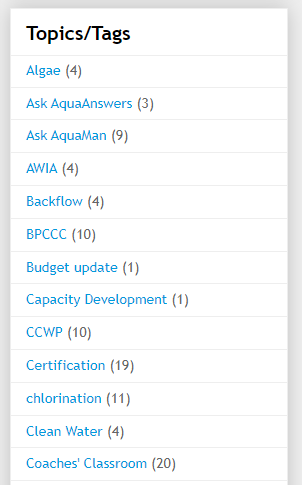
Another helpful function of the blog is the tag section. Starting on the Aqua Talk homepage you scroll a quarter of the way down the page until you see the “Topics/Tags” box on the right hand side of the screen. You can then click on the topics that interest you to see all the articles that have been tagged with those topics. 

The WQCD Engagement Page

The second tool we want you to know about is the WQCD engagement website. This website is a space for water and wastewater systems to play a part in updates that the division makes to regulations, guidance, and policies. We want to hear from you on these proposals. Whether you are a member of the public who is interested in what the state is doing or a regulated entity that is impacted by these measures, we want your feedback. The information on this webpage reflects current efforts you should be aware of and possible engagement opportunities. There are many opportunities for you to engage on the website. 

The first tool you will see is the engagement calendar. This calendar shows all scheduled WQCD engagement events.  You can select how you want to view the calendar by selecting the “Week” or “Month'' tab at the top of the calendar and then select the timeline you want to view by clicking on the horizontal arrows. If you are interested in learning more about a specific event click on the blue text in the calendar and a window will pop up with more information and links to either find more information or to copy the event to your work calendar. Many events have specific contact information at the bottom of the calendar post so, be sure to scroll to the bottom of each event to access that information. 

Another aspect of the engagement website to look into is the engagement email notifications sign-up form. If you scroll past the engagement calendar you will see a red box with a link to “Sign up for email notifications.” If you click on this link it will send you to a separate website where you can sign up for different WQCD email listservs. The subscription form will ask for the following information: 

You will then select which emails you would like to receive by clicking on the blank box next to the topics you are interested in: 

Please note that these emails will be sent out through a third party website. You can opt out of these emails at any time by clicking on the “unsubscribe” link at the bottom of the email. 

There are many other options for you to plug into division activities on the WQCD engagement page, too many to list in this article. We recommend that you spend some time looking into this website as it is a crucial tool for you to stay in-the-know. 

Safe Drinking Water Program’s Local Assistance Unit website

Lastly we want to highlight the LAU website. To start, the LAU website lists many free training opportunities for water systems. Please note that the team rotates between in-person and virtual offerings for our group training events. Please click on the registration documents (see links below) to see upcoming dates and register for the training you would like to attend by selecting your date and filling out the registration form. The LAU team will send you attendance information within 48 hours.  

  • Monitoring and Operating for Regulatory compliance
    • Offered the first Wednesday of every month 
    • Tailored to operators and decision makers 
    • 0.4 free TUs offered 
    • Meets mandatory regulatory training (MRT) requirements for certified drinking water operators
  • Sanitary Survey Preparation 
    • Offered the third Wednesday of every month 
    • Tailored to operators and decision makers who would like to prepare for their next drinking water sanitary survey inspection 
    • 0.3 free TUs offered 
  • Resilience training: Emergency Management & Financial Planning
    • Offered the third Tuesday of the last month of every quarter 
    • This training is primarily offered in-person as the curriculum is heavily activity based
    • Tailored to decision makers but operators may find valuable 
    • 0.4 free TUs offered 

The LAU will continue to develop our group training event offerings to meet the needs of the drinking water community. We also work with our technical assistance providers in the state (RCAC, CRWA, EFCN, AWWA, CoWARN, and Indigo Water) to provide free training across the state and via webinar. We strive to meet the needs of our training customers, if you have suggestions of curriculum we should offer in the coming months and years please email cdphe.wqdwtraining@state.co.us with your suggestions. Please see the LAU website to see the on-demand and on-line training opportunities that we offer for free. 

In addition to group training events our coaches also offer one-on-one visits in which we will meet virtually or in-person at your facility to provide technical, managerial, and financial technical assistance. To request a coaching visit with your drinking water facility please fill out our online assistance request form. As with the WQCD engagement website, there are many more opportunities for learning and plugging into the division on the LAU website. We invite you to take some time to look at the website. 

Thank you for your dedication to protecting public health by providing safe drinking water to your communities. We hope these tools help you in this endeavor and look forward to your engagement! 

➽ Kyra Gregory Drinking Water Training Specialist