Pages

Showing posts with label E. coli. Show all posts

Wednesday, June 26, 2024

Most Frequently Cited Significant Deficiencies and Violations - Inspection Year 2023

The Field Services Section (FSS) wrapped up the 2023 inspection year (IY 23) in September 2023 and the new IY 24 inspection year started and is almost halfway over! We appreciate all the assistance from public water systems in completing 491 sanitary surveys in 2023. IY24 started October 1, 2023 and FSS inspectors have completed 297 site visits to date. In this article we will share the top 10 most frequently cited significant deficiencies and violations from IY23 and a sneak peek into IY24 trends to raise awareness and help operators identify and correct issues before they become a potential health threat or citations in a sanitary survey. 

According to Regulation 11, Section 11.3(72), a significant deficiency means: any situation, practice, or condition in a public water system with respect to design, operation, maintenance, or administration, that the state determines may result in or have the potential to result in production of finished drinking water that poses an unacceptable risk to health and welfare of the public served by the water system. Field-based Violations of Regulation 11 have either Tier 2 or Tier 3 public notice requirements that are dependent upon the severity of the violation and any potential public health effects, pursuant to Regulation 11, Sections 11.33(1)(a,b), 11.33(2)(a), 11.33(3)(a) and 11.33(4)(a). All issued notifications must comply with the general content and distribution requirements and notice reporting requirements that are included in Regulation 11.33(5),(6) and (7).

During the 2023 inspection year, 1,256 significant deficiencies and violations were cited in 491 sanitary surveys. The Top 10 most frequent inspection citations were:
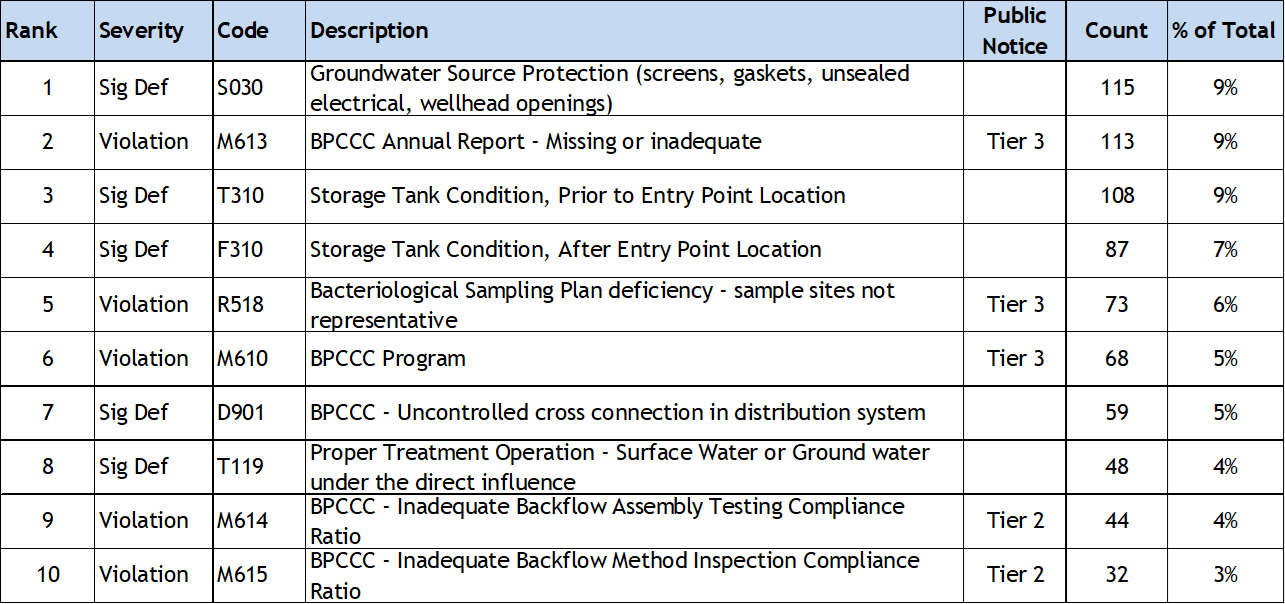
Storage tank deficiencies (F310 and T310), in the distribution system and before the entry point (CT tanks) combined account for 16% of all citations in IY23 and 17% of all citations in IY22. Storage tank deficiencies can include improperly protected screens, hatches and overflows. This underscores the importance of robust routine tank inspections under the Storage Tank Rule and also for tanks that are used for contact time or before entry point. 

The next most frequently cited significant deficiency, with 9% of the total IY23 and IY22 citations, was for wellhead pathways of contamination (S030). This can include loose wellhead seals, missing or damaged vent screens, missing gaskets, broken/open electrical boxes/conduit, cracked sanitary seal plates and wellheads. 

Backflow prevention and cross connection control (BPCCC) has four violations and a significant deficiency that make the Top 10 list, including failure to develop BPCCC annual reports, failure to develop or implement the BPCCC program (both Tier 3 public notice violations), and failure to meet the assembly testing ratio and method inspection ratio which were a Tier 2 public notice violations. Combined, all the BPCCC violations and significant deficiencies make up 26% of the citations in IY23. In 2023 the Division streamlined the BPCCC rule with the Water Quality Control Commission and the assembly and method compliance ratios were combined. In IY24 the M614 and M615 violation codes were replaced with one code, the M619 for Inadequate Backflow Prevention Annual Compliance Ratio due to combining assembly testing ratios and method inspection ratio.

A newcomer to the Top 10 is the Bacteriological Sampling Plan R518 violation which can include not performing representative sampling of the distribution system, not having a sampling plan, not rotating sample locations or not following the plan. 

In IY24 to date, 673 significant deficiencies and violations have been cited. The majority of these citations are the same as the IY23 Top 10 with the addition of two other findings:

  • Violation R536 - MONITORING DISINFECTION (T3); Failure to Monitor Groundwater EP Residual Disinfectant.
  • Significant Deficiency T116 - GROUND WATER TREATMENT; Supplier could not demonstrate adequate operation of approved groundwater treatment processes which are being used for compliance with Regulation 11.

Please check your water systems for these issues to protect public health and avoid significant deficiencies and violations during your next sanitary survey. If you would like additional assistance on technical issues or sanitary survey preparation, please sign up for individualized coaching here.  For any questions or concerns about sanitary surveys please email our Field Services team at cdphe_wqcd_fss_questions@state.co.us. Thank you for all your efforts to protect public health!

➽ Heather Young, PE, CWP, Field Services Section Manager

Wednesday, July 19, 2023

Culture of Health: Water Borne Disease Outbreak Rainbow Valley Ranch

The department promotes a ‘Culture of Health’ in order to encourage water providers to provide the highest water quality practical and to avoid waterborne disease outbreaks. Generally the department relies on what we call “performance partners” which are operators and suppliers of water to ensure the drinking water is safe. There are times that property owners do not cooperate and it becomes all the more important for the partnership between professionally certified operators and the department to stand firm. In the situation below, which did result in human illness, the contract operator that visited the site was instrumental in helping us understand and discern the facts on the ground. While ultimately the owner chose to sell off a portion of the property to avoid being a regulated public water system, the important realtime information from performance partners in the field helped mitigate the effects of this outbreak. As it stands today, the community should be receiving hauled water from a nearby regulated public water system that is safe to drink, however there is not regulatory oversight of the situation. 

The department values the public health professionals and certified water operators that are the ‘boots on the ground’ helping to protect public health and the environment every day. “If you see something, say something.” It may make all the difference in helping prevent or stop a waterborne disease outbreak.

Outbreak Summary Report:

Rainbow Valley Ranch is a small community and fishing club located in Teller County, Colorado. Before this outbreak, Rainbow Valley Ranch was considered to be a nonpublic water system as they served fewer than 25 people for at least 60 days of the year. Nonpublic water systems are not required to comply with the Safe Drinking Water Act and CDPHE has no regulatory authority over their water system.

According to residents of Rainbow Valley Ranch, people reported illness in April 2022, and CDPHE epidemiologists and WQCD staff worked together to collect and analyze information. Ultimately, CDPHE confirmed this as a confirmed waterborne disease outbreak on July 25, 2022. Four people from multiple households met the case definition of an acute onset of gastrointestinal illness. All four cases were Colorado residents, no one was hospitalized, and all individuals survived the illness.

Epidemiology and Investigation Concluded: Illness was likely Non-Shiga Toxin-Producing Escherichia coli bacteria are found in surface water, like lakes and streams. These bacteria live in the intestines of mammals, and some can cause mild to severe gastrointestinal illnesses.

Summary of Sampling and Gastrointestinal illness:

  • 4 sick individuals
  • 5 total coliform positive results
  • 2 E. coli positive results 

Gastrointestinal Illness: 

Non-Shiga Toxin-Producing Escherichia coli infections can cause gastrointestinal illness with diarrhea and abdominal cramps, among other symptoms. These bacteria occur naturally in the intestinal tract of most animals and people, and can enter surface waters like rivers and

lakes through animal waste. When the people at Rainbow Valley Ranch drank the untreated surface water, the bacteria made them sick. 

Incident Timeline: 

  • April 1, 2022
    • At least one resident experienced gastrointestinal illness symptoms.
  • July 20, 2022
    • CDPHE received notification from a tenant at Rainbow Valley Ranch about their drinking water. According to the complainant, the landlord was using untreated lake water for the community’s drinking water and the complainant had diarrhea and blood in their stool. The complainant took a drinking water sample and sent it to the lab, where it was later confirmed as containing E. coli bacteria.
  • July 21, 2022
    • WQCD performed a site visit, reviewed the source (2 lakes) and treatment processes and collected total coliform samples. WQCD identified a filtration and disinfection system, but the disinfection was not connected to the water and the filtration system was not certified to remove bacteria or viruses. Chlorine results were non-detect.
    • In addition, WQCD completed a population count and determined that Rainbow Valley Ranch met the definition of a public water system and would need to comply with the requirements in the Safe Drinking Water Act.
  • July 22, 2022
    • WQCD received lab results from the total coliform samples showing the presence of total coliform and E. coli. The division issued a boil water advisory to the system, requiring the owner to inform all residents that they must boil their water before using it.
  • July 23-24, 2022
    • Teller County Public Health and Environment received several other complaints from Rainbow Valley Ranch residents who were experiencing similar gastrointestinal illness symptoms.
  • July 25, 2022
    • Teller County Public Health and Environment interviewed residents to gather information on symptoms, onset dates, and water quality issues. CDPHE evaluated information and sample results and determined this was a confirmed waterborne disease outbreak. CDPHE required that the owner continue to post the boil water advisory and maintain a 2 ppm chlorine residual until the issue was resolved.
  • August 31, 2022
    • The owner of Rainbow Valley Ranch reported that she has stopped using the lakes for water and is instead hauling water from a nearby public water system.
  • September 7, 2022
    • WQCD issued an enforcement order and required the owner to pay a penalty, correct sanitary defects, and hire a certified operator, among other things.
  • Late Fall/Early Winter 2022
    • The Owner subdivided the property and sold half in order to avoid being a regulated public water system. The fine is still in effect.

➽ Tyson Ingles, Lead Drinking Water Engineer

Wednesday, June 8, 2022

Lessons learned from boil advisories: Do you really want to sample a home for compliance? Total coliform special sample stations

In the Aqua Talk post on April 6 about the total coliform rule and potential for boil advisories, we discussed that we will publish additional articles about these large-scale boil advisories and the specific challenges and lessons learned. As a reminder, the four part series is covering the following topics:

  1. Total coliform perfect storm - incidents that could lead to a boil advisory - April 6, 2022
  2. Public notice to thousands - Special steps for large scale advisories - April 20, 2022 
  3. What language do your customers communicate in? - Accomplishing public notification considering your community - May 11, 2022
  4. Do you really want to sample a home for compliance?  - Total coliform special sample stations (today)

Both the Englewood boil advisory event in August, 2021 and the Marshall Fire that started on December 30, 2021 led to boil advisories affecting more than 25,000 people. To read more about the Marshall Fire boil advisories, see our April 13, 2022 article.  

Today, we want to explore proper total coliform sampling locations. Generally, suppliers of water (regulatory speak for public water system operators and employees) collect total coliform samples from three types of sample taps:

  • Indoor taps, 
  • Outdoor taps, spigots, or hose bibs, and 
  • Dedicated sample stations.

The regulations require that sample locations are previously identified in the supplier sample siting plan (sampling plan) and that the identified sampling sites and sample collection schedule are representative of water throughout the distribution system. Outside taps, spigots, and hose bibs are open to the atmosphere, dust, and animals. Such taps may be subject to higher levels of contamination than inside sampling taps or dedicated sample stations. Outside bacteria sampling sites are not generally recommended due to the risk of contamination, but are allowed. 

Occasionally, suppliers may not have access to a previously identified sample location. If a supplier chooses to sample an outdoor sample location that is not identified in their sampling plan, the supplier must update its total coliform sample siting plan and make sure that the new site is representative of distribution system water quality. Suppliers can easily add their total coliform sample sites using the drinking water portal. If you have any questions, please contact your drinking water compliance specialist. Please be advised that the department will not invalidate positive total coliform or E. coli results just because the samples were collected at outdoor locations.

If a system chooses to collect total coliform samples from outside locations, the department recommends that the supplier take the necessary precautions to ensure that the sample tap is properly cleaned and disinfected with bleach or alcohol before the sample is collected. 

Similarly, indoor sampling sites may be poor sampling sites. Any time water flows through internal building plumbing or pipes not under the control of the water system, the sample is susceptible to contamination. If a system chooses to collect total coliform samples from indoor locations, please be sure to always sample cold water, allow the water to flow for at least five minutes before sampling and remove any attachments on the faucet. The department recommends that the supplier take the necessary precautions to ensure that the sample tap is properly cleaned and disinfected with bleach or alcohol before the sample is collected. Avoid:

  • thread taps, swing sprouts, leaky faucets, faucets connected to cisterns, softeners, pumps, pressure tanks
  • hot water heaters and tempered water faucets that combine hot and cold water. 

Please be advised that the department will not invalidate positive total coliform or E. coli results just because the samples were collected at indoor locations.

When considering where to take representative bacteriological sampling in your distribution system, it is important to consider that neither location discussed above, outdoor spigots or indoor private building taps best represent water in your distribution system. Despite the possibility that these sites may not be the most representative of water in the distribution system, they are allowed in the rule due to practicality of sampling throughout the service area.

An alternative to sampling at the locations indicated above is installing dedicated sampling stations. Regulation 11 and the Revised Total Coliform Rule allow for representative sampling from sample stations. Specifically, the rule states: 

“monitoring locations may include a customer’s premises, dedicated sampling station, or other designated compliance sampling site.” 

Sample stations could reduce the risk to suppliers of detecting site-specific contamination as mentioned above, due to issues with sample locations at outdoor spigots or indoor plumbing. Suppliers that install and sample from dedicated sample stations generally will have more control of the sampling tap by preventing its use by unauthorized persons and allowing no routine use of the tap except for sampling. A dedicated sample tap is also less susceptible to contamination and generally will be able to provide the most representative sample of a supplier's distribution system. The dedicated sample stations are installed on or near a water main therefore the quality of the water in the service mains is not impacted by service lines or a premise plumbing system. Sample stations could also allow suppliers more flexibility when identifying their system's most representative sample locations since they are not limited by owners or building occupants who may restrict access or not be available. Another benefit to these sample stations is that they can be used by the supplier to sample for other water quality parameters (i.e. chlorine residual, pH, turbidity).

Since several entities in Colorado already have experience with installing sampling stations and their proper upkeep, we recommend that utilities work with peers to properly budget, plan, and install sampling stations should you choose to pursue this specific option. The department is happy to provide contact information of utilities that have success with dedicated sampling stations.

➽ Jorge Delgado, P.E. CDPHE - WQCD


Wednesday, April 6, 2022

Lessons Learned for Boil Advisories: Total Coliform Perfect Storm

What events lead up to a boil water advisory and how to avoid them.

About 1 year ago - Ron Falco, the Safe Drinking Water Program Manager, published an article on the relentless culture of health and boil advisories (March 31, 2021 article). In that article he discusses how boil advisories still occur at about the same rate even though the number of E.coli events has dramatically decreased between the year 2000 and now.  

Figure 1: 25,000 people were effected by the Englewood e.coli boil advisory event (photo courtesy of “The Denver Channel”)

Since the time of the publishing of that article in March, 2021 - Colorado has seen the largest boil water advisories in recent years occur for a variety of reasons. In the next series of four short articles, we will explore several topics around boil advisories and some lessons learned in 2021 that are worth exploring. As always - the department staff are here to help water providers avoid the events that result in boil advisories as well as assist you when disaster strikes and boil advisories become necessary. The topics we will explore are as follows:

  1. Total coliform perfect storm - incidents that could lead to a boil advisory and how to avoid them
  2. Public notice to thousands - Special steps for large scale advisories
  3. What language do your customers communicate in? - Accomplishing public notification considering your community
  4. Do you really want to sample a home for compliance?  - Total coliform special sample stations

Today - we will discuss the total coliform rule and how it can lead to boil water advisories. There are specific incidents to watch out for in total coliform sampling. Total coliform sampling frequency is determined by your population. While most Colorado public water systems are very small - a few systems must collect dozens or even hundreds of total coliform samples each month (see Figure 2 below). You can find your required samples in your monitoring schedule.

Figure 2: Table 11.16 from Regulation 11 (Colorado Primary Drinking Water Regulations - 5 CCR 1002-11) specifies total coliform frequency.

When a large number of samples are being collected, many things can go wrong.  What many water professionals may not realize is that even if only 1 of those samples comes back positive for E.coli, then a boil advisory for the whole system could be required. 

Once E.coli has been detected, if any repeat samples come back with total coliform or E.coli present, then a mandatory Tier 1 public notice is required. The difficulty of understanding the extent of the boil advisory during an E.coli positive event is that the samples take 18 to 24 hours to incubate. Once a positive sample and its repeat samples have been taken, up to 72 hours could have passed since the original sampling event. 

With most water systems, it is difficult to determine the full extent of where water could circulate within 72 hours. Therefore, if a positive E.coli is detected and confirmed, the initial assumption is that the contamination may be throughout the system. Many times systems ask the question, but the contamination was only detected at one site - so why would the notice be system wide?

It is also important to remember that each total coliform sample location is a sentinel site representing your distribution system water quality. Each site does not only represent a specific location, but rather a substantial portion of the distribution system. Therefore, if there is contamination in that representative sample, contamination is presumed to be present in part or all of the distribution system pipes. 

The ramification of not quickly warning the public about confirmed E.coli contamination is that a large number of people could get sick from the water because potentially impacted populations were not warned the water is unsafe to drink.

A few of the lessons learned and possible ways to avoid or minimize the impact of a boil advisory follow. However, it is important to remember that these events could happen to any public water system. 

  • When you take total coliform samples - it is critical that proper sampling procedures are followed.  If a total coliform positive or E.coli positive occurs, follow proper sampling procedures. Inspect the site and determine if contamination exists. Ensure that sampling faucets are thoroughly disinfected before sampling and that the water is allowed to run for sufficient time to collect distribution system water. 
  • If the sample comes back E.coli positive - do not assume there was sampling error, or that somehow you received a ‘bad batch’ of sample vials, but rather act in a manner that the water actually contained those bacteria when you sampled and mitigate that risk. 
  • Focus on your distribution system and understand the fate of the drinking water - the ability to understand the hydraulics of where water can travel over time can change the fate of a boil advisory from affecting a specific area to affecting the whole system.  Each water supplier must maintain redundancy in their system, balance water age, and also consider simultaneous compliance. 
  • Run desktop activities - do not wait for the event to occur to rehearse what the responses will be. Rather, perform ‘what if’ scenarios with staff to understand if an E.coli positive occurred in a certain area - what would be the extent of the advisory? Similar activities can be performed simulating pressure loss events.

As always, reach out to the department for guidance and partnership during challenging events. We stand ready to assist you when issues arise.

➽ Tyson Ingels, P.E Lead Drinking Water Engineer


Wednesday, December 8, 2021

SB20-218 PFAS Grant Program


PFAS are man-made chemicals with chemical properties that make them useful for consumer and industrial use. But those properties also make them persistent in the environment. PFAS chemicals from firefighting foam, personal products, and other substances are toxic and may get into the groundwater and surface water, potentially contaminating Colorado’s drinking water supplies. There is evidence that exposure to PFAS can lead to adverse human health effects including low infant birth weights, cancer and negative effects on the immune system. 

The state continues to address PFAS issues through Senate Bill 20-218. The Colorado Department of Public Health and Environment Hazardous Substances Response Act (SB20-218) was signed into law on June 29, 2020 ( C.R.S. 8-20-206.5(7)). 

The act created fees on the transportation of fuel products and those fees are to be collected between September 1, 2020, through September 30, 2026, when the available balance in the fund is less than eight million dollars. The collected fees that are placed in  the PFAS Cash Fund established by SB20-218. The funding can be used for the PFAS grant program, PFAS takeback program, and PFAS technical assistance.

The PFAS Grant Program, provides funding opportunities to eligible entities through three (3) primary project categories: 

  1. Sampling - standard sampling and Independent Environmental Studies;
  2. Emergency Assistance - to communities and water systems affected by PFAS; and 
  3. Infrastructure -water system infrastructure for the treatment of PFAS and prevention strategies for upstream sources of PFAS.

The sampling category will fund eligible participating entities to work with a state contractor or work independently to develop sampling plans to sample for PFAS. Drinking water providers can also utilize this funding opportunity to test their treated drinking water and source waters. 

The general eligible entities for the PFAS grant program are listed below:

  • Governmental agencies
  • Tribes
  • Public water systems
  • Private not-for-profit public water systems
  • Counties or local health departments
  • Fire Departments
  • Not-for-profit Non-governmental organizations
  • Domestic Wastewater Treatment Works
  • Non-profit educational institutions

Each PFAS grant program category has different criteria and eligible entities must review the request for proposals material and complete the required documents located on the following website PFAS Projects webpage under the PFAS grant program heading. 

The application period for the sampling category of the PFAS Grant Program opened in early December 2021. The application period will end on April 1st, 2022 and all applicants will be notified by April 29th, 2022. A potential rolling application for any remaining funds will begin in May, 2022. 

Any questions may be directed towards the cdphe_wqcd_pfas_grant@state.co.us email. Please use the subject line “Grant Program Questions.”

Click here for more information about the PFAS Grant Program.

➽ Sierra Mitchell, PFAS Program Coordinator

Wednesday, May 12, 2021

Success Story: Seasonal Start-up Procedures

Reopening Your Seasonal Water System

Of the approximately 2,050 active public water systems in Colorado, nearly 20% (407) are seasonal. Unfortunately, roughly 10% of all our state’s public water systems have reported that they are temporarily closed or have delayed their seasonal operations due to the pandemic. It seems there is light at the end of the tunnel as Colorado’s COVID-19 Dial has been retired and the responsibilities of restrictions have been handed over to counties. In addition, vaccination is now available to all. Many seasonal and year-round water systems are gearing up to reopen for the summer. We here at the Department wish for everyone to prosper and stay safe while doing so; we would like to remind all seasonal systems of their requirement to complete the Department’s seasonal startup procedures prior to serving water to the public.  

On April 1, 2016, the Revised Total Coliform Rule (RTCR) of the Colorado Primary Drinking Water Regulations (Regulation 11) became effective. One item that was incorporated or modified was the seasonal systems and start-up procedures. The Department created the “Department’s Revised Total Coliform Rule Start-up Procedure for Seasonal Systems Handbook” (seasonal system handbook) to help guide these systems on how to evaluate and ensure that their waterworks and water have been properly inspected, disinfected and treated prior to service to the public. (See below for specific information about hand-pumped well systems). Here are some key highlights of what can be found in the seasonal system handbook: 

  • Conduct a waterworks inspection: look for any damage or evidence of contamination and ensure all sanitary seals are intact.
  • Integrity check: identify leaks in the waterworks as these pose a potential avenue for contaminants to enter the water system. 
  • Disinfection and flushing: disinfect the water system prior to opening to kill any microorganisms that could’ve been introduced during the offseason. 
  • Special Purpose Sampling: collect a “special purpose” total coliform (TC) sample within the distribution system prior to opening (must test absent for the presence of coliform bacteria). Please note that this sample does not count as your “routine” compliance sample. 
  • Routine Sampling: A routine TC sample must be collected within the first month of operation. This TC sample must be collected after seasonal start-up procedures have been completed. For example if a supplier collects a special purpose TC sample on May 10,  but does not complete start-up procedures till May 12, and the supplier begins serving water to the public in May the supplier must collect a routine TC after May 12 to satisfy that month's monitoring requirement.
  • Certification: submit a “Certification of Completion of Start-up Procedures” to the Department no later than the 10th day of the following month after startup.
  • Record keeping: hold onto your “Seasonal System Start-up Log” along with the special purpose total coliform sample result, as these will be reviewed during sanitary surveys. For these reviews, please note that it would be beneficial if you add details to your start-up log concerning your disinfection and flushing procedures such as chlorine dosing levels and hold times. 
  • What’s new: seasonal systems with finished water storage tanks, two periodic tank inspections are required each year. One must be conducted while completing the seasonal startup procedures and another while serving water to the public and at least 30 days after the pre-opening inspection.

Since the RTCR rule came into effect, Colorado seasonal water systems have been increasingly successful at doing a great job of following the seasonal system handbook and submitting their certificate of completion. The Department is appreciative and hopeful that operators and systems continue this trend moving forward.


For those year-round systems that have been closed due to COVID-19, in the interest of public health the Department strongly encourages that procedures matching the seasonal startup procedures in the handbook be completed prior to opening. Even if water pressure and treatment have been maintained while closed, a thorough system super-chlorination and flushing to remove any stagnant water should be conducted due to Legionella contamination concerns. For suppliers who own and/or operate premise plumbing systems, the system flushing should also include a thorough flushing of the hot water distribution system and tanks. A pre-opening special purpose total coliform sample should be collected prior to serving the public. The Department also expects a routine total coliform sample to be collected within the first month of operation if monitoring is less frequent than monthly. 

Together we can make the summer of 2021 a much-needed period of renewal and growth. As a resource for water systems restarting operations, the seasonal systems handbook along with the certificate of completion can be found here under Guidance.

Did you know: Did you know that there are roughly 75 hand-pumped active water systems in the state of Colorado? You may have seen one or more of these hand-pumps if you’ve ever enjoyed any of our state’s stunning campsites. But did you also know that these hand-pumps, much like seasonal systems, have their own policy, sampling requirements and guidance that they follow to ensure that the water that is served to the public is safe? One of these requirements is to conduct a seasonal start-up. For more information on hand -pumps please visit the division's RTCR website


Wednesday, March 31, 2021

Culture of Health - Boil Orders

Our Culture of Health is Relentless

Hello everyone,

One of the activities that we get involved with requires responding to acute public health threats in drinking water that could lead to waterborne disease outbreaks. These events can entail E. coli violations when there is confirmed bacterial contamination in a water system to line breaks that depressurize large segments of a distribution system. When a system loses water pressure contamination can enter and make people sick when full water service is restored. Both of these situations involve issuing what we call a “Boil Water Order,” which is actually a requirement to issue Tier 1 public notice under the Colorado Primary Drinking Water Regulations (Regulation 11). The Tier 1 public notice typically advises the public to boil their water or obtain an alternate source of water, like bottled water. There are other situations including treatment failure and chemical contamination that have resulted in Tier 1 public notices. In the case of certain events, boiling the water could concentrate the contamination, and so an alternate water source is advised.

Fortunately, the number of E. coli violations has decreased significantly in recent years, so they are pretty rare now. In the 1990s, there were 114 E. coli violations at public drinking water systems in Colorado, but in the 2010s that number was reduced to 32. In fact, from 2014 through 2020 there were only 11 such violations and most of those occurred at just a few systems that had not been previously regulated. We believe that water systems and certified operators have done an excellent job improving disinfection, controlling cross connections and protecting storage tanks resulting in the decline in E. coli violations. 

However, our overall numbers of boil water orders has not steadily decreased. Of course, disasters like floods may cause increased numbers of boil water orders to be issued. But boil water orders from main breaks and other distributions system problems appear to have been increasing. It is hard to know if actual infrastructure problems are on the rise, or whether water systems are just more aware of the need to work with us through these situations and issue Tier 1 public notice. Earlier in this century we typically issued 30 to 50 boil water orders per year. That seemed to stabilize in the high teens during the four year period from 2015 to 2018, but since then ticked up to near 40 in 2019, 50 in 2020 and already about 10 in the first quarter of 2021.  

Whether it’s an E. coli violation or main break resulting in pressure loss, department staff help water systems with assessing the situation, assuring compliance with the Tier 1 public notice requirement and reviewing the disinfection, flushing and sampling process that needs to be undertaken to lift the boil water order. Other situations are handled on a case-by-case basis. We provide these services 24/7/365. To get in touch with someone during an emergency, simply call 1-877-518-5608, the department’s incident reporting line and someone will get back to you. We recognize that water system personnel are basically always on the job or on call, and we will be available to help if needed. Our collective Culture of Health is relentless in this way, and never stops. We have helped water systems through natural disaster events, but also other emergencies that have occurred on or near every major holiday on the calendar. I remember that we lifted a boil water order one time on the day before a major holiday, so the public could enjoy the holiday without the terrible disruption that being under a boil water order represents. As always, thanks for all you do to keep tap water safe in Colorado.

Ron Falco, P.E. Safe Drinking Water Program Manager


Friday, April 5, 2019

Success stories

Bringing a recently regulated public water system into compliance

Wellhouse before design approval and modifications
During the year, the department routinely activates anywhere between 10 to 30 “unregistered” public water systems. These are systems that have been in routine operation, but have not been regulated. Many of these systems struggle with meeting the drinking water regulatory requirements (e.g. installing disinfection, hiring an operator, developing a monitoring plan, sampling, etc.). In 2017, due to customer complaints, the department activated an unregistered system in Teller County that is a year-round campground and serves approximately 20 residents and 50 transients. Initially, the owners feared the cost of installing treatment and ensuring compliance with the drinking water regulations would force them to shut the campground down.

In July 2017, the system was placed on a boil water advisory due to confirmed E. coli in the distribution system and lack of chlorination for their groundwater well. The advisory was escalated to a bottled water advisory in October 2017 due to high levels of nitrate in addition to the detected E. coli in the drinking water. The system was issued a formal enforcement order in April 2018 for numerous unresolved violations, including ongoing failure to disinfect the drinking water.

The system contacted the department’s local assistance unit in late March 2018 for assistance with completing plans and specifications for a new treatment system and well/wellhouse upgrades. During five separate coaching visits, the coach worked with the campground owners to complete a design submittal for a new treatment system, ensure proper chlorinator installation, and inspect the final project after completion. As of October 2018, the system has an approved chlorination system installed and in operation. This project would not have been possible without the extensive collaboration between the water system owners and the department’s drinking water compliance assurance section, the engineering section, the field services section, and the assistance coach. Through the collaboration efforts, the water system realized the compliance issues were solvable and could be completed without hindering their business.
Wellhouse after design approval and installation of treatment system


The system’s disinfection treatment project also included wellhead and source water protection improvements to address both nitrate and E. coli issues, and expansion of the existing treatment building to accommodate a contact time pipeline. After over 16 months of being on a boil water advisory due to E. coli in the distribution system, the advisory was rescinded in early November 2018 as the department determined the system is operating properly and providing safe drinking water to the public. The department is continuing to work with system to meet the drinking water regulatory requirements and to close the enforcement order in the near future.

➽ Haley Orahood, compliance assistance and Mike Bacon, local assistance coach