Pages

Showing posts with label Did you know. Show all posts

Wednesday, February 5, 2025

Early 2025 CoWARN updates

The WQCD is sending the below updates in partnership with the CoWARN steering committee. We encourage all water and wastewater providers in Colorado to join the mutual aid network to enhance your preparedness for emergency incident preparation, response, and recovery. Please reach out to CoWARN administrator Kyra Gregory with any questions or if you have interest in joining the CoWARN steering committee made up of volunteers from water/wastewater providers in CO: kyra.gregory@state.co.us 303-908-7519. 

New CoWARN website launched, take action today!

Colorado's Water/Wastewater Agency Response Network launched a new and much-improved website in fall 2023! However, the new website could not retain all the information from the old website. So, all CoWARN members need to please update their membership profiles on the new website. So far, only 63 out of 246 CoWARN members have updated their membership information. Because of this there have been multiple CoWARN activations that many CoWARN members did not receive: Two Buttes 8/27/24, Gardner 8/29/24, Genoa 11/19/24. If you did not receive text or email notification of these activations, please take action today to update your contact information and system membership through the new CoWARN website.

How does the new website work?

As a CoWARN member your water or wastewater facility will have a profile on the website. Each member profile will assign primary users who can activate CoWARN to send out email/text messages to the CoWARN network. As a user under your facility’s membership, you will need to: 

  1. Reset your personal password
  2. Navigate to your dashboard by clicking on the red icon in the top right hand corner of the screen. 
  3. Update your personal information - be sure to add a cell phone number as you will need to receive a text message to log into the site. 
  4. Create your facility’s membership profile - Under “my systems” click “Add”. You are now the primary user for the membership profile. 
  5. Assign other primary users by clicking “Add” under “System Contacts” 

For more information and videos explaining the process, please follow these instructions and reach out to Kyra Gregory with any questions or issues you encounter. 

New Mutual Aid Agreement 

The CoWARN steering committee has revised the CoWARN Mutual Aid and Assistance Agreement. Please sign and return a copy of the updated agreement to CoWARN administrator Kyra Gregory (kyra.gregory@state.co.us). See new MAA here. Please note this is the new agreement that went into effect on January 8th, 2025 regardless of received signatures. 

A short description of the updates is below. 

  • Correct Colorado Revised Statutes references 
  • Revise definitions of operational structure to better reflect current operations and create flexibility for any future structural changes
  • Remove specific language regarding agreement expiration
  • Clarify CoWARN’s role in activations and that CoWARN is not a guarantor in any transactions nor an administrator of transactions.

Wednesday, November 30, 2022

How does my PWS stay in the know?

Using Aqua Talk and engagement website

One of the most frequent questions that our Local Assistance Unit (LAU) coaches get is: how does our public water system stay in the know with rule and regulation updates? To answer this question we are presenting some tools for you to access up-to-date information and to stay engaged with the division. These tools include: 

  1. The Aqua Talk Blog engagement functions: searching the blog and using the tag function 
  2. The WQCD engagement website: calendar, signing up for engagement email notifications
  3. Safe Drinking Water Program’s Local Assistance Unit website: free monthly training opportunities, one-on-one coaching requests, and on-demand free online trainings

Aqua Talk Blog

If you are reading this article then you know about the safe drinking water program’s Aqua Talk blog that is published 2-3 times a month. What you may not know is that this blog platform offers many functions to help you find the information that you need to run your public water system. The first function we want to highlight is the search function. To start, you will go to the Aqua Talk homepage. On the upper right hand corner you will see a search box that says “Search This Blog.” By typing topics of interest to you into the search box you can locate articles on specific topics. 

For example, if you would like to learn about recent updates to the lead and copper rule you can type “lead and copper” into the search bar and click “Search.” The blog will then show you all articles that have the words lead and copper in their title or the body text. The blog defaults to sort the articles by relevance. If you would like to see the most recent articles you can click on the blue text at the top of the page that says “Sort by date.” Please note that the “Show all posts” link will send you back to the Aqua Talk homepage where you can see all posts in our archive (since 2019).

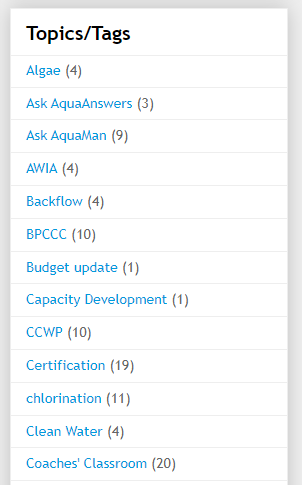
Another helpful function of the blog is the tag section. Starting on the Aqua Talk homepage you scroll a quarter of the way down the page until you see the “Topics/Tags” box on the right hand side of the screen. You can then click on the topics that interest you to see all the articles that have been tagged with those topics. 

The WQCD Engagement Page

The second tool we want you to know about is the WQCD engagement website. This website is a space for water and wastewater systems to play a part in updates that the division makes to regulations, guidance, and policies. We want to hear from you on these proposals. Whether you are a member of the public who is interested in what the state is doing or a regulated entity that is impacted by these measures, we want your feedback. The information on this webpage reflects current efforts you should be aware of and possible engagement opportunities. There are many opportunities for you to engage on the website. 

The first tool you will see is the engagement calendar. This calendar shows all scheduled WQCD engagement events.  You can select how you want to view the calendar by selecting the “Week” or “Month'' tab at the top of the calendar and then select the timeline you want to view by clicking on the horizontal arrows. If you are interested in learning more about a specific event click on the blue text in the calendar and a window will pop up with more information and links to either find more information or to copy the event to your work calendar. Many events have specific contact information at the bottom of the calendar post so, be sure to scroll to the bottom of each event to access that information. 

Another aspect of the engagement website to look into is the engagement email notifications sign-up form. If you scroll past the engagement calendar you will see a red box with a link to “Sign up for email notifications.” If you click on this link it will send you to a separate website where you can sign up for different WQCD email listservs. The subscription form will ask for the following information: 

You will then select which emails you would like to receive by clicking on the blank box next to the topics you are interested in: 

Please note that these emails will be sent out through a third party website. You can opt out of these emails at any time by clicking on the “unsubscribe” link at the bottom of the email. 

There are many other options for you to plug into division activities on the WQCD engagement page, too many to list in this article. We recommend that you spend some time looking into this website as it is a crucial tool for you to stay in-the-know. 

Safe Drinking Water Program’s Local Assistance Unit website

Lastly we want to highlight the LAU website. To start, the LAU website lists many free training opportunities for water systems. Please note that the team rotates between in-person and virtual offerings for our group training events. Please click on the registration documents (see links below) to see upcoming dates and register for the training you would like to attend by selecting your date and filling out the registration form. The LAU team will send you attendance information within 48 hours.  

  • Monitoring and Operating for Regulatory compliance
    • Offered the first Wednesday of every month 
    • Tailored to operators and decision makers 
    • 0.4 free TUs offered 
    • Meets mandatory regulatory training (MRT) requirements for certified drinking water operators
  • Sanitary Survey Preparation 
    • Offered the third Wednesday of every month 
    • Tailored to operators and decision makers who would like to prepare for their next drinking water sanitary survey inspection 
    • 0.3 free TUs offered 
  • Resilience training: Emergency Management & Financial Planning
    • Offered the third Tuesday of the last month of every quarter 
    • This training is primarily offered in-person as the curriculum is heavily activity based
    • Tailored to decision makers but operators may find valuable 
    • 0.4 free TUs offered 

The LAU will continue to develop our group training event offerings to meet the needs of the drinking water community. We also work with our technical assistance providers in the state (RCAC, CRWA, EFCN, AWWA, CoWARN, and Indigo Water) to provide free training across the state and via webinar. We strive to meet the needs of our training customers, if you have suggestions of curriculum we should offer in the coming months and years please email cdphe.wqdwtraining@state.co.us with your suggestions. Please see the LAU website to see the on-demand and on-line training opportunities that we offer for free. 

In addition to group training events our coaches also offer one-on-one visits in which we will meet virtually or in-person at your facility to provide technical, managerial, and financial technical assistance. To request a coaching visit with your drinking water facility please fill out our online assistance request form. As with the WQCD engagement website, there are many more opportunities for learning and plugging into the division on the LAU website. We invite you to take some time to look at the website. 

Thank you for your dedication to protecting public health by providing safe drinking water to your communities. We hope these tools help you in this endeavor and look forward to your engagement! 

➽ Kyra Gregory Drinking Water Training Specialist


Wednesday, July 27, 2022

Facility Operator Certification: What’s in a Name?

Not long ago, an exam candidate contacted me, distressed because he had not been allowed to take his scheduled certified operator exam. When he showed up to take the test, PSI, the exam administrator, examined his photo ID and noted that the name of the candidate approved to take the exam did not exactly match the name on the ID. Therefore, the candidate was turned away and forfeited his exam fee.

The candidate’s perspective was that PSI should have accepted that Jimmy Smith was the same person as James Smith. He thought it was ridiculous to be turned away on such a technicality! 

As much as we may sympathize with this candidate and others like him, the reality is that the verification of identity is a serious matter when it comes to state-issued certification. It ensures that the candidate who sits for an exam is the same person whose qualifications were reviewed and approved. It is one of the ways the program protects the integrity of Colorado-issued certificates.

PSI’s candidate handbook makes it clear that “If your name on your registration is different than it appears on your identification, you must bring proof of your name change (e.g., marriage license, divorce decree or court order).” Your “registration” is your CCWP Portal account.

The candidate handbook also informs candidates that “Failure to provide appropriate identification at the time of the examination is considered a missed appointment.” The last thing anyone wants or needs on exam day is the frustration of being turned away. If you need to change the name in your CCWP Portal account so it matches your photo ID, please contact the CCWP Office for assistance.

➽ Nancy Horan, Facility and Operator Outreach and Certification Board Liaison

Wednesday, June 29, 2022

Marshall Fire Recovery Update

The Marshall Fire, the most destructive wildfire in Colorado history, devastated the cities of Louisville and Superior on December 30, 2021. As the impacted communities recover, CDPHE Water Quality Control Division is coordinating with the water systems to protect customers from potential cross connection issues at fire-damaged service taps. Water testing done by CDPHE and the water suppliers after the fire showed that extreme heat and damage to homes and structures caused by fire can create harmful contaminants such as VOCs. These harmful contaminants from the damaged water infrastructure can impact the water supply through connections to the supplier’s distribution system by backflow of contaminants into the supplier’s distribution system. 

For impacted connections where service was suspended, suppliers are consulting with the department before service can be returned. It is very important that customers do not reestablish water service to suspended service connections without approval by the supplier as it could cause potential contamination of the water system. To  return service to a fire-impacted connection, suppliers are performing one of the following actions:

  1. Water quality sampling at the fire-impacted connection to ensure that no contaminants are present in the potable water supply. 
  2. Installing an appropriate backflow prevention assembly at a non-impacted location to control the connection. The supplier must ensure that all installed backflow assemblies are tested by a certified cross-connection control technician upon installation. If a previously installed backflow assembly is suspected of being impacted by the fire, the assembly must be retested in order to confirm the connection is controlled.
  3. Replacing all water supply infrastructure including the meter pit and entire service line. If all water supply infrastructure has been replaced, the supplier can follow normal protocols for supplying water to a new connection. The suppliers are informing the department when this process has been completed at an impacted location.

CDPHE WQCD continues to support the water suppliers as they rebuild their communities impacted by the Marshall Fire. Governor Polis expressed his deep appreciation for all the utilities and this appreciation is echoed by CDPHE.

➽ Heather Young, PE, CWP, Field Services Section Manager

➽ Clayton Moores, PE, Field Unit I Manager


Wednesday, June 1, 2022

Highlights of the CCWP and Operator Certification Board websites

The Colorado Certified Water Professionals (CCWP) website contains a wealth of information to answer frequently asked questions about the operator certification program. From the home page, you can move to two other main sections: one dealing with the CCWP Portal and the other concerning certification and other operator issues. The home page also includes links to:

  • Contact information for the CCWP office
  • Search engine for looking up certified operators 
  • Course catalog for training opportunities approved for continuing education credit
  • List of jobs boards that post certified operator positions

The CCWP Portal page provides links to:

  • The CCWP Portal Log In
  • Free, online courses approved to meet the mandatory regulatory training requirement
  • Video tutorials to help operators and course providers navigate the portal and enter data 

The CCWP Program section answers the most common certification and operator questions. It links to pages that: 

  • Provide step-by-step instructions for becoming certified in Colorado, including information about:
    • Submitting applications through the CCWP Portal
    • Fees
    • Scheduling exams
    • Remote testing option
    • Exam preparation
    • PSI test center guidance for exam candidates
  • Explain the certification options and process for operators coming to Colorado from other states to seek reciprocity 
  • Detail the requirements for upgrading certificates
  • Explain the criteria and process for certificate renewals
  • Provide information about accommodations for military and veterans, including how credit is calculated for military training and experience

The CCWP Program section links to a page for operators in responsible charge. From this page, ORCs can find information to help with the development of written delegation plans for subordinate operators, as well as information about the required written agreement between ORCs and facility owners. There is also a link to ORC contact update forms.

From the CCWP Program page, you can open a link to a listing of contract operators who provide services in Colorado. Finally, the CCWP Program page includes information and a form for operator misconduct complaints.

The Water and Wastewater Facility Operators Certification Board maintains its own website. In addition to meeting and hearing information, the board’s website posts the following documents you may be interested in:

  • Current version of Regulation 100 
  • Colorado Certified Water Professionals Code of Conduct
  • WWFOCB board’s formal policies, guidance and procedures

➽ Nancy Horan, Facility and Operator Outreach and Certification Board Liaison


Wednesday, January 5, 2022

Recent activities in the operator certification program

The beginning of a new year is a great time to review recent decisions and activities in the operator certification program that may affect operators in the coming months.

1. Course approvals for 2022

Courses approved for training unit (TU) credit have a calendar-year life-span. In 2021, over one thousand courses were approved for TUs and over six hundred of those were available as on-demand, online training. Although those courses expired on December 31, 2021, almost eight hundred new and renewed courses have already been approved for calendar-year 2022. Of those courses, more than four hundred are on-demand, online training. 

New courses will continue to be added to the course catalog throughout the year, but the majority will be approved by the end of the first quarter of 2022. The CCWP web has instructions for finding approved online courses for TUs.

It is worth noting that the course catalog automatically defaults to the current year offerings. 

2. Updated water Mandatory Regulatory Training (MRT) course

Operators who renew or upgrade their certificates in 2022 must have evidence in their portal account that they completed an approved water and/or wastewater MRT course within the past three years. The MRT course must be appropriate for the category of certificate being renewed or upgraded (water MRT course for water treatment and distribution certificates, wastewater MRT course for wastewater treatment and collection certificates). As regulations change, the required content for the water and wastewater courses MRT are updated. This increases operator awareness of the most current requirements for water and wastewater facilities.

The water MRT course content was updated for 2022, but the wastewater MRT course did not require any modifications.

Operators who need to take a water and/or wastewater MRT course can use the course catalog search engine to find courses that have been approved to meet the MRT requirement. To find MRT courses, from the course catalog search screen, find “Additional Course Approvals:” then select “Approved for regulatory water training” and/or “Approved for regulatory wastewater training” then click search. This will return a list of courses approved for water and/or wastewater MRT. In addition, the program provides links on the CCWP web to free, on-demand, online water and wastewater MRT courses. 

3. Lawful presence requirement removed

In May 2021, the Colorado legislature repealed the statutory requirement for individuals holding state-issued licenses or certificates to verify that they are in the country lawfully. Therefore, the Water and Wastewater Facility Operators Certification Board amended Regulation 100 in September 2021 to remove the regulatory requirement for certified operators to verify their lawful presence in the United States.

Operators must still upload current documentation to their CCWP Portal accounts to verify identity, but applications no longer require a statement from applicants attesting to their lawful presence.

➽ Nancy Horan, Facility and Operator Outreach and Certification Board Liaison

Wednesday, December 15, 2021

Colorado Wastewater Surveillance Program


Environmental researchers around the world have demonstrated a correlation between SARS-CoV-2 RNA concentrations found in wastewater and COVID-19 case reports. Since  August 2020, CDPHE’s Communicable Disease branch and Water Quality Control Division have been working with Colorado wastewater utilities and local universities to monitor wastewater for SARS-CoV-2 levels in Colorado communities. The result of this work culminated in the Colorado Wastewater Surveillance Collaborative. This wastewater data is used by the State and local public health agencies (LPHAs), in conjunction with case report data, to more accurately estimate trends of disease within a community. This data also gives local public health partners an early warning system for increasing disease levels in their communities as it can identify cases prior to case report data being available. In addition, the CDPHE lab performs whole genome sequencing on all positive wastewater samples for identification of mutations indicative of variants of concern.

Participating wastewater utilities collect wastewater samples twice per week from 24-hour composite samples collected just before the wastewater enters the water treatment plant. The samples are made up of a mixture from all the homes and businesses served by that wastewater utility, making this form of COVID-19 monitoring more efficient than clinical testing. CDPHE’s wastewater program also has potential to expand to neighborhood or even building-level monitoring. We are currently partnering with the University of Denver to perform wastewater sampling at two major correctional facilities in Denver.

Wastewater data can capture cases in communities where testing is unavailable, underutilized, or from asymptomatic individuals who may not seek testing. Wastewater data has been used by local public health agencies (LPHAs) to target testing and vaccination campaigns. Tri-County Health Department utilized wastewater data in a series of social media posts in nine targeted zip codes. The wastewater data was successful in generating a higher than usual community engagement in these posts. The Wastewater Surveillance Team at CDPHE is creating reports to send to LPHAs when elevated concentrations of SARS-CoV-2 are identified.

Data from the wastewater samples are available to the public via an interactive online dashboard. Currently, CDPHE is partnering with 21 wastewater utilities with plans to expand to more in the future. Wastewater disease monitoring is a vital part of understanding trends in COVID-19. In the future, we hope to expand and monitor for other communicable diseases. To learn more about the CDPHE Wastewater Monitoring Project please visit our frequently asked question page.

➽ Kevin Andresen, MPH Wastewater Surveillance Coordinator  Communicable Disease Branch

Wednesday, October 6, 2021

Trying to Find Your Drinking Water Records? We Can Help!

Are you looking for records for your drinking water system? We have an easy online way to help! Using the instructions below, you will be able to access all of your publicly available drinking water system files. 

  1. On the Drinking Water Information page, open the data table by clicking on the "Water System Search" hyperlink.

  2. Enter the name of the Public Water System into the table. 

  3. Clicking on the PWS ID number takes you to all the online records. 

  4. Scroll down, and there's a list of violations (click Records for violation documents). Below violations are a list of inspection deficiencies and sample results.

We also recommend that you always have up-to-date contact information (e.g., owner, operator, and administrative contact) for your system. This ensures that you receive important updates, reminders, and correspondence from the Department. Using the same website above, you can also check that your Owner and Administrative Contact names, phone numbers, and email address are correct. The website also lists your treatment and distribution system operator. 


If you need to make an update, please use our online Monitoring Plan Wizard and select “Contacts” under the Individual Template Section. Please submit any contact updates using our drinking water portal (this is the preferred method as this ensures the document is submitted and received), by fax at (303) 758-1398, or by hardcopy mail. We cannot accept any contact updates, other documents, or data through email. 


If you have any questions, please contact your compliance specialist. Current drinking water compliance assurance contact information can be determined by county and system type on our website or by navigating to page 4 (CAS Contacts) of the Public Water System table.

➽  Stephanie Hosie and Amy Schultz, Drinking Water Compliance Assurance Section


Wednesday, June 30, 2021

Providing water for mobile home park communities

We want every Coloradan to have safe drinking water, but when it comes to mobile home parks, the department does not have regulatory authority over most of these communities. While we cannot always address complaints and concerns we get from mobile home park communities, we work closely with other state agencies, counties, and cities to try to resolve them. 

The Department of Local Affairs (DOLA) oversees the Mobile Home Park Act. We partner with DOLA to share information to protect public health and ensure residents have a livable environment. DOLA and their Dispute Resolution and Enforcement Program is a useful resource for public drinking water system operators to know about. 

What does DOLA regulate at mobile home parks?

In 2019, the state legislature passed the Mobile Home Park Act, setting up a state registration program for mobile home parks and a complaint program. The Mobile Home Park Oversight Program within the Department of Local Affairs (DOLA) oversees the Mobile Home Park Act, registers mobile home parks, and runs the Dispute Resolution and Enforcement Program. 

Program activities include:

  • Receiving and investigating complaints.
  • Facilitating dispute resolutions between mobile home owners and their mobile home park managers. 
  • Determining whether violations of the law have occurred and issuing a Notice of Violation when necessary.
  • Registering all mobile home parks annually. 
  • Conducting outreach and education on mobile home park laws, such as informing landlords of their responsibility to provide and pay for alternative sources of potable water and maintaining portable toilets no later than 24 hours after a service disruption begins, unless conditions beyond the landlord’s control prevent compliance.

Under the Mobile Home Park Act, “mobile homes” do not include camper coaches, camper trailers, fifth wheel trailers, motor homes, recreational park trailers, recreational vehicles, travel trailers, or truck campers. DOLA does not oversee these vehicles nor parks that rent space to these vehicles unless they also rent space to five or more “mobile homes” as defined in 8 CCR 1302-15-1.1.

What does CDPHE regulate at mobile home parks?

CDPHE is the regulatory authority under the Colorado Primary Drinking Water Regulations, Regulation 11(5-CCR 1002-11). Regulation 11 focuses on safe drinking water in accordance with the federal Safe Drinking Water Act. Our enforcement authority is limited to specific violations of Regulation 11, which does not address concerns with taste, odor, color or other issues that may not directly impact safety.

We regulate any entity that provides drinking water and meets the following criteria:

  • Provides water to at least 25 people per day for at least 60 days per year or at least 15 service connections (trailers, buildings, etc) AND: 
    • Has their own source of drinking water (well or surface water source); or
    • Purchases water from another utility and they bill the residents specifically for water (e.g. their water bill fluctuates every billing cycle); or 
    • Receives water from another utility and provides additional treatment to meet safety standards on site for the water.
  • We do not regulate mobile home parks (or other entities) if:
    • They receive water from another utility and do not bill the residents for water or water usage (e.g. included in rent, lease, or flat-rate utility billing).
    • They do not serve water to at least 25 people per day for at least 60 days per year or at least 15 service connections.

What does this mean for water at mobile home park communities?

Most mobile home parks do not meet the criteria to be a regulated water provider. This means that the department does not have an inventory of these parks or regularly interact with them about drinking water. This typically leads to residents reaching out to DOLA or their local government when they have concerns about their water.

DOLA’s Dispute Resolution and Enforcement Program allows mobile home park residents, managers, and owners to file complaints about many different issues they may come across at the mobile home park. This includes issues with water safety, connection, and maintenance. DOLA then investigates the complaint and may issue a violation if necessary. Oftentimes DOLA’s investigation into water-related complaints turns up no concrete violation as the complaint stems from water smell, odor, or color which is not regulated by the department. 

In promoting a culture of health, we want to ensure that everyone has access to safe and enjoyable drinking water. We are building an open dialogue with DOLA so complaints and concerns they receive are addressed as quickly as possible to protect human health. We also share issues at mobile home parks we are alerted to so that DOLA can make sure the owner follows all required statutes for resident safety and livability.

For any disruptions of service, we will work with the public water system who provides water to the mobile home park or the certified water operator if the mobile home park is a regulated public water system.


Wednesday, June 23, 2021

State Revolving Fund can fund Water Rights Purchases!


At the end of 2019, EPA issued a class deviation to allow the drinking water state revolving fund (SRF) to finance the purchase of water rights. This is a big step forward!

Previously water rights purchases were only eligible in the SRF program for water system consolidation purposes. When the drinking water SRF program was established via amendments to the 1996 Safe Drinking Water Act, those amendments prohibited the use of SRF funds to purchase water rights. The reason for the prohibition was that EPA assumed the primary purpose for water rights purchases would be to supply future population growth. In statute, the SRF program does not allow funding projects where the primary purpose of the project is for future population growth.

However, in implementing the SRF program, the EPA began to receive requests for an exception to the water rights prohibition for projects where water rights purchases were required to protect public health. For example, a system may need to switch from an existing water source to a new source in order to ensure the system could reliably meet primary drinking water standards. In these situations, EPA agreed to issue a project specific deviation.

In the case of Oshkosh, Nebraska an EPA deviation was granted to fund water transfer permit fees to withdraw water from new wells in a different aquifer from existing ones that were contaminated with uranium and arsenic. This case is mentioned in the Policy and Technical Evaluation for a DWSRF Class Deviation for Purchase of Water Rights, EPA October 2019. The policy paper goes on to describe the conditions that must be met for an eligible project.

In summary, a SRF fundable water rights purchase must be for an existing population (not primarily for future growth), address a public health threat, be a cost-effective alternative, and need SRF funding to ensure the project proceeds. The 2022 SRF Eligibility Survey (Opened June 1st!) includes a question to indicate if your system may be planning for water rights purchases. Please include those projects in the survey. If you have any questions regarding funding water rights purchases through the SRF, or any other program questions please feel free to contact Mark Henderson at mark.henderson@state.co.us.


Wednesday, March 24, 2021

Colorado’s Source Water Protection Plan Data Viewer

Explore this new tool today!

The Water Quality Control Division (division) is pleased to announce a new source water tool to raise awareness of public drinking water protection. The division has coordinated with participating public water providers to display public versions of their source water protection plans. This allows federal, state, and local governments, planning agencies, stakeholders and the general public to more readily access the public water system’s exceptional planning efforts. The protection tool is designed to generally display the designated drinking water protection areas for public water systems and also provide the ability to view and download their detailed source water protection plan.

Click here to access Colorado’s Source Water Protection Plan Data Viewer.   

How to use the viewer

The Source Water Protection Planning Viewer displays an interactive symbol of completed protection plans for public water systems (PWS) in the state of Colorado. The red symbols represent public water systems that have completed a protection plan, but are not directly available on this website. The division suggests that you reach out directly to that public water system if you want more information on their planning efforts. The blue symbols represent public water systems that have provided the protection planning area and plans for the interactive tool.

Selecting the symbols on the map will provide general information about the protection planning status and public water system. The blue symbols will have a direct link to the source water protection plan available for downloading.

There are two tool buttons on the upper left side of the viewer that will allow you to search for publicly available plans and also view drinking water protection planning boundaries on the map application. The viewer allows for various search functions by water system name or county. The viewer is an ArcGIS based viewer and various data layers (ex: layer list) can be accessed utilizing the tool in the upper right portion of the viewer. Additional data layers include: streams & lakes segmentation, Hydrologic Unit Code (HUC) boundaries, county boundaries and Bureau of Land Management Agency coverage showing the various federal, state, public and privately controlled lands in the state.

Source Water Assessment and Protection is here for you

The Division strongly supports the SWAP program and is committed to working with public water systems, local governments, and federal/state agencies to implement strategies to protect one of our most valuable resources; “Colorado’s Drinking Water!”

If you are a public water system that is interested in protection planning or have completed a protection plan and would like to post a public version of your plan on the website, please email us at  cdphe.wqswap@state.co.us help to complete those processes.

➽ John Colbert SWAP program 

Wednesday, September 30, 2020

ORC Hiring and Contracting Guide

A new resource for owners and administrators of water and wastewater facilities serving <100,000 persons 


The Water Quality Control Division is excited to make a new resource available to water and wastewater facilities serving fewer than 100,000 persons. The purpose of the ORC Hiring and Contracting Guide is to:

  • Promote better understanding of owner and operator in responsible charge (ORC) responsibilities;
  • Provide tools to help facility hiring or contract managers select qualified ORCs that will be a good fit for their systems; and
  • Help facility hiring or contract managers write effective agreements that clearly articulate all ORC duties and responsibilities.


The ORC Hiring and Contracting Guide is organized into four distinct sections which relate to, and support, each other, but which can stand alone to meet a facility’s specific need. 

Section 1 – Responsibilities Table

  • The Responsibilities Table lists facility and ORC responsibilities under 9 category headings. The two-column format makes it easy to compare and contrast related responsibilities.

Section 2 – Interview Tool

  • The Interview Tool suggests questions a hiring or contracting manager can ask to help evaluate candidates’ qualifications, experience, availability, etc.

Section 3 – Topics for Written Agreements

  • The Topics for Written Agreements section discusses a number of topics that may be useful and appropriate for written agreements between facility owners and their ORCs. The agreement with a contract operator in responsible charge may include more items than an agreement with an employee who serves as the ORC, but all written agreements should establish clear expectations and include a comprehensive list of the ORC’s duties.
Section 4 – List of Potential ORC Duties
  • The List of Potential ORC Duties can be used by facility owners to evaluate the needs of their systems and identify the specific duties their ORC will need to perform.

The ORC Hiring and Contracting Guide empowers facility owners to knowledgeably select the best candidates for the role of ORC and to negotiate fair, clear and effective agreements with their ORCs.

Interested persons can find the Guide under “Resources” on the division’s “Training opportunities and resources for water systems” webpage. (Google search: “CDPHE training opportunities.”) Moreover, the division is offering free training to help interested persons navigate the Guide and better understand how to apply it to their specific situations. Registration for the training is also available on the division’s “Training opportunities and resources for water systems” webpage. (Google search: “CDPHE training opportunities.”)

➽ Nancy Horan, Facility and Operator Outreach and Certification Board Liaison

Thursday, July 25, 2019

Did you know?

Storage Tank Rule


Questions around wetwells are now included in the sanitary survey. If you haven’t seen a question during your most recent sanitary survey, you’ll probably hear it during your next one.


Why are we interested in wetwells? 


A wetwell is a specifically designed system that pumps water from one place to another, usually against gravity forces (e.g. pumping water upwards or uphill). We are interested in wetwells because some wetwells fall under the definition of a finished water storage tank. Regulation 11 (11.28(1)(c)) states that any “tank or vessel owned by the supplier that is located downstream of the entry point and is not pressurized at the air water interface” is subject to the storage tank rule. Additionally, chapter 7 of the design criteria states “All tanks storing finished water including distribution pump station wetwells must meet the requirements of Chapter 7.” Unpressurized wetwells are an important part of the storage tank rule that the state is looking to improve on identifying in order to protect public health.

Starting this year we’ve begun a three year process to discuss and identify unpressurized wetwells during sanitary surveys. If the inspector finds a wetwell that meets the definition of a storage tank it will be added to the supplier’s Safe Drinking Water Information System inventory and the storage tank plan. 

Having wetwells in the storage tank plan will necessitate quarterly inspection, unless there is an alternative inspection plan in place. Since the department hasn’t previously required that wetwells be included in the storage tank plan, we will not be issuing any violations for failing to perform periodic inspections of previously unidentified, unpressurized wetwells until 2022.   

However, we will be looking for any sanitary defects and significant deficiencies associated with wetwells, especially those associated with any existing hatches, vents and overflows. Recent sanitary surveys have found debris, foliage, spiders and even a chipmunk carcass in wetwells. Unpressurized wetwells, like all storage tanks, need properly screened vents, water tight hatches and protected overflows to protect the quality of the finished water. 

The department encourages suppliers to be proactive in addressing the addition of unpressurized wetwells to storage tanks plans. If you have unpressurized wetwells, contact your compliance officer and update your inventory. Add any unpressurized wetwells to your storage tank plan and begin conducting and documenting periodic inspections.

Now when the inspector asks about vertical turbine wetwells during your next sanitary survey, you’ll know why.


➽ Greg Naugle, Field Services Section Manager