Pages

Showing posts with label Lead. Show all posts

Wednesday, January 7, 2026

Dear Aqua Answers - Why are unknown service line materials bad?


 Dear Aqua Answers,

I submitted the Lead Service Line Inventory (LSLI) for my water system in October 2024, as required. We were unsure of the construction materials used in some service lines. So, there are some unknowns. Why do I still need to refine my inventory? I heard that unknown line materials are bad. Why?  

Please help. 

Thanks,

Lea D. Line

Dear Lea,

Thank you so much for submitting your initial Lead Service Line Inventory (LSLI) last year. We understand that many systems do not know all the construction materials used in all their service lines. The Lead and Copper Rule Improvements (LCRI) finalized by EPA in 2024 requires ongoing effort to identify service line construction materials and submitting a baseline service line inventory, including connectors, by November 1, 2027. This inventory is different than the initial inventory submitted in 2024. The baseline inventory submittal will establish your system’s baseline for identifying, prioritizing, and replacing lines that contain or may contain lead. 

Under the LCRI, each system must track its progress by calculating a service line replacement rate, which is based on the number of lead, galvanized requiring replacement (GRR), and lead status unknown service lines identified in the baseline inventory. The required Lead Service Line Removal (LSLR) calculation method and required percent removals of lead lines may jeopardize future compliance if you have a high number of unknown service lines that are later confirmed to be non-lead. This lowers the total number of lines in the replacement pool without crediting overall progress in identifying service line materials. This structural flaw risks forcing systems to meet unrealistic replacement rates and/or face non-compliance, even when they have effectively removed all known lead or GRR service lines or ultimately determine all unknown service lines to be non-lead. Customer refusals to allow service line material identification or line removal will also heavily influence system compliance into the 2030s.

This means that unknown service lines are bad for future compliance with LCRI. CDPHE will be communicating with EPA about these concerns and seeking additional flexibility. 

What can you do in the meantime? Make as much progress as possible on your system’s service line (and connector) inventory before the baseline inventory is due on November 1, 2027. Try to reduce the number of unknowns, especially by 2030.

The division continues to support water systems serving up to 15,000 persons by offering technical assistance provided by WSP. The program is currently operating on a wait list, and suppliers can sign up here to be contacted by WSP in the event that the division is able to provide additional funding for the program. Enrolled suppliers can request remote support or hands-on assistance, offered at no cost. The division has selected only one contractor to provide technical assistance to eligible water systems, and it will not reimburse systems for the costs of hiring outside contractors. Waitlisted suppliers should continue to work on their inventories while they await potential additional funding for the program. 

In addition, the division has a team of drinking water coaches available to help you with LSLI project management. Our team can coach your system as you: 

Identify and navigate grant and loan funding for service line identification and replacement 

 Navigate regulatory requirements, including inventory templates, communications tools, public notice and drinking water portal 

Draft and update your LSLI 

If you are interested in working with one of our coaches on your LSLI please fill out a coaching request form, and one of our coaches will reach out to assist you and your team. 

Thank you for your efforts to identify service line materials in your water system. 

Sincerely,

Aqua Answers

Wednesday, June 12, 2024

Optimize corrosion control treatment NOW! Get it done now to put yourself in the best position for LCRI

In late 2023, EPA released the proposed Lead and Copper Rule Improvements (LCRI). See this article for more information on the proposed LCRI.The LCRI is intended to improve upon the requirements promulgated in early 2021 in the Lead and Copper Rule Revisions (LCRR). The LCRR/LCRI will affect more than 1,050 community and non-transient, non-community public water systems in Colorado, serving nearly 6.5 million people. The LCRI public comment period is closed and EPA is planning to finalize the rule in October 2024. The LCRI compliance date is estimated to be late 2027. This gives water systems time to prepare and optimize their corrosion control treatment (CCT) before the LCRI requirements take effect. 

What is corrosion control treatment (CCT)? CCT is chemical treatment at the water treatment plant that makes the potable water less corrosive to water lines and premise plumbing. CCT is typically achieved by adding a phosphate-based corrosion inhibitor or with pH/alkalinity adjustment. The Lead and Copper Rule (Section 11.26 of Regulation 11) requires installation of CCT for systems with action level exceedances (ALE) and requires optimal corrosion control treatment (OCCT) for all systems serving more than 50,000 people. Approximately 65 systems in Colorado are operating OCCT with Department set optimal water quality parameters (OWQP) to comply with the current Lead and Copper Rule. 

Several changes in the proposed LCRI may impact systems that either have corrosion control treatment (CCT) installed currently or that may need to install CCT as a result of elevated lead or copper levels. Proposed LCRI changes that may impact CCT include:

  • Setting a lower lead action level at 10 parts per billion (ppb).
  • 1st and 5th liter lead sampling at lead service lines may result in higher lead levels than seen under the current rule. 
  • Corrosion control study required for large systems without OCCT that exceed the practical quantitation limit (PQL) of 5 ppb based on 90th percentile lead levels.
  • Medium and large systems with lead service lines that are required to conduct a corrosion control study must use harvested lead pipe in a pipe loop rig.
  • Deferred OCCT installation or re-optimization for systems that replace 100 percent of lead service lines within five years of the date they trigger CCT steps.
  • Removal of hardness as a corrosion control treatment option and specifies any phosphate inhibitor must be orthophosphate.
  • Small system compliance options (e.g., point of use devices, replacement of all lead-bearing plumbing materials) for community water systems with 3,300 people or less and all non-transient, non-community systems.
  • Review of CCT during sanitary surveys.

While these changes were part of the proposed LCRI, we will need to wait for the final rule to see if all of these items are included and if new items are added. Also, under the proposed LCRI, water systems will also have to provide Tier 1 public notice to consumers within 24 hours after a lead action level exceedance.

Possible actions to take:

  • Review your 90th percentile lead results: One of the key changes in the draft LCRI is setting the lead action level at 10 ppb; the current lead action level is 15 ppb. Since 2010, approximately 115 systems had 90th percentile lead levels that were between 10 ppb and 15 ppb. Investing in operational controls, treatment, and/or treatment optimization now may allow you to lower your lead levels below the 10 ppb action level before the LCRI takes effect.  
  • Evaluate treatment at large systems that are deemed optimal: Systems that have a population of more than 50,000 people “large systems” are required to have optimal corrosion control treatment (OCCT). The majority of Colorado’s systems that serve over 50,000 people have been “deemed” to have OCCT based on low source water lead and 90th percentile lead concentrations less than 5 ppb. The proposed LCRI requires large systems with a 90th percentile lead value greater than 5 ppb to complete a corrosion control study (CCS). For systems with lead service lines, the proposed LCRI requires the CCS be completed using harvested lead lines in a pipe loop. Many large systems have treatment processes that may impact corrosion. If possible, you should work on optimizing any existing treatment to lower lead levels as much as possible. 
  • For systems with CCT,  determine if you can optimize your treatment process: Analyze your treatment process and determine if your corrosion control treatment could be optimized. A great tool for this is a bench scale immersion coupon study.  
    • pH/alkalinity CCT systems: Systems using pH/alkalinity adjustment may want to more tightly control pH and/or find the optimal target pH. The EPA guidance document recommends a pH range at the entry point of 0.4 s.u. (for example: 7.8 to 8.2 s.u.) and a 0.6 s.u. range within the distribution system. Maintaining a tighter pH range may also improve other water quality contaminants such as disinfection byproducts. Conducting an immersion study to determine the optimal pH target may also be beneficial.
    • Phosphate-based inhibitor systems: Phosphate-based inhibitor systems may want to optimize their dosing. Orthophosphate is the chemical that is effective at corrosion control and the EPA generally recommends a minimum orthophosphate concentration of 1.0 mg/L as PO4 in the distribution system. Blended phosphate inhibitors are a blend of orthophosphate and polyphosphates, which are typically used to sequester iron and manganese. These systems may want to review the percentage of orthophosphate in their chemical to better control corrosion. A bench scale immersion coupon study may be advantageous to determine the more effective dose and/or chemical.  
  • Systems with CCT and OWQPs should review their OWQPs: Systems with OWQPs should review their monitoring schedule to verify the required OWQPs at the entry point(s) and in the distribution system. You may want to request an OWQP modification if you have additional water quality data or immersion coupon study results. 

Making changes to your CCT now can help you meet the LCRI requirements that are coming down the pipe. If you have any questions, please contact Melanie Criswell at melanie.criswell@state.co.us.

Resources:

➽ Melanie Criswell Lead Service Line, Corrosion, and Emerging Contaminants Engineer

➽ Haley Orahood Regulatory Development and Implementation Specialist

Wednesday, May 8, 2024

EPA Reallotment of Lead Funds helps Colorado

In order to address the critical need to replace lead service lines across the nation, the Bipartisan Infrastructure Law (BIL) included funding specific to lead service line inventory and removal projects for the State Revolving Fund Program. In 2022, Colorado received over $56 million for lead service line inventory and removal projects. However, in 2023 due to a change in how EPA allotted lead funds, many states including Colorado experienced a drastic cut in lead service line funding. In fact, the 2023 BIL lead service line funding for Colorado was cut by over 40%. This cut in funding is significant and means many Colorado systems may not be able to access this funding to replace lead service lines. However, earlier this year EPA announced that some state SRF programs did not need the lead service line funding allotted to them through the BIL. The states of Alaska, Hawaii, Maine, Nevada, Oregon, South Dakota, and Washington declined a total of $219 million of 2022 BIL lead service line funding. As a result, Colorado was able to apply for a portion of the unused funds, up to $4.86 million. Although it is not enough to make up for the funding cut, these additional funds will help Colorado to continue to meet the high demand for lead service line funding across the state. Colorado utilizes this funding in multiple ways to assist public water systems to inventory, plan, design, and complete removal of lead service lines. The SRF Program provides low interest loans as well as grants for eligible systems to complete construction to remove lead service lines. The Division has utilized the EPA lead service line funding to provide lead service line inventory grants and to develop a robust technical assistance program. The lead service line inventory grant program has awarded over $700,000 in grants. The technical assistance program provides services free of charge to complete lead service line inventory and to plan for lead service line removal. The Division encourages public water systems to contact these programs for assistance in inventory, planning, and removal of lead service lines. The SRF program can be contacted at SRF Program Contacts. Systems interested in the inventory grants and free technical assistance can contact the program at Colorado@LeadRemoval.info. Please note that systems that want free technical assistance need to apply to the program prior to May 15 by completing a service agreement.

➽ Mark Henderson Community Development and Partnership Section Manager

Wednesday, November 8, 2023

Lead and Copper Rule Revisions and Service Line Inventories

On August 14, 2023, the Water Quality Control Commission adopted the Lead and Copper Rule Revisions into Regulation 11. The changes to Regulation 11 are effective as of October 15, 2023, but the Lead and Copper Rule Revisions have a delayed start date and won’t take effect until October 16, 2024. The Lead and Copper Rule Revisions are a comprehensive update to the EPA’s 1991 Lead and Copper Rule.

Prior to adoption the division conducted an extensive stakeholder process with 26 meetings that provided opportunities for public feedback about the proposed changes. Overall, the division gained stakeholder consensus on adopting the Lead and Copper Rule Revisions into Regulation 11 within two years after promulgation of the revisions, and many of the stakeholder comments related to clarity of the rule requirements. The division reorganized the structure of the Lead and Copper Rule Revisions and incorporated stakeholder comments into the draft rule, where possible, to increase readability and clarity.

The Lead and Copper Rule Revisions affect more than 1,050 community and non-transient, non-community public water systems in Colorado, serving nearly 6.5 million people. A key requirement due by October 16, 2024 is that all systems subject to the rule must complete an initial lead service line inventory to classify the material of each service line entering a building, regardless of ownership.

To aid systems, the division has made many resources available to systems. First, we have posted EPA and state guidance for systems on how to complete a lead service inventory and reporting forms to submit to the division once completed. Second, the division contracted with Corona Engineering and worked with stakeholders to develop an initial lead service line inventory development policy that details the expectations for completion of an inventory and clarifies many lingering issues that remained unanswered in EPA guidance. Some examples include: 

  • When can galvanized pipe be considered non-lead versus galvanized requiring replacement?
  • How does a system use predictive modeling to complete their inventory?
  • When can a system indicate all service lines installed after 1959 are non-lead?

Third, we are contracting with WSP USA Inc to provide no-cost technical assistance to systems serving less than or equal to 15,000 people and allowing systems serving 7,500 or more people to apply for grants to assist with completing their service line inventory and service line replacement planning. This money cannot be used for physical replacement of lead service lines. Grants will be awarded on a first-come, first-serve basis to eligible applicants over several application periods. 

It’s important to note that with less than one year left to complete an initial lead service line inventory and recognizing the resources necessary to diligently complete an inventory, water systems may categorize service lines as “lead status unknown” when they cannot determine the material through an evidence-based approach. However, additional requirements, including customer outreach and planning, are triggered under the new rule if any service lines are listed as “lead status unknown.”

  • Other key changes under the LCRR include, but are not limited to:
  • Compliance with a new lead “trigger level” set at 10 parts per billion (ppb).
  • Tap sampling requirements that target lead service lines.
  • Testing water for lead in schools and childcare facilities.
  • Strengthened corrosion control treatment, lead service line replacement, and public education requirements.

Please note that these key requirements (e.g., lead trigger level and sampling changes) may be revised under another new rule, the Lead and Copper Rule Improvements (LCRI). The EPA plans to finalize the LCRI by October 2024. The department is awaiting more information about the LCRI in late 2023 or early 2024. Therefore, the department will provide communication and resources related to these requirements once more is known about the LCRI.

Resources:

➽ Bryan Pilson Technical & Regulatory Implementation & Coordination Unit Manager

Wednesday, October 4, 2023

Ready, set, go - the WQCD provides assistance for lead service line projects

On December 16, 2021, EPA finalized the Lead and Copper Rule Revisions (LCRR), which further strengthened the protections against lead in drinking water. The LCRR requires community and non-transient, non-community public water systems to develop a service line inventory (LSLI) to identify the materials of service lines connected to the public water distribution system. If one or more lead, galvanized requiring replacement, or lead status unknown service lines are identified, systems must submit a lead service line replacement (LSLR) plan. Both documents are due to the Drinking Water Compliance Assurance Section by October 16, 2024.

The Water Quality Control Division (division) is providing free technical assistance and grants to help eligible public water systems with the service line inventory and lead service line replacement planning process. Additionally, there are low interest loans available for lead service line removal construction costs.

Direct Technical Assistance

Through a competitive bid process, the division has selected WSP, in partnership with Sunrise Engineering, to support water systems serving up to 15,000 persons. Suppliers can request remote support or hands-on assistance, offered at no cost until funding is depleted. The division has selected only one contractor to provide no-cost technical assistance and support to eligible water systems, and under this assistance program it will not reimburse systems for the costs of hiring outside contractors. Suppliers can sign up here to be contacted by WSP. 

Technical Assistance Grants

The division has additionally made grant funding available to assist public water systems with the service line inventory and lead service line replacement planning process for those systems who elect to perform work outside of the technical assistance program above. Grants range from $10,000 to $250,000, and cover 90% of the project cost. Applications will be accepted at four upcoming deadlines, beginning October 1, 2023. Grants will be awarded on a first-come, first- served basis during each application review period, until funds are depleted. Reimbursements will only be made for expenses incurred after the grant agreement is executed. Smaller water systems are encouraged to make use of the technical assistance provider before applying for grant funding. 

Eligible applicants for the grant program include:

  • Publicly owned water systems and private not-for-profit public water systems whose service area is between 7,500 persons and 50,000 persons and whose Median Household Income is less than 120% of the State’s Median Household Income.
  • Publicly owned water systems and private not-for-profit public water systems whose service area is larger than 50,000 persons, and whose Median Household Income is less than 80% of the State’s Median Household Income.
  • Applicants must proceed with work within 30 calendar days of contracting. 

For more information on grant funding and application materials, please visit the division’s Water Quality Grants Webpage

SRF Program Loans for lead service line projects

For public water systems who know they have service lines that require removal and who are interested in construction funding or a combination of inventory work and concurrent removal work, please visit the State Revolving Fund web page for more information. Eligible applicants to the SRF program must have indicated lead service line funding needs on the annual SRF Eligibility Survey. 


Wednesday, January 18, 2023

Lead and Copper Rule Variance: a Culture of Health


In December 2022, the EPA announced final approval renewing Denver Water’s variance from the lead and copper rule provisions associated with Optimum Corrosion Control Treatment (OCCT). What a great success story for promoting the culture of health! Search the Aqua Talk blog for “culture of health” to learn more. The variance includes a multi-pronged approach to reducing lead in drinking water. This new variance replaces the initial variance approved by the EPA on  December 16, 2019.

 When a public drinking water system exceeds the lead action level, the state and water system must ensure that adequate steps are taken to limit lead contamination. One step in that process is often accomplished by installing OCCT, which is the treatment that minimizes lead concentrations in the tap water. Based on Denver Water’s corrosion control study, the data showed that orthophosphate was the OCCT. Denver Water, the department, and EPA worked in partnership  to develop a variance from the treatment requirement. EPA approved the variance and we are responsible for ensuring the program is run under the agreement. All parties agree that this program is better for public health, environmental protection, environmental justice, and cost effectiveness.

 Over the next 12 years, CDPHE will provide help and regulatory oversight of the variance. This effort includes:

  1. Removing all lead service lines (LSL) within the service area by the end of the variance.
  2. Providing filters that are NSF rated to remove greater than 90% of lead from the drinking water, while consumers are awaiting service line replacement. The filter program is currently serving approximately one hundred thousand people who all need new filters every six months! All residences estimated to have known or suspected lead service lines are enrolled in the program.
  3. Adjusting the pH of all water treated to reduce corrosivity. This pH adjustment will be the corrosion control treatment even after all of the LSLs have been removed.
  4. It is also important to note that there is also a great focus on health equity & environmental justice (HE&EJ) in the LSL removal process. Denver Water's LSL removal rate in communities identified by the EPA’s EJScreen tool is at least equal to the removal rate in the entire service area. For more information,  please review the information provided by the EPA here.
  5. For updated statistics regarding the variance, please see Denver Water's Online Dashboard. The dashboard also shows how many lead service lines have been replaced.


It was an incredibly collaborative process to update the final variance between local, state, and federal agencies. This process took place over several months throughout 2022. The group analyzed what worked and what could be improved upon in 2020. Then, the variance review needed to go through the applicable legal processes, and public comment periods. It is exciting that local, state and federal partners effectively collaborated to develop and then implement this variance. Again, this has proven to be a success for public health, environmental protection and environmental justice. The department worked closely with Denver Water to implement this variance in the first three years. We will continue our oversight role throughout the duration of the variance.

 At this point, Denver Water has met or exceeded all of the requirements of the variance. We are very grateful for the opportunity to work with everyone involved. We expect for this trend to continue, and even accelerate, as bilateral infrastructure law (BIL) money is awarded. 

➽ Ben Keilly, Drinking Water Compliance Assurance 


Wednesday, May 18, 2022

Lead and Copper Rule Revisions: Start Preparing for Upcoming Requirements

Lead has long been recognized as a toxic metal that can be harmful to multiple body systems, even at low exposure levels. Lead is particularly harmful to the developing brain of small children and can result in functional impairment. Lead can enter drinking water through the corrosion of lead-containing plumbing materials such as pipes, faucets, and fixtures. 

On December 16, 2021, EPA finalized the Lead and Copper Rule Revisions (LCRR), which further strengthen the protections against lead in drinking water. The LCRR requires water systems to meet a number of new requirements, including:

  • Water systems must develop a system-wide lead service line inventory and lead service line replacement plan by October 16, 2024.
  • Compliance with a lead “trigger level” of 10 ppb that triggers additional planning, monitoring, and treatment requirements.
  • Lead testing in schools and childcare facilities.
  • “Find and Fix” at any individual tap above the 15 ppb lead action level to quickly investigate and potentially remediate the source of the lead.
  • Strengthened corrosion control treatment, lead service line replacement, lead sampling, and public education measures. 

The lead service line inventory (LSLI) and lead service line replacement (LSLR) plan are key elements that support the LCRR’s overarching goal of proactive lead service line removal and more equitable public health protection.

What is a Lead Service Line Inventory (LSLI)?

The LCRR requires all water systems to submit a lead service line inventory by October 16, 2024 of every service connection in the distribution system to classify the material, of both customer-owned and utility-owned portions of the service line, as one of the following:

  • Lead: All or a portion of the service line is lead.
  • Galvanized requiring replacement: Galvanized iron or steel service line that is or was at any time downstream from a lead service line or is unknown to have ever been downstream from a lead service line.
  • Non-lead: No portion of the service line consists of lead or galvanized requiring replacement.
  • Lead status unknown: Service line is not known to be lead, galvanized requiring replacement, or non-lead.

Water systems must take steps to verify service line materials to ensure a complete and accurate inventory. Systems should verify as many “lead status unknown” service lines as possible since unknown service lines are treated as lead service lines unless proven otherwise. Most suppliers should be able to use a combination of knowledge of prohibitions, such as the federal lead ban in 1986, and local ordinances, records review, physical verification, and/or statistical modeling to determine service line materials without physically verifying each line. Only when there is a lack of records and great inconsistency in identified materials during physical verification would a system need to physically verify a large number of their service lines.

The LCRR aims to expand customer awareness, and as such, water systems must make their lead service line inventory available to the public, and systems serving greater than 50,000 people must also make their inventory available online.

Who needs to complete the LSLI?

All community and non-transient, non-community water systems must complete and submit a LSLI to the department. The department is requiring that water systems submit an inventory summary with the total number of service lines in each material category (e.g. lead, non-lead, lead status unknown). Systems with lead or galvanized requiring replacement service lines must also submit a detailed inventory of each lead or galvanized requiring replacement service line with a location identifier (i.e., address or block) and the material classification.

Resource: Lead service line inventory forms and a requirements/FAQ document are available on our website.

What is a Lead Service Line Replacement (LSLR) plan? Do all systems need to complete a LSLR plan?

Water systems with lead, galvanized requiring replacement, or lead status unknown service lines must submit a lead service line replacement (LSLR) plan to the department by October 16, 2024. Completing the LSLR plan will help systems prepare to remove sources of drinking water lead exposure and for identifying the material of unknown service lines. The LSLR plan must be sufficiently detailed to ensure the system is able to comply with the lead service line replacement requirements in the LCRR.

Water systems that have verified that their distribution system contains only non-lead service lines are not required to complete a LSLR plan.

Resources: A lead service line replacement plan template and requirements/FAQ document are available on our website .

The department encourages water systems to begin working on the LSLI and LSLR plan as soon as possible as these will require substantial resources to complete. Stay tuned for additional information on forms and guidance as well as upcoming public meeting opportunities.

➽ Haley Orahood, Regulatory Development and Implementation Specialist

➽ Bryan Pilson, Technical, Regulatory Implementation, and Coordination Unit Manager

Wednesday, April 20, 2022

Lead testing in Schools and Child Care Facilities Drinking Water Program

Applications Now Available

Applications and program updates will be available on our lead in schools website.

Questions? Please email us at cdphe_wqcd_lead_grant@state.co.us

In January of this year (2022) the Water Quality Control Division (Division) launched the lead testing in schools and child care facilities drinking water program. This is an EPA-funded program administered by the Division and is an important opportunity to take action now and target lead testing for our most vulnerable populations. Infants and young children are most at risk, but many schools and child care facilities have not been tested for lead in their drinking water. While this is a voluntary program, we encourage public health officials to apply now and take advantage of this opportunity to partner with the Division and enhance community, parent, and teacher trust in their drinking water. 

We will be accepting applications from local public health agencies, or other county agencies to participate in the program. The ideal funding strategy is to work with our local public health and county partners to implement this program. However, if local public health and county agencies are unable to implement the program in their jurisdiction, the Division may fund public water systems to assist in these community efforts.

The program involves a holistic approach per the EPA’s 3Ts guidance beginning with outreach and education in the first phase that leads into sampling, testing, and taking action in the second phase. We will provide grant recipients outreach materials, including school and child care facility information, in addition to training and detailed instructions for developing sampling plans at each participating facility. This funding currently does not cover remediation efforts; however, low-cost immediate action is possible if elevated lead levels are found as described in our sampling guidance. These actions include shutting off the source, fixture replacement, cleaning the faucet aerator/ screen, routine monitoring, and performing common practices to reduce lead levels in drinking water:

Common Practices to Reduce Lead in Drinking Water:

  • Let your water run before drinking.
    • If it has not been used for several hours, run the cold water tap until the temperature is noticeably colder. Sometimes it can take two minutes or longer. This flushes lead-containing water from the pipes.
  • Always use cold water for drinking and cooking.
    • Never cook or drink water with water from the hot water tap. Hot water can be more corrosive and lead from plumbing can get into the water. Boiling does not remove lead from the water.
  • Periodically remove and clean the faucet’s strainer/aerator.
    • While removed, run water to remove debris.
  • Consider using a water filter certified to remove lead and know when it’s time to replace.
    • Verify the claims of manufacturers by checking to make sure that filters are listed as NSF International standard 42 and 53. Look for certified drinking water treatment units by searching for lead in drinking water at www.nsf.org.

Community public water systems are encouraged to engage with their local public health agency and local government to raise awareness of this grant and lead testing program. This is a great opportunity for community public water systems to proactively identify the schools and child care facilities they serve and familiarize themselves with the sampling process and lead service line inventory that will be required per the Lead and Copper Rule Revisions.

The current program has two required phases. The first phase provides up to $5,000 to help with community outreach. The second phase provides up to $25,000 to sample for lead in drinking water at participating schools and child care facilities. The cost of laboratory testing for lead will be funded through this grant in addition to the $30,000 available to eligible applicants.

➽  Laura Leonard PhD, Lead Testing Program Coordinator

Wednesday, September 22, 2021

Federal Update: Key Issues with the Lead and Copper Rule Revisions


As most of you know, on January 15, 2021, the EPA promulgated its final Lead and Copper Rule Revisions (LCRR) with an effective date of March 16, 2021. Then, on June 10, 2021, the EPA signed a final rule extending the effective date of the LCRR to December 16, 2021 to allow for additional engagement and public comment regarding the final rule. Colorado participated in this process via co-regulator meetings with other states and the Association of State Drinking Water Administrators. EPA completed the process of obtaining additional public input and must make a decision by December 16, 2021 as to whether to maintain its final rule as published in January 2021, revise it, repeal the rule and restart from scratch, or move forward with a hybrid of these approaches. If EPA finalizes this rule in December 2021, Colorado will have two years to adopt a rule no less stringent, with a compliance date of October 16, 2024. 

During the course of 2021 EPA has already been sued twice regarding the LCRR. EPA was sued in March by parties that believed the final LCRR published in January was not sufficiently protective. This lawsuit was stayed pending the outcome of the review process that will end in December 2021. EPA was also sued in August by parties that believe the extension process was not legal, and that the final rule must stand as published in 2021. It is uncertain as to how these lawsuits will ultimately play out and whether they will impact the substance or timing of EPA’s finalization of the rule or state’s ability to adopt the LCRR. If there are no legal impacts to the timing, if EPA finalizes this rule in December 2021, Colorado will have two years to adopt a rule no less stringent. 

In general, Colorado is pleased with the efforts that EPA undertook after the draft LCRR was issued as several of our comments, including adding more flexibility regarding how Optimum Corrosion Control Treatment (OCCT) studies can be conducted. There is no way to be sure what items within the final LCRR EPA may consider adjusting, but we believe some of those items likely involve the following:

  • Increasing the proposed 3% Lead Service Line Removal (LSLR) rate after an action level exceedance.
  • Not allowing LSLR to stop, once it begins even if lead levels decrease below the action level. 
  • How components like pigtails, galvanized pipes, etc. fit into the definition of lead service lines for inventory and removal purposes.
  • Sampling procedures including utilizing an approach that would involve evaluating both first draw and 5th-liter samples.
  • Simplifying the “find-and-fix” process, especially for non-LSL sample sites.
  • Altering the small system flexibility and not allowing avoidance of OCCT for 15 years while an LSLR program is implemented. Providing filters is one option that may be added to the rule.  

Colorado has continued to urge EPA to allow for alternative OCCT options considering our experience with the Denver Water variance. Colorado believes water systems should be allowed an alternative if corrosion control treatment is applied, LSL replacement is expedited above required LSL replacement rates, pitcher filters are provided to all customers with LSLs, and the system implements an extensive public outreach and education campaign.

Of course Colorado supports being able to implement a rule that can help improve health protection and reduce lead exposure, especially for children. Beyond the specific content of the rule, we remain concerned about the technical and financial resources needed for water utilities and states to comply with the LCRR. Due to the complexities of multiple handoffs, reviews, sample site changes, and new tracking and reporting requirements, we will all need to work hard to develop needed guidance, tools, and clarifications to implement the LCRR. Once we have a final LCRR, we will begin to plan our stakeholder process to adopt the rule plus develop supporting policies and guidance. 

➽  Ron Falco, P.E. Safe Drinking Water Program Manager


Wednesday, July 28, 2021

Aqua Answers: materials evaluation vs. a lead service line inventory

Dear Aqua Answers,

What’s the difference between a materials evaluation and a lead service line inventory?


Sincerely,

Mat Plumber


Dear Mat,


A materials evaluation is a survey of all lead, copper, galvanized, and cast iron and steel piping, service lines, and interior plumbing within a water system’s distribution system. Community water systems were first required to develop a materials evaluation nearly 40 years ago. Many water systems used the original materials evaluation to help identify sample pool sites when the 1991 Lead and Copper Rule was promulgated. However, over the years, these evaluations were mostly left to languish and were not maintained or at worst lost as water system personnel came and went. In 2016, the department requested the materials evaluations from systems to evaluate the appropriateness of their current lead and copper sample sites in terms of identifying lead service lines, lead pipes, and copper pipes with lead solder. The department worked with systems over several years to update their materials evaluations, which has yielded vast improvements in proper lead and copper sample site selection based on the current tiering levels of the Lead and Copper Rule. 


The Lead and Copper Rule Revisions promulgated in 2021 requires systems to have a lead service line inventory when the rule takes effect, currently slated for the end of 2024. Water systems are required to identify the individual locations of each lead service line, galvanized pipe that is or was downstream of lead service line, non-lead service lines, and unknown service lines for both the publicly and privately owned sides. While much of this information was required for a materials evaluation, the department will expect water systems to take a second look and evaluate if they have their service lines properly identified on both the publicly and privately owned side of service lines.


It’s important that systems work hard on this inventory to develop a high confidence in their categorization of the service line material by 2024. Unknown service lines are treated as possible lead service lines and special notices will be required to be sent to these customers annually if they remain unknown. Ideally, a system has records of installed service line material or physically verifies the materials through pot-holing. Having records or physical verification of all service line materials is very unlikely for many water systems, however. When the rule becomes effective, the department will expect water systems to use a combination of installation and maintenance records, plumbing codes or permits, interviews with experienced system staff and homeowners, and selectively used physical verification when service line materials are unknown. This will allow water systems to make high confidence determinations on the material type to a swath of homes based on installation dates. The lead service line inventory must be updated at least annually as service line materials change and must be made available to the public with systems serving greater than 50,000 required to make them available online, such as a GIS map, unless there are no lead service lines, galvanized pipe downstream of previous lead service lines, or unknown service lines.


Now is the time for water systems to be proactive about their lead service line inventory. Systems should use this time to organize any available paper records and to implement service line identification procedures as part of routine distribution maintenance and repairs and meter reading and to document the findings with location identifying information. Please visit the department’s Lead and Copper Rule general website or Lead and Copper Rule FAQ for more information. 


Happy hunting,

Aqua Answers


Wednesday, June 9, 2021

Colorado’s Legislative Lead Sampling Program (2017-2020)


The Water Quality Control Division (Division) implemented the “Safe Water In Schools Act” for the period of July 2017 through June 2020 with legislative funding from HB17-1306 which helped schools with the cost of lead testing through grant funding. Lead testing in schools is especially important because of the increased risk of delays in physical and mental development, lower IQ levels, and brain damage in young children who may be exposed to lead. Because of the length of time children spend in schools and the serious health risks associated with lead exposure, it is critical that schools, particularly elementary schools, know if lead is present in their drinking water.

Under the Colorado Primary Drinking Water Regulations, Lead and Copper Rule (Regulation 11), regulated water suppliers are required to sample lead at designated sites which are typically single- or multi-family homes. A relatively small number of schools (42) are regulated as a public water system so they already test for lead in their facilities. These schools did not participate in the grant program. Similarly, some schools already tested for lead using the 1991 federal Lead and Copper Rule standards. Approximately 1,450 schools were eligible to participate in the legislative lead testing program.

During the state fiscal years of 2017-2020, 67 (41 Elementary and 26 non-Elementary) schools received funding for a total amount of $248,215.  The program funding supported sampling 3,877 fixtures that were tested for lead concentrations in drinking water.  The lead testing results were reported to be below the recommended action level of 15 parts per billion (ppb) in 3,731 samples (96.2%). The lead testing results reported above the recommended action level of 15 parts per billion (ppb) were 146 samples (3.8%). All testing results were provided to the local public health agency, the school’s water supplier, the school board, and the department as required by Section 25-1.5-203(1)(f)(IV), C.R.S. When samples exceeded the recommended action level of 15 ppb, grant recipients implemented corrective actions to reduce the lead exposure risk. These actions included replacing fixtures, taking fixtures out of service, shutting off valves, installing filters, or posting “Do Not Drink” signs.

The complete water quality test results are on the Water Quality Control Division’s historical state legislative lead testing program website

This program helped reduce lead exposure from tap water in participating schools. The data suggested that most of the lead action level exceedances are a result of fixtures, for which corrective actions are relatively inexpensive. The division sought and received a multi-year $1,200,000 Environmental Protection Agency Water Infrastructure Improvements for the Nation (WIIN) Grant to continue and expand testing at schools and daycare facilities. Funding will be provided to local public health departments and county governments to promote the program and facilitate testing in their local school districts. The EPA WIIN’s program is on hold due to COVID-19 closing down most schools while overwhelming local public health departments and local governments. The division is working with the EPA to extend the WIIN’s grant program and implement an effective strategy moving forward. This, along with the new lead and copper rule which requires water systems to test at schools, will continue to advance the goals of HB 17-1306.


Thursday, May 13, 2021

EPIC’s Lead-Free Water Challenge Sets Sights on Small Systems

The Environmental Policy Innovation Center (EPIC) is launching a Lead-Free Water Challenge to help small municipalities and water systems (with a population size of roughly 5,000-35,000) interested in replacing lead service lines launch programs by offering technical assistance, connections to resources and funders, policy guidance, and information-sharing through peer networks. EPIC welcomes submissions from public water systems (either directly or through their municipality) willing to make a commitment to remove all of their lead pipes. EPIC will select five municipalities who will be eligible for up to 100 hours of technical assistance to aid in the development and support of their lead service line replacement program.

Interested municipalities and water systems should apply online by June 15, 2021. Learn more about EPIC’s Lead-Free Water Challenge at http://policyinnovation.org/water/leadfree.

Wednesday, December 16, 2020

Corrosion immersion testing case study – Chloramine conversion complete

In Spring 2020, the City of Craig switched disinfection treatment from free chlorine to chloramines to address frequently low free chlorine residuals in their distribution system. Low disinfectant residuals increase risk of pathogen presence in tap water, which can lead to waterborne disease outbreaks. Since this treatment change could potentially affect water corrosivity, the city and the department teamed-up to conduct a proactive coupon immersion study to simulate whether the chloramines would impact lead and copper levels in the distribution system. In our January 2020 article, we discussed the corrosion immersion study setup and in our August 2020 article, we discussed the immersion study results. 

Figure 1: Jars with copper with lead solder and brass coupons.

For lead, the immersion study results predicted that switching from free chlorine to introducing chloramines would not meaningfully affect the existing lead concentrations at customer’s taps. Craig’s 90th percentile average lead concentration from 2018 and 2019 was 0.0026 mg/L which is considered quite low. The lead action level is 0.015 mg/L and the maximum contaminant level goal is 0.0 mg/L. The EPA and the Centers for Disease Control and Prevention (CDC) agree that there is no known safe level of lead in a child's blood. Lead is harmful to health, especially for children, therefore it is always advisable to minimize lead concentrations in water to the extent possible.

For copper, the immersion study results indicated some copper release may be expected with the disinfectant change but that would be a nominal change in copper concentrations. The immersion tests results indicate that introducing chloramines could increase copper concentrations by approximately 17% for the copper with lead solder coupons to 36% for the brass coupons.

The city has been operating the chloramines disinfection system for over 6 months. The city executed a chloramines conversion project despite significant challenges from the pandemic and state lockdown and should be applauded for the countless hours of hard work and diligence required.

Figures 2 and 3 below are graphs of the 90th lead and copper concentrations for the past 5 years. Again, based on immersion testing predictions - we did not expect to see the values for lead go up.  The lead and copper 90th percentile results before and after the chloramines switch are roughly equivalent as predicted by the immersion testing. 

Figure 2: Lead 90th percentile results over the past 4 years

Figure 3: Copper 90th percentile results over the past 4 years - note - a slight increase in copper concentrations was not seen full scale, which could be due to the nature of older pipes in distribution versus new coupons in the immersion study.

During the treatment transition period, the department also worked with the City to take sequential samples from two example homes in the city’s distribution system. For sequential sampling, also called a lead profile, consecutive samples (typically 1 liter bottles) are taken from a single home. Depending on the piping configuration, up to 20 liters need to be collected in order to capture the water from the home’s plumbing and service line (pipe underground to the water main in the street). Lead profile sampling may be helpful when trying to characterize household plumbing type and potentially identify lead service lines or other lead-containing plumbing like older solder or galvanized pipes. 

In this instance, the profile testing was looking for potential lead release from older homes during the disinfection transition period. Two homes were sampled before and after the transition to chloramines. The profile sampling results did not indicate any notable change and for the most part indicated a low level of lead within the selected households. Figure 4 shows the results from one home prior to the transition to chloramines. The other home had all non-detects for lead for all samples.  

Figure 4: Lead sequential profile sampling results from one home prior to chloramines.

Treatment and source changes can have impacts on distribution system lead release. The Lead and Copper Rule requires that these changes be approved by the Department prior to implementation.  The corrosion immersion study helped the city predict the negligible corrosion impacts their treatment change would have on the distribution system, prior to making the change. The study helped build confidence in the treatment change and no notable corrosion impacts have been observed. While the sequential sampling in this case showed no effect, sequential sampling can be helpful if corrosion concerns occurred during the transition period or if the public needed reassurances that the new water chemistry was not causing a problem with public health. These modeling and sampling tools can help public water systems successfully plan and implement source and treatment changes in the future.

The department would like to thank the City of Craig for their constant communications and proactive approach to solving these water quality issues. 

Tyson Ingels and Melanie Criswell

Thursday, December 10, 2020

Lead and Copper Rule Revisions Update

In early 2020 the public comment period on EPA's proposed Lead and Copper Rule Revisions (LCRR) closed and EPA indicated that it would finalize the rule in summer 2020. EPA had long stated their goal to finalize the LCRR in 2020 and we expected it to occur no later than lead poisoning prevention week, which was the last week in October. However, EPA did not finalize the LCRR and has not stated a new target date. Obviously, there is a great deal of uncertainty at present in Washington, D.C. It is also uncertain how the rule may be altered based on public comments that EPA received.

Once the LCRR are finalized, CDPHE will plan a broad and robust stakeholder process as we move forward toward developing revisions to the lead and copper rule within the Colorado Primary Drinking Water Regulations (Regulation 11). The rule covers a broad range of topics from sampling to public notice and education to Optimum Corrosion Control Treatment (OCCT). We envision that each of these topics, and probably more, would warrant individual workgroups to discuss key issues and develop a path forward. Ultimately, based on all of the stakeholder input, CDPHE will draft a new rule that is no less stringent than the federal rule and bring that forward for a formal rulemaking process before the Water Quality Control Commission. The Commission would then entertain further public input before adopting the final rule. Typically, that entire process is allowed to take a maximum of two years. Implementation and compliance dates typically follow. However, for LCRR there are indications that certain aspects of the rule may need to be implemented more quickly. At present, early implementation is expected to be involved with lead service line inventory requirements at a minimum. So, our advice to water systems is to plan now for a full lead service line inventory to be part of the final LCRR and consider how your water system would tackle that effort.

Stay tuned for more information when EPA finalizes the LCRR.

Ron Falco, P.E. Safe Drinking Water Program Manager

Wednesday, August 26, 2020

Corrosion immersion testing case study – Chloramine conversion project results

Background

In Spring 2020, the City of Craig switched disinfection treatment from free chlorine to chloramines to address frequently low free disinfectant residuals in their distribution system. Low disinfectant residuals increase risk of pathogen presence in tap water, which can lead to waterborne disease outbreaks. Since this treatment change could potentially affect water corrosivity, the City and the Department teamed up to conduct a proactive immersion study to simulate whether the chloramines would impact lead and copper levels in the distribution system. In the last article, we discussed the setup of the City of Craig’s corrosion immersion study.

The experiment tested two water scenarios: the free chlorine potable water (control scenario) and chloramine water (chloramine test scenario). Since individual home plumbing materials vary in the distribution system, three materials were tested: lead, copper with lead solder, and brass. Each material was tested under both water conditions with the water in the jars being changed out three times per week.


Figure 1: Jars with copper with lead solder and brass coupons. The experiment took place from early October 2019 to late January 2020, over approximately 13 weeks. For the first 6 weeks, all the sample jars were filled with the free chlorine water. This stabilized the metal samples and     simulated the current conditions of the distribution system pipes. The second 7 weeks, half of the jars were filled with the free chlorine water        (control scenario) and half the jars were filled with the future chloramine water (chloramine test scenario).

Craig water treatment staff created the test chloramines water by dosing ammonia to the free chlorine water and checking the total chlorine and ammonia concentrations. The staff refreshed the water in the jars three times per week. Water from each jar was collected and the three samples combined into a single sample per week per jar, which is called taking a weekly composite sample. The composite samples were analyzed for lead and/or copper at the State laboratory. 

Lead results

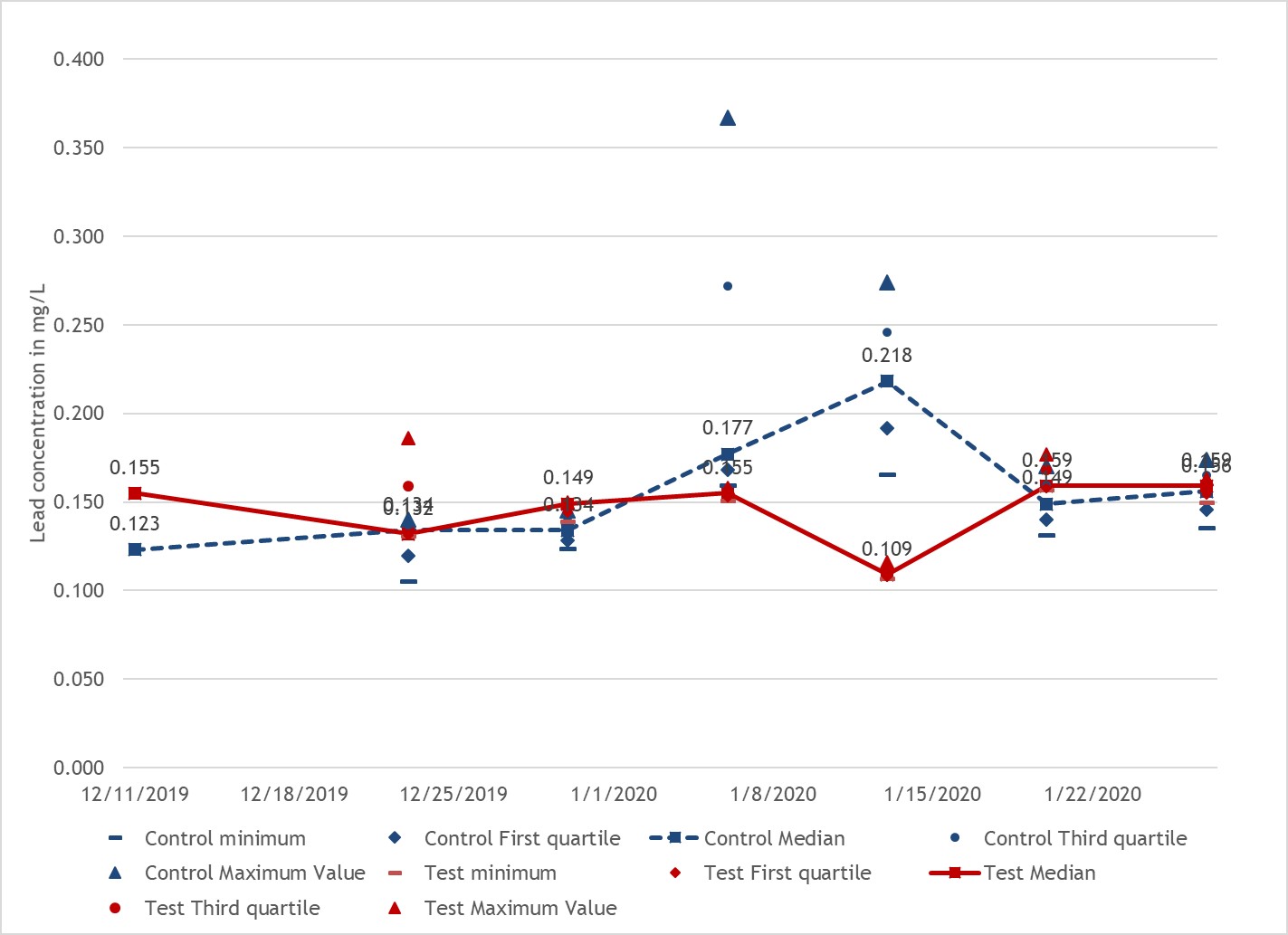
Composite lead concentrations were analyzed weekly from jars containing one of two types of metal coupons. Immersion test results are shown in the four graphs below. The free chlorine (control) scenario is the blue-dashed line and the future chloramine scenario is the red line. 


Figure 2: Weekly lead concentrations from jars with immersed lead coupons. Note: The December 11, 2019 data only has one sample per scenario due to a compositing issue.

  Figure 3: Weekly lead concentrations from jars with immersed copper with lead solder coupons. 

Immersion tests are imperfect and the cause of the lead concentration spike in the control scenario in mid-January is unknown. The median lead concentration between the test condition scenario (chloramines) and the control scenario (free chlorine) with both types of coupons was similar. Based on the immersion tests results, we don’t expect introducing chloramines into Craig’s distribution system to meaningfully affect the existing lead concentrations at customer’s taps. Craig’s 90th percentile average lead concentration from 2018 and 2019 was 0.0026 mg/L. The lead action level is 0.015 mg/L and the maximum contaminant level goal is 0.0 mg/L. The EPA and the Centers for Disease Control and Prevention (CDC) agree that there is no known safe level of lead in a child's blood. Lead is harmful to health, especially for children, therefore it is always advisable to minimize lead concentrations in water to the extent possible.

Copper results

Composite copper concentrations were analyzed weekly from jars containing one of two types of metal coupons. Figure 4 is the copper with lead solder coupon results and Figure 5 is the brass coupon results. 

 Figure 4: Weekly copper concentrations from jars with immersed copper with lead solder coupons. 

 Figure 5: Weekly copper concentrations from jars with brass coupons. 

Conclusions and Next Steps 

The median copper concentration between the test condition scenario (chloramines) and the control scenario (free chlorine) with both types of coupons indicate that some copper release may be expected. The immersion tests results indicate that introducing chloramines could increase copper concentrations by approximately 17% for the copper with lead solder coupons to 36% for the brass coupons. The immersion test is an experimental simulation and the model results may not be linearly correlated to the actual 90th percentile lead and copper results in the distribution system (e.g., a 36% jar results may not be a 36% increase in the 90th percentile). 

Craig will be monitoring lead and copper every 6-months for at least a year to ensure that the actual 90th percentile lead and copper results do not exceed the action levels. The copper action level and maximum contaminant level goal is 1.3 mg/L. In 2018 and 2019, Craig’s 90th percentile average copper concentration was 0.21 mg/L. Copper does not have the same health impacts as lead and is not a concern for developmental effects in children. Even though there may be a slight copper increase, based on the 2018/2019 customer tap sample results combined with the immersion study results, the potential copper concentration increase at customer’s taps should not affect public health. 

For more information on immersion testing please see the department’s Lead and Copper Corrosion Bench-Scale Testing Guidance Manual