Pages

Tuesday, November 22, 2022

Most Frequently Cited Significant Deficiencies and Violations - Inspection Year 2022

The Field Services wrapped up the 2022 inspection year (IY 22) in September and the new IY 23 inspection year started on October 1, 2022. We appreciated all the assistance from public water systems in completing 469 sanitary surveys in 2022! We anticipate completing over 550 sanitary surveys in 2023. In this article we will share the top 10 most frequently cited significant deficiencies and violations to raise awareness and help operators identify and correct issues before they become a potential health threat or citations in a sanitary survey. 

According to Regulation 11, Section 11.3(72), a significant deficiency means: any situation, practice, or condition in a public water system with respect to design, operation, maintenance, or administration, that the state determines may result in or have the potential to result in production of finished drinking water that poses an unacceptable risk to health and welfare of the public served by the water system. Field-based Violations of Regulation 11 have either Tier 2 or Tier 3 public notice requirements that are dependent upon the severity of the violation and any potential public health effects, pursuant to Regulation 11, Sections 11.33(1)(a,b), 11.33(2)(a), 11.33(3)(a) and 11.33(4)(a). All issued notifications must comply with the general content and distribution requirements and notice reporting requirements that are included in Regulation 11.33(5),(6) and (7).

During the 2022 inspection year, 1,155 significant deficiencies and violations were cited in 469 sanitary surveys. The Top 10 most frequent inspection citations were:
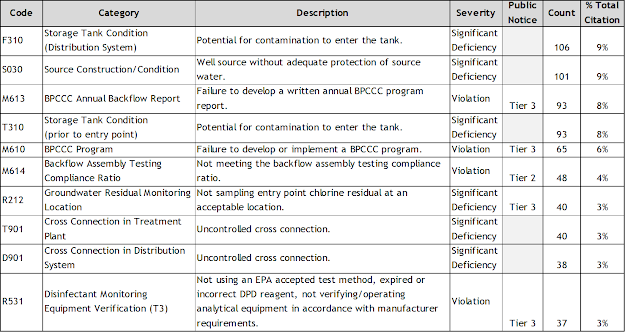
Storage tank deficiencies (F310 and T310), in the distribution system and before the entry point (CT tanks) lead the pack with 17% of all citations in 2022. Storage tank deficiencies can include improperly protected screens, hatches and overflows. This underscores the importance of robust routine tank inspections under the Storage Tank Rule and also for tanks that are used for contact time. 

The next most frequently cited significant deficiency, with 9% of the total 2022 citations is for wellhead pathways of contamination (S030). This can include loose wellhead seals, missing or damaged vent screens, missing gaskets, broken/open electrical boxes/conduit, cracked sanitary seal plates and wellheads. 

Backflow prevention and cross connection control (BPCCC) has several violations and two significant deficiencies that make the Top 10 list, including failure to develop BPCCC annual reports, failure to implement the BPCCC program and failure to meet the assembly testing ratio which is a Tier 2 public notice violation.

Groundwater entry point chlorine monitoring (R212) accounted for 40 significant deficiencies, including monitoring weekly entry point chlorine residual in the wrong location. Chlorine residual monitoring equipment practices (R531) which can apply to both groundwater and surface water systems rounded out the Top 10. Frequently encountered chlorine residual monitoring equipment violations include using expired DPD reagent, caked glassware (grayish tinged), not switching a colorimeter to High Range and using the appropriate vials when needed, and not performing weekly checks of online chlorine analyzers. In accordance with Regulation 11, Section 11.46, 40 CFR 141.74(a), and Policy 4 Guidance, suppliers must field verify online chlorine analyzers once each week by taking a grab sample and analyzing it for chlorine residual.

Please check your water systems for these issues to protect public health and avoid significant deficiencies and violations during your next sanitary survey. If you would like additional assistance on technical issues or sanitary survey preparation, please sign up for individualized coaching here.  For any questions or concerns about sanitary surveys please email our Field Services team at cdphe_wqcd_fss_questions@state.co.us. Thank you for all your efforts to protect public health!

➽ Heather Young, PE, CWP, Field Services Section Manager

Tuesday, November 15, 2022

Investigations of Operator Misconduct Complaints

The Water and Wastewater Facility Operators Certification Board (board)’s Guidance 16-1 and  Procedure 16-2 provide direction regarding Water Quality Control Division (division) investigations of possible misconduct by water and wastewater facility operators. It also describes the division’s approach to escalating from a division informal reprimand to a division recommendation of formal disciplinary action by the board.

Background

In Guidance 16-1, the board established that it is neither practical nor desirable for all instances of operator misconduct to result in formal disciplinary action by the board. Therefore, a division investigation needs to determine whether a violation of law or regulation occurred and, if so, whether the operator’s behavior rises to the level of formal disciplinary action.

Specific Allegations

According to Guidance 16-1, an investigation of operator misconduct is limited to the specific allegations against an operator. The division’s task is not to examine the operator under a microscope to see if any possible infraction might be found. Rather, the investigation must determine whether or not there is evidence to support the claim about the operator in question.  

Considerations

When there is evidence of operator misconduct, the division, guided by Board Guidance 16-1, considers the following factors before deciding whether to resolve the issue informally or to recommend formal disciplinary action of the board: 

  • The gravity of the incident(s) at issue, including the level of risk posed to public health and the environment.
  • The operator’s degree of control over the incident(s).
  • The operator’s attitude during and after the incident(s), including the operator’s willingness to cooperate with the division during the investigation.

The division also considers whether correction through training, instruction, and/or coaching might be effective.

Informal Action

When a complaint can be resolved informally, the division notifies the operator, and possibly the operator’s supervisor, of the division’s findings through an informal letter of reprimand. The division may suggest approaches to address the behavior that resulted in misconduct and/or recommend training or coaching to improve the operator’s knowledge and skills. The issuance of an informal letter of reprimand does not close the investigation of possible misconduct. The investigation will remain open and confidential for up to three years. If there is evidence of repeat misconduct or escalation of misconduct during that time, the division will request that the board take formal disciplinary action against the operator. Informal division action does not affect an operator’s standing as a certified water professional. 

Recommendation of Formal Disciplinary Action

Only the board has the authority to formally reprimand an operator or to formally suspend or revoke the operator’s certificate. However, the division does have the authority to immediately suspend or revoke an operator's certificate to protect public health in emergency situations, but then the board must confirm and formalize the division's action at a later date. The division requests formal board action for severe offenses, as well as repeat or escalated behavior. The board follows procedures detailed in Procedure 16-2 when responding to a division request for formal board action. While division informal action is confidential, the board’s disciplinary action decisions (formal reprimand, certificate suspension, or certificate revocation) are made in open meetings and are posted on the board’s website for three years.

➽ Jessica Morgan, Facility and Operator Outreach and Certification Board Liaison

Wednesday, November 2, 2022

LCRR Stakeholder Process


On January 15, 2021, EPA promulgated the final Lead and Copper Rule Revisions (LCRR), the most comprehensive update so far to the original 1991 Lead and Copper Rule. Following executive review and additional stakeholder input, the LCRR went into effect on December 16, 2021. EPA also noted several areas for additional improvements to the LCRR and committed to promulgating the Lead and Copper Rule Improvements (LCRI) rule by late 2024. The LCRR has an early implementation requirement for public water systems to complete initial lead service line inventories by October 16, 2024. The division is conducting a stakeholder process for the Water Quality Control Commission (Commission) to adopt the LCRR, so that it is effective in Colorado by December 16, 2023 and provides the department enforcement authority, instead of the EPA. This rulemaking process could prove challenging depending on the changes promulgated in the LCRI and when they become effective. 

The LCRR emphasizes lead service line identification and replacement requirements, creates a new lead “trigger level” below the current “action level,” and requires lead sampling at schools and child care facilities. The LCRR adds considerable complexity for both states and water providers. However, some public health experts and community activists believe the LCRR falls short in achieving removal of lead service lines and reducing lead exposure. 

Despite the uncertainty, CDPHE is moving forward to adopt LCRR. LCRR will be adopted and integrated into our existing Colorado Primary Drinking Water Regulations (Regulation 11). The division sees great value and opportunity to gain shared understanding by discussing the requirements during the stakeholder engagement and subsequent rulemaking process. Given the complexity of this rule, these interactions would be invaluable for the division and water suppliers. This will also allow the division to better understand the additional resources needed for LCRR implementation. The division will continue to monitor information from EPA regarding LCRI and its impact on moving forward with LCRR adoption. 

The LCRR stakeholder process launched in July 2022 and is moving forward toward an August 2023 Rulemaking Hearing before the Commission to adopt LCRR. Visit our LCRR web page to get engaged or simply see a great deal of resources to help you and your water system get ready for LCRR.  

➽ Bryan Pilson, Haley Orahood, Nicole Graziano, and Ron Falco, P.E. Safe Drinking Water Program

Wednesday, October 26, 2022

BPCCC Regulation Stakeholder Process Starting

The Division will be updating the Backflow Prevention and Cross Connection Control Program (BPCCC) regulation (in Regulation 11 Section 11.39) in 2023 and the first stakeholder meeting will be on November 9, 2022. Information on the proposed rulemaking and stakeholder sign up is available on our website here

The BPCCC rule was originally adopted with stakeholder consensus in 2015 and became effective in 2016. Minor modifications to the rule were made with stakeholder engagement in 2018 and 2020. Three major milestones took effect in 2022. The first, is the final milestone for the staged implementation of the BPCCC surveys that started in 2016 that required suppliers to achieve the survey compliance ratio of 1.0 by December 31, 2021. The second major milestone that took effect in 2022 is the final backflow prevention assembly annual testing compliance ratio must be > 0.90 starting December 31, 2021 and each year after. The third major milestone was the “90 Day Requirement.” This means that beginning January 1, 2022, for each backflow prevention assembly not tested during the previous calendar year, the supplier must ensure the backflow prevention assembly is tested no later than 90 days after the active date of the backflow prevention assembly in the following calendar year. 

Field Services has been identifying violations during sanitary surveys related to these requirements in 2022 and numerous water suppliers have voiced concerns about the requirements and the corresponding Tier 2 public notification requirements. The Division heard these concerns and initiated an update of the rule focused on streamlining the sections to eliminate the tiered implementation structure that has passed, combining the assembly and method test ratios and addressing the “100% compliance” issue. The rulemaking will be scheduled for August 2023, with an effective date in 2024, however the stakeholder process will start in November 2022.

If you are interested in participating, please register for the stakeholder email list on our website here. Thank you for your engagement in the process!

➽ Heather Young, PE, CWP, Field Services Section Manager

➽ Tyson Ingels, PE, Lead Drinking Water Engineer

➽ Clayton Moores, PE, Field Unit I Manager

➽ Cameron Wilkins, PE, Field Unit II Manager


Using Emergency Drinking Water Sources: What Water System Should Know


This updated article was originally published in the spring 2010 edition of Aqua Talk.

For drinking water, an emergency source should only be used as the result of extreme circumstances and is otherwise kept offline. Emergency sources should be out of service and only used very rarely. An emergency source should only be used in a true emergency situation. Emergency examples include:

  • Using sources to address natural disasters (e.g., fire/flood);
  • Line breaks and water loss; or 
  • Source water issues (e.g., a well dries up unexpectedly).

Additionally, emergency sources must be included as part of a water system’s inventory prior to its use and approved by the department. Unlike emergency sources, interim or seasonal sources are used intermittently or seasonally. They are often used to meet high water demand or to maintain water rights. These types of sources should be specifically listed as "interim" or "seasonal" in your monitoring plan.

If your system is experiencing an emergency situation and needs to use an emergency source, contact the department as soon as possible but no later than 24 hours after the source is used. During normal business hours, Monday through Friday, please contact your drinking water compliance specialist. Outside of normal business hours and days, please call the emergency response line at 1.877.518.6508. Additionally, you must collect a nitrate and total coliform sample at the emergency source. The sampling must be conducted within two calendar days of the source being into service. The department may also require additional sampling depending on the situation.

If your system needs to use the well for more than 30 days, the department recommends that suppliers collect lead and copper samples from a portion of its highest risk Lead and Copper Rules sample sites. The sample results could help the supplier determine if any lead release has occurred from the potential change in distribution system water quality. If there is an observed increase in the lead release, this information could be used to inform the public especially if there are concerns raised by customers. All drinking water lead results must be reported to the department. 

If you anticipate that your emergency source will be used for more than 90 days, you must: 

  1. Notify the department and submit an updated Drinking Water System Inventory Form. When using the form, please make sure to change the availability designation for the source from “emergency” to “interim” or “permanent” (depending on the specific situation). 
  2. If the emergency source has not already been approved as an “interim” or “seasonal” source, submit a Drinking Water Application for Construction Approval Form. The regulations require all sources to have design approval. Please note that the approval as an emergency source does NOT constitute an approval of the source for interim or permanent usage. Specific information regarding design approval can be found here. You may also contact the Engineering Section at 303.692.6298 or via email at CDPHE.WQEngReview@state.co.us.

The key to getting an emergency source activated quickly and in compliance is timely communication with the department.


Wednesday, October 19, 2022

2022 Operator Certification Board Vacancies

The Water and Wastewater Facility Operators Certification Board (WWFOCB) is a 10-member rulemaking body with oversight responsibility for the operator certification program and Regulation 100 plus supporting policies. Members are appointed by the governor to serve four-year terms. The board usually meets up to 10 times a year for half-day meetings. There is also an annual day-long training session, usually in August. While board members volunteer their time, they are entitled to reimbursement of travel expenses.

Currently, there is a vacancy on the WWFOCB:

  • A member to achieve geographical representation and to reflect the various interests in the water and wastewater facility certification program. This board member must reside west of the continental divide. This board member is not required to be a certified operator.

The most effective board members have a strong interest in supporting public health and environmental protection through the operator certification program. They are good listeners who can articulate their perspectives in a professional and respectful way. When there is a difference of opinions, effective board members work toward building consensus.

If you are interested in serving on the WWFOCB, and you meet the criteria for the vacancy, please apply online at the Governor’s Office of Boards and Commissions.

Or contact the board office at cdphe.wwfocb@state.co.us for more information.

➽ Brandy Valdez-Murphy, WWFOCB Administrator 

Wednesday, October 5, 2022

Cybersecurity: Protecting your system = protecting public health


When our drinking water coaches present at conferences, schools, webinars, and on the road the first item that we all discuss is how we in the drinking water sector can work together to create a culture of health. There are many ways to create a shared culture. One of the first steps is to focus on our shared goal in our daily work of providing safe drinking water to the public. The basics of this shared goal are for water providers to follow the drinking water regulations and for the safe drinking water program to ensure that those regulations are being adhered to. As we know regulations can sometimes lag behind current needs and issues that arise in drinking water. So, the question remains, how can we go above and beyond the regulations to protect public health? 

In recent years cyberattacks have been on the rise for critical infrastructure providers, including water providers. Examples of recent attacks include: cutting off operators from their SCADA controls, holding customer billing data ransom, and attempting to alter dosing rates and contaminate the drinking water supply. While the EPA does not currently have any rules for the division to adopt as regulations for cybersecurity, we know this is a critical issue that has the potential to affect systems of all sizes. 

The Infrastructure Investment and Jobs Act (Public Law No. 117-58) also known as the Bipartisan Infrastructure Law (BIL) requires the U.S. Environmental Protection Agency (EPA), in coordination with the Cybersecurity and Infrastructure Security Agency (CISA), to develop a Technical Cybersecurity Support Plan. This plan was released on August 22, 2022 and documents current and future steps that the EPA will take to increase their cybersecurity assistance for drinking water systems. In addition to sharing this report with the drinking water community the division would also like to share some resources and initial steps to help your system prepare for cyberattacks. Thank you for the work you do everyday to protect your communities. We hope these resources help with your efforts! 

Resources: 

10 Questions for a Cybersecurity Dialogue within your organization

Does your system …

  1. Keep an inventory of control system devices and ensure this equipment is not exposed to networks outside the utility? Never allow any machine on the control network to “talk” directly to a machine on the business network or on the Internet.
  2. Segregate networks and apply firewalls? Classify IT assets, data, and personnel into specific groups, and restrict access to these groups.
  3. Use secure remote access methods? A secure method, like a virtual private network, should be used if remote access is required.
  4. Establish roles to control access to different networks and log system users? Role-based controls will grant or deny access to network resources based on job functions.
  5. Require strong passwords and password management practices? Use strong passwords and have different passwords for different accounts.
  6. Stay aware of vulnerabilities and implement patches and updates when needed? Monitor for and apply IT system patches and updates.
  7. Enforce policies for the security of mobile devices? Limit the use of mobile devices on your networks and ensure devices are password protected.
  8. Have an employee cybersecurity training program? All employees should receive regular cybersecurity training.
  9. Involve utility executives in cybersecurity? Organizational leaders are often unaware of cybersecurity threats and needs.
  10. Monitor for network intrusions and have a plan in place to respond? Be capable of detecting a compromise quickly and executing an incident response plan.

Please contact us at cdphe.wqdwtraining@state.co.us if you have any questions about any of these areas or need assistance with making improvements to your cybersecurity measures. 

➽ Kyra Gregory Drinking Water Training Specialist and CoWARN Administrator