Pages

Wednesday, May 3, 2023

Storage Tank Findings

In this article, we continue our discussion of the Top 10 most frequently cited significant deficiencies and violations to raise awareness and help operators identify and correct issues before they become a potential health threat or citations in a sanitary survey. Coming in at #1 in the Top 10, storage tank significant deficiencies (F310 and T310) were the most common findings cited during sanitary surveys for the 2022 inspection year. Storage tanks can be used for treatment to achieve log inactivation by providing contact time, or in the distribution system to help with water demand and pressure (tanks in distribution are subject to the Storage Tank Rule). The most commonly discovered significant deficiencies with tanks are related to access hatches and vents.

Access Hatches:

All water storage tanks must have at least one access opening to allow for routine inspections and, if applicable, inspections required under the Storage Tank Rule (Section 11.28 of Regulation 11). The access opening must be designed to protect the tank from contaminants such as: surface water infiltration, stormwater runoff, insects, rodents, and birds.

Access Hatches - Common Significant Deficiencies to check for and correct if found:

  • Improper use of gasketing or lack of gasket on the hatch lid 
  • Infiltration of water, debris or dirt from the hatch
  • Degrading or corroding hatch lids with pathway(s) for contamination
  • Hatches with unsealed penetrations (bolts missing, unsealed openings for level sensors, etc.)
  • Hatches flush with the ground or surface of the tank that can allow water, dirt or debris to enter the tank.

It is important to note that access hatches located outdoors or exposed to the elements must be fitted with a solid, water and insect tight, gasketed cover. It is recommended that the hatch overlap the framed opening, extend down around the frame, be hinged on one side, and have a locking device.

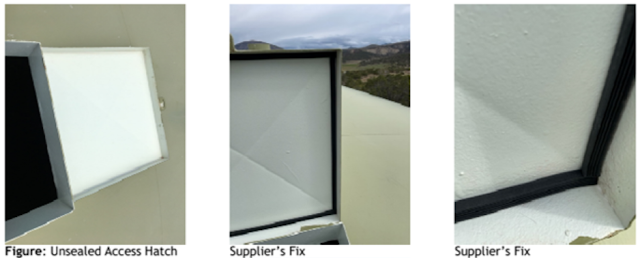
Below is a photo of an unsealed access hatch followed by a set of photos of a newly installed gasket. The supplier created a water and insect tight seal, effectively resolving the significant deficiency.
 

Below is a photo of a flush mounted hatch, which allows for potential contamination due to the lack of an overlapping framed opening. Note the channel on the interior of the hatch that can allow for water accumulation that can seep into the tank. These hatches are vulnerable to extreme weather conditions and contain potential points of failure. 

For additional discussion about flush mounted hatches - see our September, 2022 article.

Flush mounted hatches often contain drains, which frequently clog with debris, dust, dirt and insects. During heavy weather events, these clogged drains can cause water to pass through the gasket and leak into the storage tank, as seen below. 

The hatches above and below allow for insect activity and debris buildup close to or on the gasket, creating a potential for contamination. In the photo below, there are substantial spider webs surrounding the gasketed area of the hatch. 


Vents: 

Vents must be designed to protect the tank from contaminants such as: surface water, stormwater runoff, insects, rodents, birds, etc. All openings must be protected by a non-corrodible screen. Screens may not have openings that exceed 0.07 inches (typically 12 or 16 mesh screen). The screen must be installed within the vent at a location least susceptible to vandalism. The screen must be accessible for replacement. Vents must be designed for unobstructed air flow into and out of the tank.

Common Significant Deficiency to check for and correct if found (the following air vent conditions are not allowed):

  • Storage tanks with unscreened, open construction between the sidewall and the roof
  • Air vents that are not screened or that have damaged or blocked screens
  • Air vents with screens with openings that exceed 0.07 inches (typically 12 or 16 mesh screen)
  • Outdoor tanks with air vents that do not open downward or are not fully covered to protect from rainwater

Please keep in mind, the use of steel wool and/or stuffing steel wool into vents is not accepted as a proper form of screening a vent.

Below are photos of an interior tank lid that is improperly vented. The venting for these commonly found tanks function as a labyrinth preventing potential contaminants; however, the vent does not contain a mesh screen with openings that do not exceed 0.07 inches. With the addition of the mesh screen, the supplier now meets the requirement. Please note that indoor tanks must be vented and must be located at or above the highest point of the tank.


Vents on outdoor tanks must open downward. Downturned vents can be candy cane, mushroom style, or where no portion of the vent screen is visible from a horizontal position (e.g. vent in the side of a hatch assembly with louver protecting the vent). Any vent cover must overlap so that no horizontal pathway exists. Candy cane or downturned vents are allowed to have a visible screen (i.e. not covered) below the bottom of the vent opening as long as no direct horizontal pathway exists between the vent opening and the tank. When a mushroom type vent is used, the minimum opening distance must be measured from the lowest point on the vent cap to allow for air flow to enter the screened area. Integral vents on tanks (e.g., threaded cap on a polyethylene tank access lid) that do not have downturned screening are not allowed outdoors.

For outdoor elevated tanks, the vent elevation from the top of the roof should be a minimum of 24-inches above the top of the roof to prevent snow from clogging vents. The photos below show air vents on an outdoor tank that are screened but not downturned or fully covered to protect contamination from rainwater. 


Please note there are resource online to assist water systems in the operation and maintenance of storage tanks:

The supplier is responsible for complying with  Section 11.28 (Storage Tank Rule) of Regulation 11. Please note that if an inspector identifies any of these issues during a sanitary survey and they have not been previously identified as sanitary defects with a written corrective action schedule, they will be cited as significant deficiencies. If sanitary defects were identified by the supplier during a Storage Tank Rule periodic or comprehensive inspection but are not under a corrective action schedule or were not fixed in accordance with a corrective action schedule, a violation of the Storage Tank Rule may be cited during the sanitary survey.  It is highly recommended that the supplier’s inspection documentation include pictures of the “before” and “after” corrections for each sanitary defect.

Prior to making any alterations to tank venting the department recommends that the supplier consult with an engineer or a professional with expertise in potable water storage tanks to ensure that the tank’s venting capability is not compromised. Alternatively, the supplier can check with the manufacturer of the storage tank to see if any limitations exist for the component in need of alteration or repair. 

➽ Connor Clarke, CWP, Field Services Section

Wednesday, April 19, 2023

EPA Requirement to Address Cybersecurity in Sanitary Surveys

The US EPA Office of Water issued a memorandum, “Addressing PWS Cybersecurity in Sanitary Surveys or an Alternate Process” on March 3, 2023 to all State Drinking Water Administrators requiring cybersecurity evaluations during each sanitary survey. The EPA definition of sanitary survey is “an onsite review of the water source, facilities, equipment, operation, and maintenance of a PWS for the purpose of evaluating the adequacy of such source, facilities, equipment, operation, and maintenance for producing and distributing safe drinking water.” In Colorado, CDPHE conducts sanitary surveys of all public water systems (PWS) every 3 years for community systems and every 5 years for non-community systems. Colorado has been engaged with the Association of State Drinking Water Administrators (ASDWA) over the last year and with EPA’s issuance of the Memo, we are reviewing the newly published requirements and the below information summarizes what we know so far.

What systems are impacted?  

From the March 2023 EPA memorandum, cybersecurity evaluations must be included in the sanitary surveys for all PWSs that use industrial control system technology as part of the operation of the water system. In the EPA guidance document, “Evaluating Cybersecurity During Public Water System Sanitary Surveys” it states that industrial control systems include not only Supervisory Control and Data Acquisition (SCADA) systems, but also Programmable Logic Controllers (PLCs). Colorado does have some small transient water systems that are limited to a basic well and chlorinator, but the vast majority of PWSs in Colorado have industrial control systems in place.

What is being required?

In a nutshell, Colorado will be required to include cybersecurity as part of the sanitary survey process for all PWSs with industrial control system capabilities or establish a program outside of the sanitary surveys that is no less stringent than federal regulations and involves identifying and addressing significant deficiencies in cybersecurity. EPA outlined three options for conducting the assessments:

  1. PWS self assessments/third party assessments followed by a sanitary survey
  2. State conducted assessments during the sanitary survey
  3. An alternative program that meets the requirements. 

EPA recognizes that flexibility will be needed and states may choose one or more options to best meet their needs. For cybersecurity, EPA considers significant deficiencies to include the absence of a practice or control, or the presence of a vulnerability, that has a high risk of being exploited, either directly or indirectly, to compromise an operational technology used in the treatment or distribution of drinking water. The Colorado Primary Drinking Regulations (Regulation 11), Section 11.3(72) defines a significant deficiency as: any situation, practice, or condition in a public water system with respect to design, operation, maintenance, or administration, that the state determines may result in or have the potential to result in production of finished drinking water that poses an unacceptable risk to health and welfare of the public served by the water system. Water systems have to either fix significant deficiencies and violations no later than 120 days after the date of the inspection letter or request a corrective action plan (CAP). If the water system does not fix a significant deficiency by 120 days or an approved CAP schedule, a violation (type 45 violation) requiring Tier 2 public notice occurs. 

When is this taking effect?

EPA has stated that the memorandum was effective as of the date of publication, however, states will need time to build the capacity to implement the requirements. Colorado does not have the capacity to implement these requirements as part of the sanitary survey process during this current inspection year or the upcoming inspection year starting in October 2023. Colorado is evaluating the best path forward for our state at this time in coordination with CDPHE leadership, other states and ASDWA.

What can systems do in the meantime?

All PWSs with industrial control system capabilities should assess their cybersecurity programs with an established method if they have not already done so. EPA guidance recommends that self assessments be conducted with established methods such as those from the Department of Homeland Security (DHS), Cybersecurity and Infrastructure Security Agency (CISA), National Institute of Standards and Technology (NIST), the American Water Works Association (AWWA), International Organization for Standardization (ISO), or International Society of Automation/International Electrotechnical Commission (ISA/IEC). The PWS should implement measures recommended from any assessment to ensure continued production and distribution of safe drinking water. Depending on the approach CDPHE takes, the self assessment reports may be required to be submitted to the inspector prior to the sanitary survey in the future for determination of potential significant deficiencies. 

Additional resources can be found: 

Colorado recognizes that PWSs are among the  targets of malicious cyber activity and is committed to partnering with water suppliers on this issue going forward. Many large utilities have robust cybersecurity programs in place. Many small to medium size systems will need to build cybersecurity capacity. If you have any questions or concerns as we determine the implementation path, we’d like to hear from you. Please contact either Heather Young at heather.young@state.co.us or Cameron Wilkins cameron.wilkins@state.co.us of the WQCD Field Services Section. For cybersecurity training resources, please contact Kyra Gregory at kyra.gregory@state.co.us.

➽ Heather Young, PE, CWP, Field Services Section Manager

➽ Cameron Wilkins, PE, Field Unit II Manager

Wednesday, April 5, 2023

Updates coming to the Backflow Prevention and Cross Connection Control Policy - Policy 7

Our October 26, 2022 posting on the Aqua Talk blog announced our stakeholder process for proposing updates to the Backflow Prevention and Cross Connection Control Rule within Regulation 11 - section 11.39 (BPCCC rule). 

From November 2022 to January 2023, stakeholders engaged with the Water Quality Control Division to develop a draft, updated BPCCC rule which will be considered by the Water Quality Control Commission in the August 2023 rulemaking hearing. A summary of the effort to date is located on our website. The division believes the proposed updates to the rule will equivalently protect public health while making the rule more implementable. The division would like to thank all the stakeholders that engaged during that process for the thoughtful feedback and helping to craft a better rule.

During the outreach, multiple comments were received both in December and January about needing to provide better clarity within the BPCCC policy (Policy 7) in order to make the proposed changes to the rule more optimal and to help water systems know how the division will interpret some of the language in the rule. The division agreed with stakeholders that Policy 7 needs to be updated concurrently with the proposed rule update as the rule and the policy work very closely together. 

Save the date: April 20, 2023 at 2:00 PM.

The division intends to continue the stakeholder engagement process with an initial stakeholder meeting outlining the potential updates needed to the BPCCC Policy 7. The meeting will be held on 4/20/23. The division intends to utilize working groups in several key topic areas to assist in writing the policy updates. We would like to complete most of this work prior to the August rulemaking hearing. 

The topic areas will include, but are not limited to: extension requests, expanding examples on eliminating cross connections, clarifying system surveying and rounding issues, and annual reporting templates, as well as other minor edits.  

We would like feedback from the stakeholder community whether there are other areas that need to be updated within the policy and are hopeful you can participate. The division will provide a comment form on our website in mid-April for stakeholders to submit BPCCC Policy update ideas to us. Also, if you know of other professionals that can contribute to this process, please share this article and our BPCCC website with them. Sign up for stakeholder updates here to be notified of all the latest developments. 

➽ Tyson Ingles, PE, Lead Drinking Water Engineer

➽ Clayton Moores, PE, Field Unit I Manager

Wednesday, March 29, 2023

How can the Local Assistance Unit help you?

As the state primacy agency for implementing the Safe Drinking Water Act in Colorado, the Department of Public Health and Environment is responsible for implementing a capacity development program. The department implements parts of their capacity development program through the activities of the Local Assistance Unit (LAU). The goal of the LAU is to protect public health by assisting public water systems as they build their Technical, Managerial, and Financial (TMF) capacity. Division staff wrote an article in August of 2022 highlighting the importance of TMF capacity building. This article will detail the ways in which the LAU can help you and your drinking water system continue to improve your TMF capacity to better serve your customers and community. 

The department's Safe Drinking Water Program operates under a culture of health and LAU’s primary focus is to work with water professionals to build a culture of health in their duties and in the public water systems they work with. In our work with public water systems we focus on the primary mission of our industry: to protect public health by providing Colorado’s communities with safe drinking water. We know this work takes precision, dedication, expertise, and continuous improvement. Our aim as a unit is to assist you in the critical work you do.

Any water system can implement capacity development and feel the benefits of increased TMF capacity. Small systems can especially benefit from capacity development as these systems often face resource challenges (few staff members, limited funding, aging infrastructure etc). The LAU and our team is dedicated to assisting all public drinking water systems in Colorado, and especially small and rural systems. Please note that all of the programming that our unit offers is free of charge. Our coaching and training opportunities are meant to help all water sector professionals including but not limited to: decision makers, administrative staff, operators, maintenance staff, water boards, city councils, lab staff, and anyone else that is invested in and responsible for protecting public health by providing safe drinking water.  

Water Sector Coaching 

Our water coaches travel across the state to deliver one-on-one assistance to public water systems. To work with a coach (free of charge) please fill out our coaching request form. Our coaches will reach out to you to establish contact and to determine the areas where your system wants to improve. We will then work with you to create a project plan, implement that plan, and help you overcome roadblocks and challenges to your plan. The main tool that our coaches use to establish these goals is a TMF worksheet. This worksheet is a series of questions that help you and your coach identify what is working well, what needs work, and where you would like to focus your efforts. Based on the TMF worksheet your coaches may work with you on one of the below areas.

Regulatory compliance: Lead and copper rule revision, backflow and cross-connection planning and implementation, tank inspection and summaries, updating your monitoring plan, interpreting and responding to recent sanitary survey findings, preparation for an upcoming sanitary survey, developing a plan to return to compliance in cases of enforcement orders, interpreting sampling schedules, and developing sampling techniques. 

Technical troubleshooting: source water protection and analysis, storage tank operations and maintenance, data collection for potential GWUDI, treatment operations, distribution system operations, maintenance planning and execution, special studies (tracer study, jar test, etc), waste stream residual management, changes in operations that would warrant a design approval submission to division engineers, and setting up a newly discovered system. 

Facility management optimization: project management techniques, administration organization techniques and tools, regulation 100 overview, roles and responsibilities of the operator in responsible charge (ORC) and decision-maker, creating a written agreement with an ORC, delegation planning, operations and maintenance planning, standard operating procedures, staff training programing, and workforce development. 

Financial planning: capital improvement planning, grants and loans documentation, asset management planning, financial project management, rate setting, and budgeting. 

Emergency management: tabletop exercises, Continuity of Operations Planning (COOP), development of risk and resilience assessments and emergency response planning documents, security and safety, and emergency preparedness and response.

Water Sector Training Events 

In addition to coaching, LAU also offers free virtual and in-person training events every month. Below are LAU’s current training opportunities. To register for any of the training events please click on the training title, this will send you to a document with all of the upcoming offerings for that training. You can then register for the training you are interested in by selecting the date and filling out the registration form. You will receive an email shortly after you fill out your registration. Please contact cdphe.wqdwtraining@state.co.us if you have any questions or run into any issues with registration. All of the training events we offer are approved for training units. 

  • Monitoring and Operating for Regulatory Compliance: This 4-hour course is offered on the first Wednesday of every month. The training is approved to meet the operator certification regulatory training requirement for Water. The purpose of this training is to equip you and your system with the tools and strategies to comply with Regulation 11 and 100. We are currently focusing on the following topics in this training: storage tank operations, maintenance and planning, monitoring schedules, monitoring plans, backflow prevention and cross-connection control planning and implementation, compliance with current the lead and copper rule and planning for the upcoming lead and copper rule revision, and  regulation 100 planning and compliance. 
  • Sanitary Survey Preparation: This 3-hour training is offered on the third Wednesday of every month. We aim to equip you with resources and skills to recognize and proactively address potential violations and significant deficiencies.  
  • Building Resilience in Your Water/Wastewater System: This 4-hour training is offered on a quarterly basis. The training focuses on resilience planning and aims to help you create, implement, and build upon your emergency management plans, improve your system’s security measures, take stock of your current financial situation and plan for your system’s financial future, and navigate State Revolving Fund (SRF) funding opportunities.  
  • Lead and Copper Rule Revisions: This 2-hour training is offered monthly throughout 2023. The training will help your system plan and prepare for the rule revision changes that go into effect October 2024. 

Thank you for all of your hard work to protect the public health of Colorado Communities. The Local Assistance Unit looks forward to working with you! 

➽ Kyra Gregory Drinking - Water Training Specialist


Wednesday, March 22, 2023

History of Disinfection Waivers and Where We Go From Here

 Hello everyone, 

In the Fall 2013 issue of Aqua Talk we ran a brief article regarding the history of disinfection waivers in Colorado and where we were planning to go in the future. We thought it would be a good time now to provide an update. 

In 1955 the State Board of Health recognized the tremendous risk reduction from waterborne disease that results from disinfecting drinking water, and adopted a resolution recommending that all drinking water supplied to the public contain at least 0.1 parts per million of free available chlorine. In 1967 the State Board of Health required disinfection of all drinking water unless that requirement was specifically waived by the Colorado Department of Public Health and Environment based on evidence that the drinking water was free of contamination.  

Over the years from 1967 to about 2000, approximately 126 disinfection waivers were granted across the state including 62 community water systems serving 60,695 people. The department lacked a systematic process for reviewing the status of these waivers on a periodic basis. The department began to review the status of disinfection waivers in about 2007, which was before the 2008 Alamosa waterborne disease outbreak. We found that many of these systems had already begun to disinfect their drinking water. 

In 2010, the Water Quality Control Commission banned new disinfection waivers and imposed more appropriate requirements on systems with disinfection waivers if they wished to retain them. After that, the division began systematically reviewing all the disinfection waivers in the state to make sure that they complied with the requirements and working with systems to get disinfection installed if their disinfection waiver was withdrawn. We continued implementing this rule, and systems that struggled with bacterial contamination had their waivers withdrawn. We also started to periodically review the waivers every year. By late 2010, the number of disinfection waivers fell to less than 40 public water systems. 

From late 2010 through about 2013, the division implemented the new requirements regarding disinfection waivers and many systems chose to begin disinfecting while several disinfection waivers were withdrawn as well. By late 2013 only about 15 disinfection waivers remained in place. Since then, the division continued to review disinfection waivers and withdraw waivers when circumstances merited, typically when multiple positive total coliform or E. coli events occurred without there being an adequate way to assure that such events would not recur.

As of 2023, only two (2) of the approximately 2,075 public drinking water systems in Colorado have disinfection waivers, and they are both at community water systems. The systems are the Towns of Ward in Boulder county serving about 230 people and Sanford in Conejos county serving about 850 people. Without further regulatory changes, those systems will retain their waivers as long as they continue to meet the regulatory requirements. We review the status of disinfection waivers annually, whenever there are total coliform rule violations or positive bacterial tests, and during sanitary surveys. The graph below displays the history of disinfection waivers in Colorado from the high point of 2007 to 2023.


➽ Ron Falco, P.E. Safe Drinking Water Program Manager

➽ Bryan Pilson, Technical and Regulatory Implementation and Coordination Unit manager


Wednesday, March 15, 2023

Coming Down the Pipe - TMF R541 Observation

During sanitary surveys, the Field Services Section (FSS) has encountered serious significant deficiencies at water systems such as tanks with collapsing roofs, major water loss in raw water transmission lines and distribution systems, or evidence at water treatment plants of a substantial lack of preventative maintenance. Many of the systems experiencing these major issues are small community water systems struggling to manage a water system and keep up with replacement of aging infrastructure. Fundamental to this issue is Technical, Managerial, and Financial (TMF) Capacity of a public water system (PWS). TMF capacity, also known as Capacity Development, is part of the 1996 Safe Drinking Water Act (SDWA) Amendments. Capacity Development is a process for PWSs to build technical, managerial and financial (TMF) capacity to be able to continuously provide safe drinking water to the public. Activities involved with developing adequate TMF capacity include items such as asset management, financial planning and water rate setting in addition to managerial and technical capacity as shown below:  

Source: US EPA - Building the Capacity of Drinking Water Systems

As inspectors work with PWSs during the sanitary survey process, they may ask basic questions regarding TMF actions that the PWS has implemented. If a PWS has TMF capacity areas of improvement, a new observation will be listed in the inspection report. This observation will be coded as R541 TMF and will explain the importance of TMF and provide links to resources that are available to PWSs. Water system operators may find it helpful to review this observation with system ownership and management to gain support to undertake needed TMF capacity development activities and get help as discussed below.  

Please note that Regulation 11.4.1 also requires all new community or non-transient, non-community water systems commencing operations after October 1, 1999 to receive Department approval of a TMF capacity assessment using the criteria found in the New Public Water System Capacity Planning Manual (Drinking Water Policy 11). Please reach out to the WQCD Engineering Section at CDPHE.WQEngReview@state.co.us for any questions regarding new PWS TMF requirements.

Resources: 

➽ Heather Young, PE, CWP, Field Services Section Manager

➽ Tom Valenta, Field Unit III Work Group Lead 

Wednesday, March 8, 2023

Upcoming Regulatory Changes for the 2020s

In January 2023 we published a recycled Aqua Talk article about upcoming drinking water regulatory changes that were expected in the 2000s. The article was recycled from our December 2000 newsletter. Back then the newsletter was called Tapping In.  In February 2023 we again published a recycled Aqua Talk article about upcoming drinking water regulatory changes. This time the article was the October 2008  Aqua Talk article entitled “New Rules in Challenging Times” about our then-recent adoption of the Long-Term 2 Enhanced Surface Water Treatment Rule, Stage 2 Disinfectants/Disinfection By-Products Rule, and the Groundwater Rule. These rules were significant and  together applied to all the public water systems in Colorado. In both the early and late 2000s the challenges faced in the U.S. were largely economic, and there were also security concerns. 

As we move forward in the 2020s, we again face tremendous challenges in our country and the water industry. The challenges are too numerous to fully elaborate, but many stem from the COVID-19 pandemic and related economic upheaval, including serious supply chain issues. We are also faced with more severe security threats than ever before. Colorado water utilities have been targeted with ransomware attacks and other physical security incidents have occurred as well.

On top of all this, as noted in the lead-in paragraph of the January 2023 recycled article, the 2020s promise to be a decade of substantial changes to the federal Safe Drinking Water Act. I believe that these will be the most significant and intense set of new and updated drinking water rules we have experienced since the early 2000s. In the early 2000s Colorado was well-positioned for a number of these rules because of the way we approached drinking water regulations over a long period of time, such as our disinfection and certain surface water treatment practices, combined with intense planning to get ahead of, or at least early starts on, the arsenic rule, radionuclides rule and groundwater rule. Now, in 2023, I believe that we are once again well-positioned to tackle a number of the challenges associated with the upcoming rules. We have instituted special projects since the late-2010s that will help us with preparations for the Lead and Copper Rule Revisions (LCRR) via the Lead Outreach and Verification Effort (LOVE) project, surface water treatment via the Disinfection Outreach and Verification Effort (DOVE) project, and extensive PFAS sampling. We also have a considerable influx of federal funding dollars via the Bipartisan Infrastructure Law (BIL) to help with the investments that water utilities will need to make in this decade. Additionally, we recently completed the development of a Direct Potable Reuse (DPR) Rule that will support Colorado’s water supply future. The table below summarizes all these new (DPR and LCRR are either completed or underway) and new rules in the 2020s. As of this writing, the EPA’s draft PFAS rule has not been published. The modest change to the Backflow Prevention and Cross Connection Control (BPCCC) Rule slated for August 2023 is not shown. 

Please note that states typically have two years, from the date of a final federal rule to adopt and implement it, with compliance dates usually starting soon thereafter. So, for the PFAS rules, states would have until Fall 2025 to adopt the rule. However, some rules have had “early implementation” requirements in the past. Each rule is unique. 


As you can see, this is quite a list. While utilities must comply with these rules, states must be able to adopt and adequately enforce the rules to maintain primary enforcement authority or “primacy”. To gain primacy for each rule, detailed “primacy packages” need to be prepared by the state and reviewed by EPA to gain approval. In talking with many of my colleagues across the U.S., many states have experienced such a degree of staff turnover in the last several years, that a number of states have no staff that have previously prepared a primacy package for EPA. But rest assured in Colorado, we still have many experienced staff that have conducted stakeholder engagement processes and prepared primacy packages. As always, we will be engaging stakeholders in developing these rules, a process well underway for LCRR, and also importantly identifying assistance, policy and training needs during those processes as well. 

We will strive to help water systems meet these rules and requirements as best as our funding and resources enable us to. But I urge you to learn about these new rules as soon as you can, so that you can best prepare your water system for the challenges that it may face in addressing them and keeping tap water safe for your customers. Thank you.

Ron Falco, P.E. Safe Drinking Water Program Manager