Pages

Wednesday, July 19, 2023

Culture of Health: Water Borne Disease Outbreak Rainbow Valley Ranch

The department promotes a ‘Culture of Health’ in order to encourage water providers to provide the highest water quality practical and to avoid waterborne disease outbreaks. Generally the department relies on what we call “performance partners” which are operators and suppliers of water to ensure the drinking water is safe. There are times that property owners do not cooperate and it becomes all the more important for the partnership between professionally certified operators and the department to stand firm. In the situation below, which did result in human illness, the contract operator that visited the site was instrumental in helping us understand and discern the facts on the ground. While ultimately the owner chose to sell off a portion of the property to avoid being a regulated public water system, the important realtime information from performance partners in the field helped mitigate the effects of this outbreak. As it stands today, the community should be receiving hauled water from a nearby regulated public water system that is safe to drink, however there is not regulatory oversight of the situation. 

The department values the public health professionals and certified water operators that are the ‘boots on the ground’ helping to protect public health and the environment every day. “If you see something, say something.” It may make all the difference in helping prevent or stop a waterborne disease outbreak.

Outbreak Summary Report:

Rainbow Valley Ranch is a small community and fishing club located in Teller County, Colorado. Before this outbreak, Rainbow Valley Ranch was considered to be a nonpublic water system as they served fewer than 25 people for at least 60 days of the year. Nonpublic water systems are not required to comply with the Safe Drinking Water Act and CDPHE has no regulatory authority over their water system.

According to residents of Rainbow Valley Ranch, people reported illness in April 2022, and CDPHE epidemiologists and WQCD staff worked together to collect and analyze information. Ultimately, CDPHE confirmed this as a confirmed waterborne disease outbreak on July 25, 2022. Four people from multiple households met the case definition of an acute onset of gastrointestinal illness. All four cases were Colorado residents, no one was hospitalized, and all individuals survived the illness.

Epidemiology and Investigation Concluded: Illness was likely Non-Shiga Toxin-Producing Escherichia coli bacteria are found in surface water, like lakes and streams. These bacteria live in the intestines of mammals, and some can cause mild to severe gastrointestinal illnesses.

Summary of Sampling and Gastrointestinal illness:

  • 4 sick individuals
  • 5 total coliform positive results
  • 2 E. coli positive results 

Gastrointestinal Illness: 

Non-Shiga Toxin-Producing Escherichia coli infections can cause gastrointestinal illness with diarrhea and abdominal cramps, among other symptoms. These bacteria occur naturally in the intestinal tract of most animals and people, and can enter surface waters like rivers and

lakes through animal waste. When the people at Rainbow Valley Ranch drank the untreated surface water, the bacteria made them sick. 

Incident Timeline: 

  • April 1, 2022
    • At least one resident experienced gastrointestinal illness symptoms.
  • July 20, 2022
    • CDPHE received notification from a tenant at Rainbow Valley Ranch about their drinking water. According to the complainant, the landlord was using untreated lake water for the community’s drinking water and the complainant had diarrhea and blood in their stool. The complainant took a drinking water sample and sent it to the lab, where it was later confirmed as containing E. coli bacteria.
  • July 21, 2022
    • WQCD performed a site visit, reviewed the source (2 lakes) and treatment processes and collected total coliform samples. WQCD identified a filtration and disinfection system, but the disinfection was not connected to the water and the filtration system was not certified to remove bacteria or viruses. Chlorine results were non-detect.
    • In addition, WQCD completed a population count and determined that Rainbow Valley Ranch met the definition of a public water system and would need to comply with the requirements in the Safe Drinking Water Act.
  • July 22, 2022
    • WQCD received lab results from the total coliform samples showing the presence of total coliform and E. coli. The division issued a boil water advisory to the system, requiring the owner to inform all residents that they must boil their water before using it.
  • July 23-24, 2022
    • Teller County Public Health and Environment received several other complaints from Rainbow Valley Ranch residents who were experiencing similar gastrointestinal illness symptoms.
  • July 25, 2022
    • Teller County Public Health and Environment interviewed residents to gather information on symptoms, onset dates, and water quality issues. CDPHE evaluated information and sample results and determined this was a confirmed waterborne disease outbreak. CDPHE required that the owner continue to post the boil water advisory and maintain a 2 ppm chlorine residual until the issue was resolved.
  • August 31, 2022
    • The owner of Rainbow Valley Ranch reported that she has stopped using the lakes for water and is instead hauling water from a nearby public water system.
  • September 7, 2022
    • WQCD issued an enforcement order and required the owner to pay a penalty, correct sanitary defects, and hire a certified operator, among other things.
  • Late Fall/Early Winter 2022
    • The Owner subdivided the property and sold half in order to avoid being a regulated public water system. The fine is still in effect.

➽ Tyson Ingles, Lead Drinking Water Engineer

Wednesday, July 5, 2023

Program Manger's Message: Draft CCR Rule Considerations

We recently published an article about the draft PFAS rule published by EPA in March 2023. EPA also published a draft rule in March 2023 to revise the Consumer Confidence Report (CCR) Rule. EPA was required to undertake this action when Congress passed and the President signed America’s Water Infrastructure Act (AWIA) of 2018. AWIA amended the Safe Drinking Water Act and required EPA to revise the CCR rule to:
  • Increase the accuracy and readability of CCRs;
  • Provide more information about lead;
  • Require systems serving more than 10,000 people to provide CCRs twice per year; and,
  • Allow for electronic CCR delivery.

EPA also decided to include a provision in the rule requiring states to provide direct compliance monitoring data to EPA as opposed to the current practice of reporting summary information and violations only. We are concerned about this provision leading to EPA micromanaging states with primacy and frequently questioning us about specific water systems that may have issues particularly with per- and polyfluorinated alkyl substances (PFAS) or lead or whatever contaminant may be perceived as a hot topic at the moment.

In reviewing the draft rule we identified some items of concern that the Association of State Drinking Water Administrators (ASDWA) highlighted in its comments on the draft rule. While EPA was certainly required by AWIA to increase the CCR frequency for large systems, specific provisions in the draft rule appear to require water systems to duplicate efforts and communications already undertaken when water systems provide information to the public as part of the Public Notice Rules. We hope EPA elects to reduce those duplicative activities. 

The draft CCR rule also placed a heavy emphasis on translating CCRs into alternate languages and requires states to assist water systems in this process. We support helping people get information they need in a language they best understand. We are happy to assist water systems in achieving this goal. However, we are concerned that the draft rule could be construed as requiring states to undertake translation services in some instances. We believe that EPA must take the lead in helping states and water systems with translation. But states should not be directly required to take on this task by EPA; doing so can create an inherent conflict of interest with states' oversight role. 

Although EPA was tasked in AWIA with improving readability, ASDWA still believes that some of the revised language, such as the nitrate and arsenic education statements, are reading at a 12th -14th -grade level, which is too high for the general public. To improve readability, EPA should simplify much of its new language to a lower reading level. 

EPA also had some concerning language in the draft rule about “misleading statements.” We agree that it is unacceptable for water systems to put misleading statements in CCRs that underplay the health risks from violation or similar circumstances. In Colorado, we review CCRs and require that misleading statements be corrected. However, EPA used an example of a misleading statement as characterizing the drinking water as “safe.” We have serious concerns about this example. Considering that the Maximum Contaminant Level Goals (MCLGs) for many contaminants are zero, we understand that many contaminants can impart a very low health risk even if below the MCL. However, we do not believe that stating the water is safe to drink when a system is in compliance is a misleading statement that must be corrected. 

The timeline for this proposed rule is also concerning. EPA plans to finalize this rule in 2024, and then have it go into effect in 2025. This is not enough time and very challenging from a feasibility standpoint. For most drinking water rules, states have two years to adopt the rule and then the compliance date is one year out from that. Specifically, this is not enough time for states to adopt the rule and attain primacy. This is also not enough time for states to develop the needed policies, guidance, and business processes to support implementation. This is not enough time for states and water systems to develop translation assistance efforts and materials needed. We hope that EPA takes a more reasonable approach to the timing of the final rule.

Lastly, this rule will also require new resources for the division to implement. Colorado has been able to implement several new rules the last decade involving disinfection, water haulers, storage tanks, backflow prevention and cross connection control, and the revised total coliform rule without adding program resources for implementation. However, with this CCR rule coming essentially at the same time as the Lead and Copper Rule Revisions (LCRR) and the PFAS rule, the division must obtain additional resources to support maintaining primacy into the future.  

As always, we will engage with stakeholders in developing the CCR rule for Colorado. We already have a very strong program with respect to public notice, the current CCR rule and translation, especially into Spanish. We will do our best to help water systems comply with the CCR rule considering our funding and resource levels. I advise you to learn about the new draft CCR rule and take steps to prepare your water system for it. 

Thank you,

➽ Ron Falco, P.E. Safe Drinking Water Program Manager


Wednesday, June 28, 2023

Chlorine Residual Monitoring and Pocket Colorimeters


During sanitary surveys, inspectors evaluate where chlorine residual sampling is being performed and will request to do side-by-side chlorine residual measurements with the operator. Chlorine residual monitoring is required both for entry point chlorine residual monitoring and also in the distribution system during bacteriological sampling. Public water systems that only use sodium or calcium hypochlorite or chlorine gas to form free chlorine for disinfectant residual should be monitoring and reporting free chlorine residual at all times. Conversely, any systems adding ammonia to form chloramines must monitor and report disinfectant residual as total chlorine residual. In this article, we will discuss handheld colorimeters and questions we’ve received from operators during sanitary surveys on properly measuring both high range and low range chlorine residuals. Improperly using an EPA accepted test method, using expired or incorrect DPD reagent or not verifying or operating disinfectant monitoring analytical equipment in accordance with manufacturer requirements can result in a violation of Regulation 11, Section 11.46. This was one of the Top 10 most cited violations cited during sanitary surveys in 2022.

The main issue inspectors often see in the field is measuring low range vs. high range free chlorine residual. For HACH pocket colorimeters (PCII) in the low range (LR) setting, a readout of 2.2 will flash repeatedly if the sample concentration is above 2.2 mg/L free chlorine. Recording the 2.2 mg/L as the chlorine residual is not correct and will result in a violation during a sanitary survey. The operator should be familiar with how to change their chlorine analyzer setting from low to high range. For a HACH DR300 or a HACH PCII, you must select the High Range (HR) menu option (please see your manual). For HACH units in High Range, the sample cell also changes to the plastic vial with a 5-mL sample and two 10‑mL DPD Free Chlorine Reagent Powder Pillows or two 10‑mL DPD Total Chlorine Reagent Powder Pillows must be used for each test. Please see your manual for your specific chlorine residual kit, and note that some manuals have to be downloaded online now.

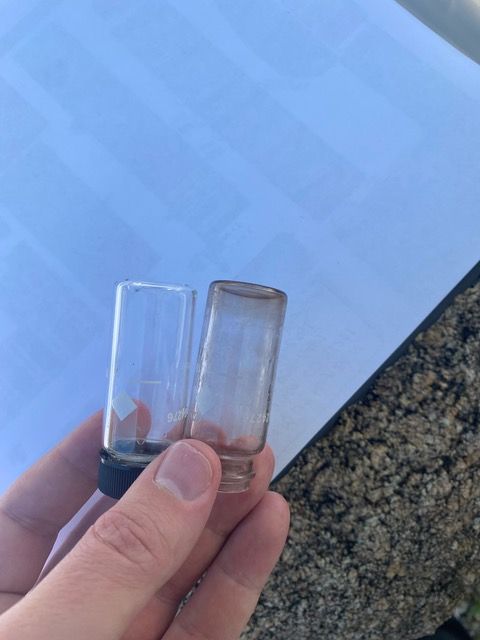
Other issues that can result in field based violations for chlorine residual monitoring is using expired DPD reagent and glassware that is caked with DPD (see photo below). 

Operators must be familiar with their colorimeter and should have written maintenance procedures and a maintenance log implemented for the analyzer, including routine verifications required by the manufacturer (HACH does not specify a frequency for pocket colorimeters but CDPHE does quarterly checks with GELEX standards on our pocket colorimeters). Please note that for online chlorine analyzers used for compliance with Regulation 11, online analyzers must be verified at least once a week by taking a parallel grab sample and analyzing it by another verified method (bench top) or by comparison with other parallel analyzers (see Policy 4 Guidance). All verification checks and results should be written down in a logbook.

Please avoid these field-based violations related to chlorine residual monitoring and ensure proper disinfection by being familiar with your analyzer and following proper sampling protocol. For any questions or concerns, please email our Field Services team at cdphe_wqcd_fss_questions@state.co.us.  

➽ Connor Clarke, CWP, Field Services Section

➽ Heather Young, PE, CWP Field Services Section

Wednesday, June 21, 2023

Program Manager's Message: Draft PFAS Rule Considerations

We finally reached the stage where EPA is nearing the completion of the process that leads to a new drinking water rule being added to the Safe Drinking Water Act to address per- and polyfluorinated alkyl substances (PFAS). This has been a long journey, and there is still a ways to go before a rule is in place and implemented. Several years ago two PFAS compounds, PFOA and PFOS, were part of the third Unregulated Contaminant Monitoring Rule (UCMR3). We started working to address PFAS in drinking water in 2016 after we became aware of their presence in drinking water at several communities in El Paso County. Our efforts continued through the 2020 sampling project and today in implementing the updated PFAS health advisory EPA issued in June 2022.

EPA made the decision to regulate PFAS under the Safe Drinking Water Act in late 2021 and in March 2023 published a draft rule for public comment. The draft rule for PFAS establishes Maximum Contaminant Levels (MCLs) for PFOA and PFOS at 4 parts per trillion (ppt) and a novel (at least within the Safe Drinking Water Act) Hazard Index approach to address four more PFAS compounds - PFNA, PFHxS, GenX and PFBS. Of these, PHHxS which is often associated with firefighting foam has been detected most often in Colorado. During its fifth Unregulated Contaminant Monitoring Rule (UCMR5) testing EPA is again sampling for multiple PFAS compounds, so more of these may be addressed in future rule revisions. 

EPA indicated that after the public comment period on the draft rule, it anticipates finalizing the PFAS rule in early 2024. States typically have two years to adopt a final rule, and then the compliance date follows a year of initial monitoring. So the compliance date for this rule would be sometime in 2027 if the normal schedule is followed.

EPA structured this draft rule to model other chronic organic contaminants with quarterly monitoring and compliance based on a running annual average of those results. Reduced monitoring options are available. Violations of the MCL or Hazard Index would result in Tier 2 public notice. We support this approach as compared to a possible approach treating violations as an acute health risk warranting Tier 1 public notice.

There is a significant need for EPA guidance on this rule that addresses treatment design and conduction pilot studies, residual waste handling and disposal, reduced monitoring and the trigger level, public notice and communications and much more. This is very important to foster state implementation and water system compliance. 

We believe that there are many feasibility concerns associated with addressing PFAS contamination in drinking water generally, and these become even more challenging with MCL values set at the practical quantitation limit that many laboratories can reliably achieve. Although the laboratory Colorado has been using can get lower values than the MCLs, this one laboratory will not be able to serve all the water systems that need to test. Lab capacity could become a significant problem, and the turnaround time to obtain results could also become very slow.

This rule will also require significant new resources to implement. Colorado has been able to implement several new rules the last decade involving disinfection, water haulers, storage tanks, backflow prevention and cross connection control, and the revised total coliform rule without adding program resources for implementation. However, with this PFAS rule coming essentially at the same time as the Lead and Copper Rule Revisions (LCRR) and the Consumer Confidence Rule (CCR) revisions, the division must obtain additional resources to support maintaining primacy into the future.  

In addition to feasibility concerns with laboratory capacity and program resources, financial resources for water systems to secure compliance will also be needed. The State Revolving Fund and Bipartisan Infrastructure Law have provided a boost, but this will not be enough funding for all the needed projects. These funding sources help with initial design and construction activities, but do not help with the long-term operating and maintenance costs. For PFAS, residual handling and disposal costs are likely to be high, and these costs will need to be borne by water utilities and ultimately rate payers. Small systems will face special challenges with the costs and need for higher operator certification levels if treatment needs to be installed. 

As always, we will be engaging stakeholders in developing the PFAS rule for Colorado. Fortunately, we have many staff that are experienced with PFAS that understand the issues and challenges, and have been helping water systems address contamination. This will enable us to identify assistance, policy and training needs. We will strive to help water systems meet the requirements of the PFAS as best we can considering our funding and resource levels. Our goal will be to get as many systems as possible into compliance before the required deadline. I advise you to learn about the new draft PFAS rule and take steps to prepare your water system for it. If you have not yet collected PFAS samples from your system, I advise you to contact us and we will test your water for free. Getting in front of this now while funding is available is the best approach to keeping tap water safe for your customers. 

Thank you,

➽ Ron Falco, P.E. Safe Drinking Water Program Manager


Wednesday, June 14, 2023

Lessons Learned - Weld county legionella cluster

What Occurred?

In November and December of 2022, the Weld County Public Health Department consulted with CDPHE about an unusual number of cases of Legionnaires Disease occurring in a relatively small area. There were five reported cases of the illness and case interviews were completed for four of the five affected people. Excerpt from the internal communications at the time:

"We have recently seen a notable increase in reported legionella infections in Weld County – five cases in the last 12 days. Of the three most recent cases, two live within two miles of each other and one lives within seven miles of the other two. We have not yet found any evidence of linked exposures."

In a situation where a cluster of illnesses is identified and there is a potential for the root cause of the illness to be drinking water, public health partners work with the Safe Drinking Water Program here at CDPHE to assess the likelihood/possibility that the drinking water is the root cause of the cluster (or waterborne disease outbreak).

What was the Response?

Based on initial interviews with the ill folks, the county determined that there appeared to be a lack of common exposures that are usually seen. Typically in a legionella outbreak, you may find that all infected people used the same recreation center hot tub or shop at the same grocery store that has vegetable misters running. 

The county and state epidemiologist group then reached out to the Safe Drinking Water Program staff to check the known addresses of the ill people to see if they were served by the same water system and if it was possible that a contamination event had occurred at that specific water system. We specifically were trying to determine whether there had been any service disruptions, major construction projects, water main breaks, or other events related to the water utilities that service these individuals' residential areas. 

The Safe Drinking Water Program then interfaced with water system operational staff to confirm whether there had been any water quality issues in these areas. Also, it was determined that these homes- while being in proximity to each other, were served by four different water providers. All providers demonstrated robust chlorine residuals and were able to show a lack of bacteriological contamination in their drinking water.

While the specific cause of this outbreak was never determined, public drinking water was eliminated as a source.

What can a water operator do to prepare for such an event?

If a cluster of illnesses occurs in your service area, you may be called upon to produce records of treatment and distribution system water quality in order to eliminate any potential that your drinking water caused the illnesses. 

Maintaining treatment plant records is standard procedure for most public water systems.  However, having a comprehensive distribution system microbial sampling that goes beyond the minimums of the total coliform rule is more rare. Consider developing water quality sampling starting with distribution system basic water quality parameters like chlorine residual, pH, turbidity and heterotrophic plate count. This will help provide assurance that your distribution system water quality is not the cause of a legionella outbreak. Also, water sampling for legionella can be done on a quarterly or semi-annual basis to provide further assurances to the public that the drinking water quality you provide to your customers is safe and relatively pathogen free. 

➽ Tyson Ingles, Lead Drinking Water Engineer

Wednesday, May 31, 2023

Coaches' Classroom: Asset Management

What is Asset Management - What’s in it for you? 

First off, you may be asking yourself, what exactly is an asset? Everything from your water source (maybe a reservoir or even a well) all the way to the valves, pipes, and storage tanks in your distribution system. Even your treatment chemicals, filters, and pumps. Don’t forget your operators, buildings, and office equipment. All of these are assets and they are essential to protecting public health and the environment. 

Asset management has many definitions but think of it as getting the most for your money. Through asset management, you will learn how to optimize the lifespan of your equipment and reduce water quality problems due to failing equipment. 

In fact, asset management is one important activity involved with developing adequate Technical, Managerial, and Financial (TMF) Capacity, and it is a best management practice that department inspectors are looking for during the sanitary survey process.

Asset Management Resources & Training Opportunities 

Every system has differences in equipment, environment, and financial capacity. Owners and operators must study and understand the specific assets that their system has. They must keep records and make plans in order to make sure their system is operating at its best now and in the future. Unsure how to pull together all of the critical information or where to get started? There are resources and people available to you. 

If you still have questions after reviewing these tools and attending the free training, consider one-on-one assistance provided by the Local Assistance Unit. Click here to request a coaching visit (virtual or in-person options are available). 

We all have the same goal in mind - the protection of public health and the environment, and with some thoughtful planning and communication, we can help ensure this happens. 

➽ Jessica Morgan, Facility and Operator Outreach and Certification Board Liaison

Wednesday, May 17, 2023

Small Utility Boards, Operators, and the Public: Collaboration for Safe Drinking Water

In the Fall 2009 issue of Aqua Talk, the division ran an article on how collaboration amongst small utility boards, operators, and the public helps ensure communities are provided with clean, safe drinking water. We thought it would be a good time to revisit this information and highlight its importance. 

A water board’s primary responsibility is to provide consistently safe drinking water to its community. There are various elements the board must implement to ensure that happens. 

  • The water board must retain a Certified Operator in Responsible Charge (ORC) that holds a certificate in a class equal to or higher than the class of the water system; 
  • Foster a water system that is protective of its source water; 
  • Employ treatment techniques appropriate to the quality of the raw water; 
  • Prevent recontamination in storage takes and distribution lines; 
  • Meet all regulatory monitoring and reporting requirements; 
  • Provide consumers with water quality information; 
  • Notify consumers of any health threats; and
  • Obtain approval prior to the construction of new facilities.

Clear communication between the board, the ORC, and the state is a collaborative effort and is necessary to provide the community with clean, safe drinking water. Clear communication means establishing and maintaining well-defined duties and expectations, operation and maintenance manuals, standard operating procedures, well-organized records, and financial planning for future repairs, upgrades, and emergencies.  

A well-organized board of directors has established procedures for the recruitment, selection, and orientation of new members. The board should have a mission statement, bylaws, and personnel and procurement policies that are regularly updated. The board must protect its community by providing adequate liability insurance, financial procedures and oversight, and strategic planning. Boards should meet regularly, provide minutes of meetings, retain an organized file of copies of all system records, and continually monitor the performance of the water systems’ services and compliance records. 

Strategic planning is an approach that systematically shapes the future of a water system. It creates a framework for establishing goals, working towards those goals, and evaluating progress that can increase the water system’s efficiency and effectiveness. Strategic planning also helps ensure that the water system has the funds available to support ongoing repair and maintenance needs and to fund capital improvements, as necessary. The development of a strategic plan should be done in cooperation with the system’s operations staff, the board, and members of the community. Strategic plans are never “finished” and the board should make sure that it revisits its strategic plan at least annually.

A board should understand the basics of its water system’s facilities and equipment so it is able to make informed decisions and provide leadership that increases the system’s quality, efficiency, and sustainability. It is important to note that unless certified, board members should never attempt to operate the water system or make process control and/or system integrity decisions as those are reserved to the ORC. Only certified operators may perform operations, adjust the water system, or supervise the repair and replacement of system components. The board’s function is to ensure the water system has the required staff, equipment, guidance, and financial support. 

If you would like to receive water board training to help build your board's technical, managerial, and financial capacity please fill out a drinking water coach request form

Source: Water Board Basics for Small Water Systems in Colorado, Rural Community Assistance Corporation, and the Colorado Department of Public Health and Environment. 

➽ Jessica Morgan, Facility and Operator Outreach and Certification Board Liaison