Pages

Wednesday, January 25, 2023

Meeting Training Needs: Our Next and Better Normal Approach

The Safe Drinking Water Program operates under a Culture of Health umbrella. We take our responsibility seriously and make every effort we can to support public water systems and the operators that help make safe tap water available to the public every day. Among the services we provide are coaching and training for water systems and operators. During the COVID-19 pandemic these services almost always had to be done remotely. There are many advantages to this learning modality including reduced travel time and convenience. But some people learn better in person and some topics are better covered in person also. As the pandemic subsided we shifted to mixed modes of offering coaching and training services in our Local Assistance Unit. We believe this shift fits with our Culture of Health by maximizing opportunities for water systems and operators to get the coaching and training they need in the most efficient and effective manner for them and our staff. The information below summarizes some recent activities in our Next and Better Normal way of doing things.  

Summary of recent coaching and training services late 2022: 

  • The team provided a “Monitoring and Operating for Regulatory Compliance” webinar training session on September 7. The webinar training was attended by 8 water professionals from 7 drinking water systems. The team provided a “Monitoring and Operating for Regulatory Compliance” in-person training session on October 5 in Limon. The in-person training was attended by 16 water professionals from 12 drinking water systems.
  • The team provided a “Building Resilience in your Water/Wastewater System” in-person training session on September 20 in Steamboat Springs. The in-person training was attended by nine water professionals from five public water systems. 
  • The team provided a “Sanitary Survey Preparation” in-person training session on September 21 in Steamboat Springs. The in-person training was attended by ten water professionals from nine drinking water systems. The team provided a “Sanitary Survey Preparation” webinar training session on October 19. The webinar training was attended by 13 water professionals from 11 drinking water systems.
  • The team provided a “Monitoring and Operating for Regulatory Compliance” webinar training session on November 2. The webinar training was attended by  26 water professionals from 22 drinking water systems. The team provided a “Monitoring and Operating for Regulatory Compliance” in-person training session on December 7 in Trinidad. The in-person training was attended by 8 water professionals from 6 drinking water systems.
  • The team provided a “Building Resilience in your Water/Wastewater System” in-person training session on December 8 in Colorado Springs. The in-person training was attended by 5 water professionals from 4 public water systems. 
  • The team provided a “Sanitary Survey Preparation” in-person training session on November 15 in Ft Morgan. The in-person training was attended by 23 water professionals from 20 drinking water systems. The team provided a “Sanitary Survey Preparation” webinar training session on December 21. The webinar training was attended by 24 water professionals from 24 drinking water systems.


The division has been tracking the number and cumulative total one-on-one coaching and group training events for more than a decade. The graph below summarizes these data. Since we have about 2,100 public water systems in Colorado, and not all have received coaching assistance, we obviously get a lot of “repeat customers.” You will notice a decline in one-on-one in-person events due to the ramp up of the webinar approach (the blue bar). We believe that our overall approach is greatly enhanced since incorporating the lessons learned from the pandemic. 

The division also tracks water systems that make performance improvements after receiving coaching assistance services from us. The data for 2022 as so far reported through December are summarized below. The 2022 annual running monthly average is 82% of all systems that received one-on-one assistance are making at least one improvement.

To request customized one-on-one on-site coaching assistance or other training assistance from the local assistance unit Google search “CDPHE training opportunities” and click on “Training opportunities, recognition, and resources for water systems” or click here to visit https://cdphe.colorado.gov/dwtrain.   

➽ Ron Falco, P.E. Safe Drinking Water Program Manager

➽ Armando Herald, Local Assistance Unit manager


Wednesday, January 18, 2023

Lead and Copper Rule Variance: a Culture of Health


In December 2022, the EPA announced final approval renewing Denver Water’s variance from the lead and copper rule provisions associated with Optimum Corrosion Control Treatment (OCCT). What a great success story for promoting the culture of health! Search the Aqua Talk blog for “culture of health” to learn more. The variance includes a multi-pronged approach to reducing lead in drinking water. This new variance replaces the initial variance approved by the EPA on  December 16, 2019.

 When a public drinking water system exceeds the lead action level, the state and water system must ensure that adequate steps are taken to limit lead contamination. One step in that process is often accomplished by installing OCCT, which is the treatment that minimizes lead concentrations in the tap water. Based on Denver Water’s corrosion control study, the data showed that orthophosphate was the OCCT. Denver Water, the department, and EPA worked in partnership  to develop a variance from the treatment requirement. EPA approved the variance and we are responsible for ensuring the program is run under the agreement. All parties agree that this program is better for public health, environmental protection, environmental justice, and cost effectiveness.

 Over the next 12 years, CDPHE will provide help and regulatory oversight of the variance. This effort includes:

  1. Removing all lead service lines (LSL) within the service area by the end of the variance.
  2. Providing filters that are NSF rated to remove greater than 90% of lead from the drinking water, while consumers are awaiting service line replacement. The filter program is currently serving approximately one hundred thousand people who all need new filters every six months! All residences estimated to have known or suspected lead service lines are enrolled in the program.
  3. Adjusting the pH of all water treated to reduce corrosivity. This pH adjustment will be the corrosion control treatment even after all of the LSLs have been removed.
  4. It is also important to note that there is also a great focus on health equity & environmental justice (HE&EJ) in the LSL removal process. Denver Water's LSL removal rate in communities identified by the EPA’s EJScreen tool is at least equal to the removal rate in the entire service area. For more information,  please review the information provided by the EPA here.
  5. For updated statistics regarding the variance, please see Denver Water's Online Dashboard. The dashboard also shows how many lead service lines have been replaced.


It was an incredibly collaborative process to update the final variance between local, state, and federal agencies. This process took place over several months throughout 2022. The group analyzed what worked and what could be improved upon in 2020. Then, the variance review needed to go through the applicable legal processes, and public comment periods. It is exciting that local, state and federal partners effectively collaborated to develop and then implement this variance. Again, this has proven to be a success for public health, environmental protection and environmental justice. The department worked closely with Denver Water to implement this variance in the first three years. We will continue our oversight role throughout the duration of the variance.

 At this point, Denver Water has met or exceeded all of the requirements of the variance. We are very grateful for the opportunity to work with everyone involved. We expect for this trend to continue, and even accelerate, as bilateral infrastructure law (BIL) money is awarded. 

➽ Ben Keilly, Drinking Water Compliance Assurance 


Wednesday, January 4, 2023

Upcoming Regulatory Changes - Recycled from our December 2000 newsletter (Back then it was called Tapping In)

Hello everyone, 

The 2020s promise to be a decade of substantial changes to the federal Safe Drinking Water Act. I believe that these will be the most significant and intense set of regulatory changes we have experienced since the 2000s. At the federal level, the changes in the 2010s were primarily related to the Revised Total Coliform Rule. Colorado was well-positioned for this rule due to our disinfection practices that predated the Safe Drinking Water Act, and then  were further updated by 2016. So, look for an upcoming article summarizing the Upcoming Regulatory Changes in the 2020s, one of which - the Lead and Copper Rule Revisions is already in process. In the meantime, I hope you enjoy reminiscing about how much progress we have made since this article ran more than 20 years ago. For me, it is difficult to conceive of the Safe Drinking Water Act without the revised Public Notification Rule in particular. What’s your favorite? Can you tell how these planned changes actually transpired or did not happen at all? Thank you.

➽ Ron Falco, P.E. Safe Drinking Water Program Manager


Upcoming Regulatory Changes - Originally published December 2000 

Sandra McDonald Compliance Monitoring and Data Management Unit Manager

EPA is promulgating new drinking water rules in response to the statutory requirements of the Safe Drinking Water Amendments of 1996. The breadth of these rules will change the way the drinking water community does business and the sheer number of new rules make it difficult to stay informed. The Colorado Water Quality Control Division (WQCD) is working hard to be able to provide you with information regarding these rules. This newsletter is one avenue. However, the summaries here are very brief. Some new products being developed by the WQCD will help keep you informed. Additional information will be forthcoming as these initiatives are developed.

As rules are finalized, the department will provide you with additional notification, either through a web site or through the mail. A general summary of upcoming regulatory changes that can be anticipated for the new drinking water rules is provided below. Call (303) 692-3500 with specific questions. In addition, the Safe Drinking Water Hotline is a good source of information at (800) 426-4791. 

Arsenic Rule: 
The Proposed Rule for Arsenic was published on June 22, 2000. The EPA has proposed that the current arsenic maximum contaminant level (MCL) be reduced from 50 µg/1 (parts per billion - ppb) to 5 µg/1. In Colorado approximately 85 to 100 systems may be affected by this proposed reduction in the MCL. EPA's deadline for promulgation of the final rule was extended to June 22, 2001. It is not certain whether the new MCL will be relaxed once the final rule is promulgated. However, there has been a vast outcry from the western U.S. based upon the cost of treating to the 5 µg/1 level. 

Public Notification Rule: 
On May 4, 2000, the Public Notification Rule became final. This rule changes the language that is used to notify the public of violations of the Safe Drinking Water Act. The rule also allows monitoring violations to be recorded in the annual Consumer Confidence Report rather than the normal delayed notification currently required. Colorado anticipates delegation of this rule within the next year. 

Radionuclide Rule:
The Radionuclide Regulation is being revised to set a MCL for uranium as required by the 1986 amendments to the Safe Drinking Water Act. The current MCL's are combined radium 226/228 of 5 pCI/1; a combined standard of 4 millirems for beta emitters; and a gross alpha standard for all alphas of 15 pCi/1, not including radon and uranium. The Radionuclide Rule adds uranium to the list of radioactive parameters being monitored. The uranium MCL is 30 pCi/1 and monitoring will begin in 2002.

Sulfate Rule:
A decision on whether to regulate sulfate is expected in August 2001, with a proposed rule not expected until August 2003. 

Ground Water Rule: 
On May 10, 2000, the proposed Ground Water Rule was published. As proposed, the Ground Water Rule will specify when corrective action (including disinfection) is required to protect consumers from bacteria and viruses. Some of the major elements of this rule would include the requirement that groundwater systems certify that the water is disinfected to a level resulting in 4-log (99.99%) removal of viruses. If the system cannot provide this certification, then all sources must be sampled on a regular basis for coliform and viruses. All systems would be required to conduct and report their daily chlorine residuals on a monthly basis. Any sample results indicating the presence of total coliform would trigger a variety of sampling requirements, including monitoring of a source or additional studies to assure that sources are not contaminated. The final rule is expected in June 2001. 

Disinfection/Disinfection By-Products Rule: 
On December 16, 1998, the final Disinfection/Disinfection By-Products Rule was published. Colorado is working to receive delegation of this rule, and is developing Implementation Guides for water systems. Essentially, this rule requires large and small systems to sample for total trihalomethanes (TTHMs), five haloacetic acids (HAA5s), and total organic compounds. The MCL for TTHMs was reduced from 100 µg/1 to 80 µg/1. In addition, a 60 µg/1 MCL is established for HAA5s. Large systems serving surface water to more than 10,000 people will begin monitoring in January 2002. All other community systems, both surface and groundwater, will begin monitoring in January 2004. It is suggested that systems conduct this analysis prior to the regulatory requirement being imposed so that any potential operational changes might be made prior to the regulatory monitoring being required.

Enhanced Surface Water Treatment Rule:
The Long-Term Enhanced Surface Water Treatment Rule affects water systems serving less than 10,000 people, but requires the same level of compliance. The Long-Term Rule was proposed on April 10, 2000. 

According to the proposed rule, all surface water systems serving less than 10,000 people will be required to monitor for TTHM and HAAS in the warmest month of the year sometime prior to January 7, 2003, and meet levels less than 80% of the proposed standard, or conduct disinfection profiling for giardia. Once this rule is finalized, more information will be provided. 

Radon Rule: 
Radon is a radionuclide that was not included in the previously mentioned Radionuclide Rule, but instead has its own rule. The rule is still not final. Much of the delay has been a result of attempts to find the most inexpensive method to reduce the health risks associated with the presence of radon in public water systems. It turns out that most of the health risk associated with the presence of radon in drinking water results from the vaporization of the radon when water is being used for general purposes such as washing and showering, and its subsequent inhalation by consumers. However, radon is also present in the air of certain homes at levels considerably above the levels that result from the presence of radon in drinking water alone. It also turns out that it is generally much less expensive to treat the air in a home to reduce the concentration of radon than it is to treat the water. Accordingly, the regulatory scheme allows a state to have a higher allowable concentration of radon in the drinking water (i.e., 4,000 pCi/1) if the state has an approved indoor air radon program than if it does not have an approved indoor air radon program. In the event that the EPA does not approve Colorado's program, the MCL for radon could be 300 pCi/1, which would place approximately 85% of the drinking water systems in Colorado in noncompliance. The final rule is expected in December 2000. 

Unregulated Contaminant Monitoring Rule:
The Unregulated Contaminant Monitoring Rule has become final and is to be directly implemented by EPA. Several systems have been notified that they are required to participate in the unregulated contaminant monitoring. All systems that serve water to more than 10,000 people will be monitoring for the unregulated contaminants. Ten of Colorado's small and medium-sized systems have also been selected for this monitoring. For these small and medium-sized systems, the state will conduct the sampling and EPA will pay for the sample bottles, shipment, and analysis costs. The state will receive the sample results of the unregulated contaminants, especially with chemicals such as methyl tertiary-butyl ether (MTBE).

Tuesday, December 27, 2022

It’s the End of the Year - How do systems know if they submitted all of their drinking water samples?

2022 is coming to a close! That means systems must have all their required testing results submitted to the department in a timely manner. Every year, the department issues an average of 3,000 to 4,000 monitoring and/or reporting violations. To prevent any unnecessary violations, we highly encourage systems to review their monitoring schedule. We also recommend that systems sample early, to allow your lab adequate time to process and submit your sample results.  


You can find the most up-to-date monitoring schedules by visiting the department’s monitoring schedule website and searching for your system’s PWSID (COXXXXXXX) or name. Your monitoring schedule will clearly identify your testing requirements and if the department has received the test results.

If you notice that some of your results are not showing as “received,” please contact your contract laboratory and your drinking water compliance specialist. Stay tuned for 2023 - we are releasing new data tracking tools.

➽ Nicole Graziano Drinking Water Compliance Assurance Section Manager 


Wednesday, December 21, 2022

Simple Fixes: Using Facility Status and Availability with Waterworks

What are the implications when a water system changes the status or availability? 

Public water systems’ waterworks facilities have both a ‘status’ and ‘availability’ that is tracked by the state. Facility status is either ‘active’ or ‘inactive.’ Facility availability is typically either ‘permanent’, ‘seasonal’, ‘interim’, ‘emergency.’ Changing any of these items has significant regulatory implications and must be understood in order to avoid unintended consequences. 

Waterworks status

Any waterworks with an ‘inactive’ status MUST be physically disconnected from the public water system. The status of ‘inactive’ means the waterworks are not in use and are physically disconnected. If you intend to change the status from ‘inactive’ to ‘active,’ you must ensure that each waterworks element has received design approval prior to (re)connecting the waterworks. Typically, getting design approval will mean documenting construction of the waterworks, additional water quality sampling, and may even require treatment modifications. Design submittals for community water systems require the stamp of a professional engineer licensed in Colorado. Visit the Water Quality Control Division's (division) design approval website for more information. 

Waterworks availability

Any waterworks with an availability status of ‘emergency’ is considered a special case and can be connected and ‘active’, but as emergency infrastructure, the waterworks has not been reviewed for compliance with all chronic contaminants and may not have robust treatment in place for continuous use. Therefore, modifying a waterworks availability from ‘emergency’ to ‘seasonal’, ‘interim’, or ‘permanent’ means you must ensure that each waterworks element has received design approval prior to changing the availability. As stated above, obtaining design approval will typically mean additional water quality sampling and may even mean treatment modifications. 

Since the Department of Public Health and Environment (department) has seen an increase in the activation of ‘inactive’ waterworks or the changing of availability of ‘emergency’ infrastructure to ‘seasonal’ or ‘permanent’ waterworks, the department developed a few key examples using commonly asked questions to help refresh public water systems on the department’s requirements.

1. What does a public water system need to do before beginning to use a waterworks facility, currently having a status of ‘inactive?’

The division does not consider inactive waterworks to meet the prior approval requirements of Section 11.4 of Regulation 11 Colorado Primary Drinking Water Regulations (Regulation 11).  Even waterworks that may have received department approval in the past, once converted to inactive, are presumed disconnected from the water system and are no longer approved.  The department uses this interpretation because conditions and criteria change over time; inactive waterworks are not reviewed during sanitary surveys; and systems may not adequately maintain or upgrade this infrastructure to reliably protect public health over time.  

As an example, consider a well that has been inactive and disconnected for several years. Over time, the regulations may have evolved (e.g., regulations for continuous chlorination with 4-log virus capability, newly regulated compounds like PFAS, etc). Also, design standards may have changed including the burden of proof to confirm a well is not under the direct influence of surface water.

If connected and brought back online, the source may introduce contaminants that exceed maximum contaminant levels, introduce pathogens, or cause lead and copper corrosion violations. The department finds that the design review process mitigates these concerns.  

For a public water system to change a waterworks element from emergency status to seasonal or permanent use, the public water system must first submit and receive approval of the waterworks element to the Department in accordance with Section 11.4 of Regulation 11.  

2. If I want to inactivate a waterworks element, what types of disconnection/valving off are required?

The department requires inactive waterworks to be isolated from the system. If a waterworks element is disconnected (blind flanged) and not under construction, the department expects the facility status to be inactive. During a sanitary survey, the inspector may identify concerns with a waterworks element isolated from the system by a valve and require that this element be physically disconnected from the system (blind flanged) due to concerns related to sanitary defects from leaky valves, etc. Valves are not an acceptable means of isolation for inactivation of a facility as valves can leak or accidentally be opened by untrained staff. If an inactive facility is valved off as the means of isolation, it may be identified as a significant deficiency and/or cross connection during the sanitary survey. This is because inactive facilities are not usually maintained to the same sanitary standards as active facilities and can be a potential source of contamination to the finished water.  

3. What does a public water system need to do before beginning to use an existing waterworks element whose availability is currently identified as ‘emergency?’

The division does not consider emergency waterworks to meet the requirements of Section 11.4 of Regulation 11 Colorado Primary Drinking Water Regulations (Regulation 11).  Even waterworks that may have received department approval in the past, once converted to emergency, are not considered approved.  The department uses this interpretation because conditions and criteria change over time; emergency waterworks are reviewed during sanitary surveys but only for immediate health risks. The department has found that ‘emergency’ wells and tanks may not be adequately maintained for continuous use.  

As an example, consider a well source that has only been connected to the distribution system and has an availability of ‘emergency.’  Over time the source water qualities may change and create public health issues.  In addition, the system’s water quality may equilibrate without the constant input from this emergency source. If brought back online, the source may introduce constituents that exceed maximum contaminant levels (e.g., radionuclides, PFAS) or cause lead and copper corrosion violations. The department finds that the design review process mitigates these concerns by confirming the compatibility of water quality prior to use.  

For a public water system to change a waterworks element’s availability from emergency to seasonal or permanent, the public water system must notify compliance assurance and  submit and receive approval of the waterworks element to the department in accordance with Section 11.4 of Regulation 11.  Once approved, the system may request a change for this waterworks’ availability by updating their monitoring plan and submitting it to the drinking water portal.  

Because this article does not cover all potential variations, please reach out to the department if you have any questions regarding converting a water facility’s ‘status’ or ‘availability.’ The department encourages suppliers to reach out before making changes to make sure no unintended consequences occur. You can find contact information for our engineering section in this publicly available document

➽ Bret Icenogle Engineering Section Manager 

➽ Tyson Ingels Lead Drinking Water Engineer


Wednesday, December 14, 2022

New Storage Tank? Prior Approval Required

Prior to 2010, the Department did not consistently inspect, review, or approve storage tanks within distribution systems. The Department did however approve storage tanks located at drinking water treatment plants for the purpose of achieving necessary disinfection for treatment. The Department would like to use this opportunity to remind systems that all new storage tanks and major modifications to storage tanks must obtain prior approval from the Department’s Engineering Section. Obtaining prior approval will help ensure public health is adequately protected and help make sure that hatches, vents, and overflows will be acceptable to Department inspectors on future sanitary surveys. This can save your system the time and money associated with having to repair or replace these items in the future.

The two articles below were published in 2009 and 2019 respectively. In the 2009 article, the Department introduced the concept of requiring storage tanks to receive prior approval from the Department before being constructed. A decade later in 2019, the Department realized that some pump station wet wells (which are considered storage tanks) were being installed without approval and reminded the regulated community that those structures are considered storage tanks as well.

As with all design-related questions, should you have a concern or question about which types of projects should be submitted to the Department, please visit our design approval website or feel free to contact us CDPHE.WQEngReview@state.co.us.

➽ Tyson Ingels, Lead Drinking Water Engineer


1. 2009 Aquatalk Article: Submitting Plans for Storage Tanks (updated references in parentheses have been added):

Prior Design Review and Approval Requirement Extended to All Storage Facilities

➽ Gary Soldano

Starting in January 2010, the Safe Drinking Water Program will require prior approval of all such projects as required by Article 1.11 (current regulatory reference is Section 11.4(1)) of the Colorado Primary Drinking Water Regulations. This requirement has been in place for many years for storage vessels that are actively used to provide disinfection contact time. The requirement will be extended to all storage tanks in an effort to address issues preventatively rather than upon discovery during sanitary surveys or, worse yet, waterborne disease outbreak investigations.

The applicable design criteria for storage facilities can be found in Appendix I of "Design Criteria for Potable Water Systems ... " (current reference is Chapter 7 of the Colorado Design Criteria for Potable Water Systems, 2022 version). As many readers know, a stakeholder group process has been established to update that document and will resume work to finalize a revised document in the near future. Until that process is completed, the current criteria will continue to be used (criteria were updated in 2013, 2017, and again in 2022).

To prepare a complete submittal, water system staff and consultants should review the design criteria and obtain an "Application for Construction Approval" form from engineering section staff or the section's Web page links that can be found at https://cdphe.colorado.gov/design (hyperlink updated to be active).

Applicable design calculations should be bundled with design drawings and specifications for submittal to the engineering section unit manager whose geographic area includes the county in which the water system is located. For community water systems, a professional engineer's seal and signature is required on the documents.

If you have any questions about the process, please contact an engineering section staff member or unit manager. We look forward to working together with water systems to ensure safe drinking water throughout storage and distribution systems in this effort.

2. 2019 Aqua Talk Article: Submitting Plans for Pump Station Wet wells to be approved as Storage Tanks

Wednesday, November 30, 2022

How does my PWS stay in the know?

Using Aqua Talk and engagement website

One of the most frequent questions that our Local Assistance Unit (LAU) coaches get is: how does our public water system stay in the know with rule and regulation updates? To answer this question we are presenting some tools for you to access up-to-date information and to stay engaged with the division. These tools include: 

  1. The Aqua Talk Blog engagement functions: searching the blog and using the tag function 
  2. The WQCD engagement website: calendar, signing up for engagement email notifications
  3. Safe Drinking Water Program’s Local Assistance Unit website: free monthly training opportunities, one-on-one coaching requests, and on-demand free online trainings

Aqua Talk Blog

If you are reading this article then you know about the safe drinking water program’s Aqua Talk blog that is published 2-3 times a month. What you may not know is that this blog platform offers many functions to help you find the information that you need to run your public water system. The first function we want to highlight is the search function. To start, you will go to the Aqua Talk homepage. On the upper right hand corner you will see a search box that says “Search This Blog.” By typing topics of interest to you into the search box you can locate articles on specific topics. 

For example, if you would like to learn about recent updates to the lead and copper rule you can type “lead and copper” into the search bar and click “Search.” The blog will then show you all articles that have the words lead and copper in their title or the body text. The blog defaults to sort the articles by relevance. If you would like to see the most recent articles you can click on the blue text at the top of the page that says “Sort by date.” Please note that the “Show all posts” link will send you back to the Aqua Talk homepage where you can see all posts in our archive (since 2019).

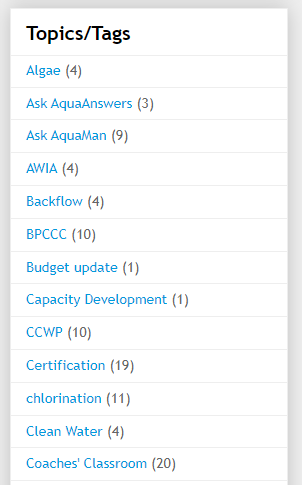
Another helpful function of the blog is the tag section. Starting on the Aqua Talk homepage you scroll a quarter of the way down the page until you see the “Topics/Tags” box on the right hand side of the screen. You can then click on the topics that interest you to see all the articles that have been tagged with those topics. 

The WQCD Engagement Page

The second tool we want you to know about is the WQCD engagement website. This website is a space for water and wastewater systems to play a part in updates that the division makes to regulations, guidance, and policies. We want to hear from you on these proposals. Whether you are a member of the public who is interested in what the state is doing or a regulated entity that is impacted by these measures, we want your feedback. The information on this webpage reflects current efforts you should be aware of and possible engagement opportunities. There are many opportunities for you to engage on the website. 

The first tool you will see is the engagement calendar. This calendar shows all scheduled WQCD engagement events.  You can select how you want to view the calendar by selecting the “Week” or “Month'' tab at the top of the calendar and then select the timeline you want to view by clicking on the horizontal arrows. If you are interested in learning more about a specific event click on the blue text in the calendar and a window will pop up with more information and links to either find more information or to copy the event to your work calendar. Many events have specific contact information at the bottom of the calendar post so, be sure to scroll to the bottom of each event to access that information. 

Another aspect of the engagement website to look into is the engagement email notifications sign-up form. If you scroll past the engagement calendar you will see a red box with a link to “Sign up for email notifications.” If you click on this link it will send you to a separate website where you can sign up for different WQCD email listservs. The subscription form will ask for the following information: 

You will then select which emails you would like to receive by clicking on the blank box next to the topics you are interested in: 

Please note that these emails will be sent out through a third party website. You can opt out of these emails at any time by clicking on the “unsubscribe” link at the bottom of the email. 

There are many other options for you to plug into division activities on the WQCD engagement page, too many to list in this article. We recommend that you spend some time looking into this website as it is a crucial tool for you to stay in-the-know. 

Safe Drinking Water Program’s Local Assistance Unit website

Lastly we want to highlight the LAU website. To start, the LAU website lists many free training opportunities for water systems. Please note that the team rotates between in-person and virtual offerings for our group training events. Please click on the registration documents (see links below) to see upcoming dates and register for the training you would like to attend by selecting your date and filling out the registration form. The LAU team will send you attendance information within 48 hours.  

  • Monitoring and Operating for Regulatory compliance
    • Offered the first Wednesday of every month 
    • Tailored to operators and decision makers 
    • 0.4 free TUs offered 
    • Meets mandatory regulatory training (MRT) requirements for certified drinking water operators
  • Sanitary Survey Preparation 
    • Offered the third Wednesday of every month 
    • Tailored to operators and decision makers who would like to prepare for their next drinking water sanitary survey inspection 
    • 0.3 free TUs offered 
  • Resilience training: Emergency Management & Financial Planning
    • Offered the third Tuesday of the last month of every quarter 
    • This training is primarily offered in-person as the curriculum is heavily activity based
    • Tailored to decision makers but operators may find valuable 
    • 0.4 free TUs offered 

The LAU will continue to develop our group training event offerings to meet the needs of the drinking water community. We also work with our technical assistance providers in the state (RCAC, CRWA, EFCN, AWWA, CoWARN, and Indigo Water) to provide free training across the state and via webinar. We strive to meet the needs of our training customers, if you have suggestions of curriculum we should offer in the coming months and years please email cdphe.wqdwtraining@state.co.us with your suggestions. Please see the LAU website to see the on-demand and on-line training opportunities that we offer for free. 

In addition to group training events our coaches also offer one-on-one visits in which we will meet virtually or in-person at your facility to provide technical, managerial, and financial technical assistance. To request a coaching visit with your drinking water facility please fill out our online assistance request form. As with the WQCD engagement website, there are many more opportunities for learning and plugging into the division on the LAU website. We invite you to take some time to look at the website. 

Thank you for your dedication to protecting public health by providing safe drinking water to your communities. We hope these tools help you in this endeavor and look forward to your engagement! 

➽ Kyra Gregory Drinking Water Training Specialist